

## Outline Failure
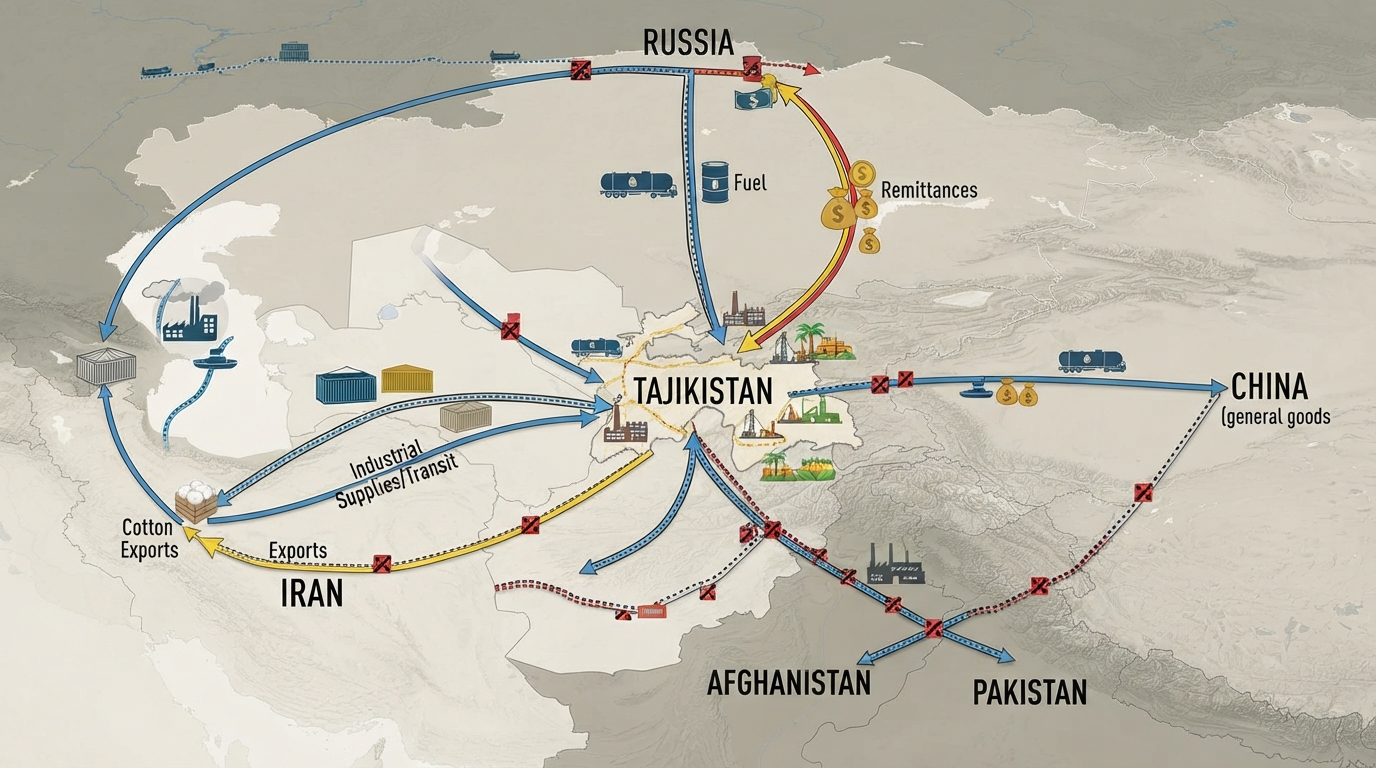
Although armed conflicts are occurring outside Tajikistan, their consequences are increasingly felt within the country. Particularly sensitive are events surrounding Russia and Iran—countries on which migrants depend for their income, fuel supplies, cotton exports, and international shipping.
Russia remains the main labor market for Tajik migrants and the largest supplier of petroleum products. Iran has become a significant buyer of Tajik cotton and one of the main transit routes to seaports. Remittances are currently supporting Tajikistan's economy, but interruptions in Russian fuel supplies, sanctions risks, and disruptions to southern transport routes are already affecting prices and business operations.
## Growth Under Pressure
So far, external crises have not led to a general economic downturn. In January–June 2026, Tajikistan's GDP grew by 8.2%, reaching 81.7 billion somoni. Foreign trade turnover increased by 44.2% to $6.82 billion. Exports totaled $1.58 billion, while imports totaled $5.24 billion. The negative trade balance approached $3.66 billion.
The country continues to import more than three times as much goods as it sells abroad. Therefore, delays in deliveries, increased shipping costs, or problems with international payments quickly spill over to the domestic market.
China remained Tajikistan's largest trading partner in the first half of the year, with a trade turnover of $1.78 billion. Russia ranked second, with $1.32 billion. Trade with Iran reached $254.3 million.
However, the importance of these countries is determined by more than just trade volume. Russia primarily influences household incomes and the fuel market, while Iran influences industrial supplies, cotton exports, and access to southern transport corridors.
## Remittances Maintain Demand
Russia's most significant channel of influence is remittances from migrant workers. According to the World Bank, over the past five years, they averaged approximately 41% of Tajikistan's GDP and came primarily from Russia. In 2025, net remittances grew by 30.5%, reaching 46% of GDP. The Bank attributes this to rising wages in Russia and the strengthening of the ruble.
After the start of the SVO in Ukraine, it was expected that sanctions, a weakening Russian economy, and a depreciating ruble would lead to a reduction in migrant employment. However, a labor shortage in Russia pushed wages up.
Remittances supported consumption, retail trade, construction, imports, bank deposits, and the somoni exchange rate. However, dependence on the Russian market has simultaneously increased. The incomes of many families are directly linked to the state of the Russian economy, the ruble exchange rate, and Moscow's decisions regarding migration.
The World Bank expects that, due to slowing growth in Russia and stricter migration regulations, the share of remittances from Tajik migrants could decline to 30.3% of GDP by 2028.
Even this level will remain very high. A decline in remittances could slow trade, housing construction, the import of cars and household appliances, and the flow of money into the banking system.
## Fuel Strikes First
The most noticeable consequence of external conflicts was the situation in the oil product market. From January to June 2026, Tajikistan imported and produced 927,500 tons of fuel, liquefied gas, and other fuel products. Russia imported 670,800 tons, or 72.3% of the total. Kazakhstan accounted for 20.3%, and its own oil refineries accounted for only about 0.5%.
In 2026, the Russian oil refining industry faced production cuts and export restrictions. Supplies to Tajikistan under the intergovernmental agreement are partially protected, but the ability to purchase additional commercial volumes has been reduced.
In June, Tajikistan imported approximately 65,000 tons less fuel than in April, and 50,000 tons less than in May.
The reduced supplies quickly affected the market. In July, diesel fuel at some Dushanbe gas stations increased in price to 17-18 somoni per liter. Where it remained, sales were sometimes limited to 20 liters per vehicle. By July 30, AI-92 gasoline cost 13 somoni, and most inspected gas stations were out of diesel.
The rise in diesel prices is particularly sensitive for agriculture, construction, freight transportation, and mining. Fuel costs include the cost of plowing, harvesting, and the delivery of food and building materials.
However, the shortage cannot be attributed solely to the war. Heat, road conditions, truck traffic restrictions, and domestic inventory levels also affect supplies. However, external conflicts exacerbate the consequences of dependence on a single supplier.
## Global Prices Rising
Tajikistan is affected not only by the situation at Russian oil refineries but also by rising global energy prices. The World Bank predicts that the conflict in the Middle East could cause temporary disruptions in energy supplies. According to the bank's forecast scenario, in 2026, the average price of Brent crude oil could rise by 36%, natural gas by 67%, and fertilizer by 20%.
Inflation in Tajikistan, according to the bank's forecast, could accelerate from 3.4% in 2025 to 4.8% in 2026.
Even if fuel is primarily sourced from Russia and Kazakhstan, global prices influence procurement costs. Higher fertilizer prices simultaneously increase farmers' costs and subsequently impact food prices.
## Sanctions Trail
Another channel of influence of the war is international restrictions against companies and banks connected to the Russian financial system. In January 2025, the United States imposed sanctions against Gazprom Neft and its associated entities. The restrictions also affected Gazpromneft-Tajikistan, a company operating in the republic.
In the fall of 2025, the European Union included Dushanbe City Bank, Spitamen Bank, and Commerzbank of Tajikistan in the 19th package of sanctions against Russia. The World Bank noted that the restrictions complicated the international operations of Tajik banks. In April 2026, the three banks were removed from the sanctions list. Nevertheless, this episode demonstrated that Tajikistan's financial system is no longer immune to the international sanctions standoff.
Even temporary restrictions can trigger additional payment checks, settlement delays, and correspondent banks refusing to cooperate. For investors, this means that simply investing is not enough: they must be able to pay for equipment, pay suppliers, and withdraw profits.
## The Iranian route is narrowing
Prior to the current escalation, Iran was rapidly increasing its importance to the Tajik economy. In 2025, trade between the countries grew by 28% to $483.9 million. Tajikistan's exports reached $112.8 million, while imports reached $371.2 million.
In the first half of 2026, bilateral trade reached $254.3 million. The conflict has not yet collapsed trade, but it has made supplies more expensive and irregular.
In March, trade between the countries decreased by 9.8% compared to February, to $40.6 million. Tajik exports fell almost threefold: from $10.6 million to $3.9 million. Imports from Iran, by contrast, increased from $34 million to $36.7 million.
Transit was much more severely affected. According to the Customs Service of the Republic of Tajikistan, the transportation of goods from third countries through Iran has virtually ceased. Previously, cargo from many countries entered Tajikistan through the port of Bandar Abbas.
Some goods are now sent via the Caucasus, Azerbaijan, Turkey, Turkmenistan, and the Caspian Sea. Delivery times, instead of the previous 10–15 days, can sometimes reach up to a month.
A longer route means additional costs for transportation, transshipment, insurance, and storage. Companies require more working capital: goods have already been paid for, but remain in transit for several weeks.
## Cotton under threat
Iran is important not only as a transit country but also as a sales market. From January to June 2026, Tajikistan exported $73.5 million worth of cotton fiber. Iran accounted for 61.8% of deliveries, Turkey for 25.5%, China for 8%, and Russia for 3%. This concentration creates a serious risk. Problems with the Iranian textile industry, banking, or transportation could directly reduce the income of Tajik producers.
Tajikistan, however, primarily exports raw materials. The production of yarn, fabric, and finished garments would allow Tajikistan to sell its products to a wider range of customers and reduce its dependence on a single foreign market.
Before the escalation, Tajikistan and Iran discussed the creation of textile clusters based on Tajik cotton and Iranian technology. A prolonged conflict could delay the implementation of such projects.
## Industry Slows Down
Route issues are already impacting production. Industry Minister Sherali Kabir reported that instability around Iran, Afghanistan, and Pakistan has complicated the import of raw materials and the export of finished products.
Delivery through the Pakistani ports of Karachi and Gwadar typically took 7-10 days. Routes through Russia or Georgian ports require 25-30 days, while shipment through Iranian ports took at least two weeks.
The leather industry was particularly hard hit, with production falling by 65%. Pakistan was the main buyer of raw materials, but due to the route closure, entrepreneurs were unable to export their products on time.
The disruptions also affected carpet and furniture manufacturers. Companies are facing a double blow: unable to obtain raw materials on time, and then experiencing difficulties exporting finished products. The result is downtime, rising costs, and a shortage of working capital. The decline in production at large enterprises simultaneously reduces tax and customs revenues.
## Investments Without a Collapse
It is impossible to determine how much investment Tajikistan has lost directly due to wars and sanctions. Official statistics do not separately account for projects cancelled or postponed due to route closures and payment problems.
However, there has not yet been a general collapse in foreign capital. In 2025, Tajikistan attracted approximately $6.93 billion in foreign investment—35.1% more than the previous year.
In the first quarter of 2026, the inflow reached $1.898 billion, an increase of 23.2%. However, direct investment amounted to only $187.7 million—less than 10% of the total. During this period, the authorities also signed six investment agreements worth $1.455 billion, providing for the creation of over 2,000 jobs.
However, the total inflow of foreign capital cannot be equated with direct investment. It can include loans, trade finance, and other funds not necessarily aimed at creating new businesses.
The World Bank estimates the net inflow of foreign direct investment in 2025 at just 0.2% of GDP. A recovery to 1.1% is projected for 2026.
An investor may not officially abandon a project, but they may postpone it, reduce investment, or demand additional guarantees. Therefore, the impact of conflicts often appears in statistics with a delay.
## How to Mitigate Risks
In the short term, Tajikistan needs to increase its reserves of fuel and other critical goods and negotiate contracts with alternative suppliers in advance.
Russia will likely retain its dominant role in the fuel market, but additional volumes can be found in Kazakhstan, Turkmenistan, China, Iran, and Iraq. Such supplies may prove more expensive due to more complex logistics.
Several transport routes need to be developed simultaneously. The Iranian route is important for access to the sea, but it should not remain the only alternative to the northern corridor.
In the banking sector, it is important to expand correspondent relationships and consider sanctions risks. Companies should more thoroughly verify counterparties, the origin of goods, and the final recipients of payments.
The primary long-term solution remains the development of domestic production. Processing cotton into yarn, fabric, and clothing will expand the customer base. Domestic production of food, building materials, and industrial raw materials will reduce dependence on imports.
## The Price of Dependence
For now, remittances, domestic demand, construction, and growing trade have allowed Tajikistan's economy to maintain high growth rates. The influx of foreign capital also demonstrates that the country has not become financially isolated. However, this resilience is largely dependent on external markets, suppliers, banking systems, and transport routes.
The main threat is not a single conflict, but the simultaneous disruption of several channels. A decline in remittances could coincide with fuel shortages and import delays. In this case, household incomes would decline precisely when goods and transportation costs become more expensive.
Economic resilience is determined not only by import and export volumes, but also by how quickly a country can replace a supplier, bank, market, or transport route. Without this ability, proxy wars could result in higher prices, lower incomes, and slower production for Tajikistan.
Payrav Chorshanbiev
Source