

Everything comes with a price
Billions against the elements: how much it costs to protect Central Asia from avalanches, mudslides, and landslides
**Everything Has a Price**
Central Asia has long viewed its mountains as an economic resource. They provide water, electricity, pastures, minerals, tourist routes, and space for transport corridors. But that same mountainous terrain presents a bill every year that the region's states must pay in the form of destroyed roads, damaged power lines, closed passes, mudslides, avalanches, and landslides. Kazakhstan, Kyrgyzstan, Tajikistan, and Uzbekistan differ both in the area of their mountainous territories and in the structure of their economies, but they share a common problem: the more actively the mountains are developed, the more expensive it becomes to protect them.
A modern snow shed, a mudflow-retarding dam, or a slope monitoring system is no longer auxiliary infrastructure, but an economic element on par with a bridge, a tunnel, or a substation. Protecting a single hazard-prone section can cost anywhere from several hundred thousand dollars to tens of millions. Comprehensive protection for a large mountain valley, a city, or a transport corridor can require $50–200 million, and sometimes significantly more. If Central Asia's needs are evaluated not by individual facilities, but as a system for decades to come, the figures run into the billions of dollars.
The region's defining feature is the scale of potential damage. The Tien Shan and Pamir ranges occupy a vast portion of Kyrgyzstan and Tajikistan, mountainous areas shape life in the east and southeast of Kazakhstan, and the densely populated regions of Uzbekistan directly border the mountain systems of the Western Tien Shan and Gissar-Alay. Here, a dangerous natural phenomenon rarely remains merely natural. An avalanche that descends on a deserted slope costs the economy almost nothing. That same avalanche on a highway translates into road service expenses, halted freight traffic, disruptions in fuel and food supplies, lost tourist flows, and the risk of casualties. A mudslide in a valley devoid of infrastructure is a geological process. A mudslide passing through a suburb, an industrial site, or an area upstream of a hydroelectric power plant becomes a financial risk. Therefore, the cost of protection is determined not so much by the size of the hazardous area as by the value of the assets located on it. One kilometer of road along a strategic route can be economically more vital than dozens of square kilometers of uninhabited mountainous terrain.
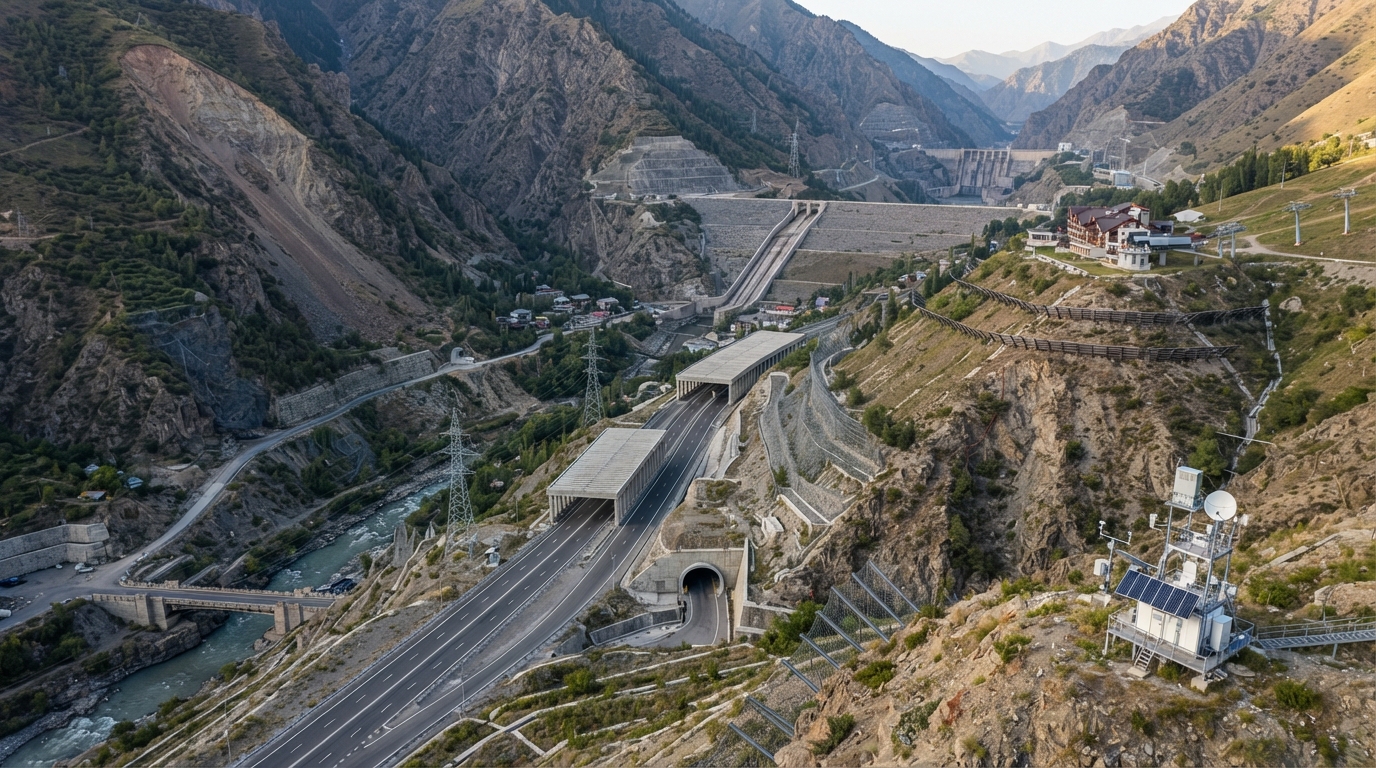
The most obvious example is transport. A mountain road demands far more protective infrastructure than a lowland one. The simplest measures—drainage, slope reinforcement, retaining walls, rockfall netting—can cost from hundreds of thousands to several million dollars per section. More complex solutions drive up the cost sharply. A snow shed is essentially a reinforced concrete tunnel, open on one side or fully enclosing the road from a snow slide. Depending on the terrain, length, geology, and traffic volume, one kilometer of such a structure can cost tens of millions of dollars. Protecting 5–10 of the most dangerous kilometers of a highway can sometimes rival the cost of building an entirely new road on a plain. Yet inaction is also expensive: a pass closed for several days means idling freight transport, additional fuel costs, disrupted trade schedules, and reduced reliability for the entire transport corridor. For landlocked countries, route reliability is not a luxury, but a component of the prime cost of foreign trade.
Mudslides require a different scale of engineering solutions. A torrent of water, rocks, and mud can move down a mountain channel with immense destructive power, making it impossible to stop with an ordinary concrete wall. Debris-retarding dams, cascades of barriers, diversion channels, channel stabilization, and specialized retention basins are utilized. A large debris-flow dam can cost tens of millions of dollars, while a protection system for a major city can cost hundreds of millions in modern infrastructure project terms. Almaty is the most striking regional example of why such expenditures must be approached strategically. The city is situated right at the foot of the mountains, with mudslide basins located directly above an area with a population of a million people, high-value real estate, transport, and utility networks. In such a scenario, even a structure costing $100 million cannot be judged merely as a concrete dam. It insures assets worth billions. In Bishkek, Dushanbe, eastern regions of Uzbekistan, and numerous smaller towns, the principle remains the same, though the scale of the facilities varies.
Landslides present an even more complex economic dynamic. While the trajectory of an avalanche or a mudslide channel can often be predicted with reasonable accuracy, a slope may move slowly, accelerate after rainfall, an earthquake, or human activity, and then stabilize again. Consequently, an expensive concrete structure is not always the immediate solution. Geological surveys, drilling, displacement sensors, satellite interferometry, drainage, slope anchoring, and continuous monitoring are required. An automated monitoring station for a single section can cost tens of thousands of dollars, whereas an integrated system featuring radars, geodetic sensors, weather stations, communications, and an analytics center costs hundreds of thousands or millions. For the most dangerous slopes, the cost of engineering stabilization can reach tens of millions of dollars. Sometimes it is cheaper to relocate a road or several dozen homes than to anchor an unstable mass for decades. However, relocation also entails property buyouts, utility construction, and the creation of new social infrastructure.
A separate expenditure item is hydropower. For Kyrgyzstan and Tajikistan, mountain rivers form the backbone of the energy system, and the construction of new hydroelectric stations makes the issue of geological safety even more costly. A mudslide or a large landslide upstream of a reservoir can generate a wave, block inflow, increase siltation, or damage access roads and power transmission lines. Therefore, around major hydropower facilities, it is necessary to monitor not just the dam itself, but also dozens of kilometers of surrounding slopes. Against the backdrop of a modern major hydroelectric station's cost, which can run into billions of dollars, spending a few million on geological monitoring appears to be a modest sum. Yet skimping on these very systems can turn a localized event into a national-scale energy crisis. A single day of downtime at a major facility means lost power generation, the need to draw on backup capacity, and additional stress on the grid.
Tourism highlights this economic reality even further. Ski resorts, cable cars, hotels, and tourist villages concentrate people and capital precisely where avalanche probabilities are highest. Thus, a modern resort begins not with a ski lift, but with a risk map. Snow-gauging stations, weather radars, automated sensors, controlled avalanche release systems, protective netting, and barriers can add millions of dollars to the cost of developing a territory. A single set of stationary anti-avalanche infrastructure on a limited slope can cost hundreds of thousands of dollars. Protecting a large resort cluster involves several million or tens of millions. Yet closing a resort after a major avalanche costs more than just the hotel owner. Losses are incurred by restaurants, transport services, rental shops, retail, and local residents. For Issyk-Kul, the Almaty mountain cluster, Chimgan, Amirsoy, Varzob, and future tourist areas of the Pamir mountains, natural safety is gradually becoming an integral element of investment attractiveness.
The most undervalued cost item is early warning. At first glance, a rain gauge, a camera, an automated snow sensor, or a siren costs incomparably less than a dam. However, an effective system consists of thousands of elements. Stations must be installed in hard-to-reach areas, provided with power and communications, transmit data around the clock, build digital slope models, purchase satellite imagery, maintain dispatch centers, and train specialists. If 1,000 of the region's most hazardous sections were equipped with systems averaging $100,000 each, the initial capital expenditure alone would be around $100 million. Factoring in communications, server infrastructure, drones, radars, satellite monitoring, maintenance, and equipment upgrades, the bill quickly approaches several hundred million. Furthermore, the lifespan of electronics is significantly shorter than that of a concrete dam. In 7–10 years, a substantial portion of the equipment will need to be modernized.
Climate change complicates these calculations. For the mountains of Central Asia, the issue lies not only in general warming, but also in altering conditions of glaciers, snowpack, permafrost, and precipitation patterns. A slope that was considered stable for decades may gradually change its mechanical properties. Intense precipitation can produce a volume of water in a matter of hours that older drainage systems were never designed to handle. Glacier retreat creates new lakes, while the degradation of high-altitude permafrost weakens rock masses. This implies that protective structures designed according to 20th-century statistics do not necessarily match the risks of the mid-21st century. Central Asia's engineering infrastructure is entering a period where it must be designed not around past averages, but for a broader spectrum of future scenarios.
Attempting to estimate the regional scale makes it clear why a few large projects will not solve the problem. Supposing the upgrade of protection along 100 critical road sections averages $10 million each, that alone represents $1 billion. Another 30 major mudslide basins, at an average cost of $20 million per measures package, would require $600 million. Monitoring 1,000 landslide- and avalanche-prone areas at $100,000 each adds another $100 million. Adding regional data processing centers, satellite control, meteorological networks, emergency response equipment, and the modernization of bridges, riverbeds, and hydraulic structures easily adds another $1–2 billion. Thus, even a rough, conservative program for the priority protection of the most valuable infrastructure in Kazakhstan, Kyrgyzstan, Tajikistan, and Uzbekistan lands in the $3–5 billion range. If long-term road reconstruction, major mudslide protection works, and the safeguarding of new hydroelectric stations, tourist zones, and settlements are included, a $10 billion horizon no longer seems excessive. This is not about a single budget cycle, but a 10-to-20-year program.
Yet the main economic paradox is that the effectiveness of such infrastructure is almost invisible. A new highway generates traffic, a power plant produces kilowatt-hours, and a hotel accommodates tourists. A mudslide prevention dam produces nothing in a good year. A snow shed creates no freight traffic. A sensor on a slope can transmit virtually identical readings for ten years. Their economic return consists of an event that did not happen: the road was not destroyed, the settlement was not evacuated at the last moment, the hydroelectric station did not halt operations, tourists were not stranded, and the bridge did not have to be rebuilt from scratch. This is precisely why expenditures on natural hazard protection are easy to defer to the next budget cycle. But as infrastructure values grow, this logic becomes increasingly costly.
In the coming decades, Central Asia will construct new roads through the mountains, hydroelectric power plants, transmission lines, resorts, logistics corridors, and residential areas. Every billion dollars invested in the mountain economy automatically increases the value of assets at risk from natural hazards. Therefore, the true cost of protecting the region from avalanches, mudslides, and landslides is no longer measured by the price of a few dams or dozens of sensors. It is measured by the cost of preserving the economic activity of entire valleys. For Central Asia, the bill may indeed run into many billions of dollars, but the potential price of inaction could prove significantly higher. In the mountains, a single destroyed road can cut off an entire district, a single landslide can alter a riverbed, and a single mudslide can obliterate infrastructure built over decades. As mountains increasingly become spaces for major power generation, tourism, and transit, protection against natural processes ceases to be an emergency expense. It becomes the price of operating the economy itself.