

Oh, the Roads, Ah, the Roads
The Eurasian Development Bank has calculated 402 transport projects with a total value of $345 billion. Almost $72 billion of this amount is accounted for by Central Asia, with Kazakhstan capturing about half of the regional portfolio. The figures look impressive, but railways and highways alone are not enough. Their return now depends on how much throughput capacity is provided by borders, ports, and neighboring sections of the route. Let's look into why cargo gets stuck at borders and where investments are being directed.
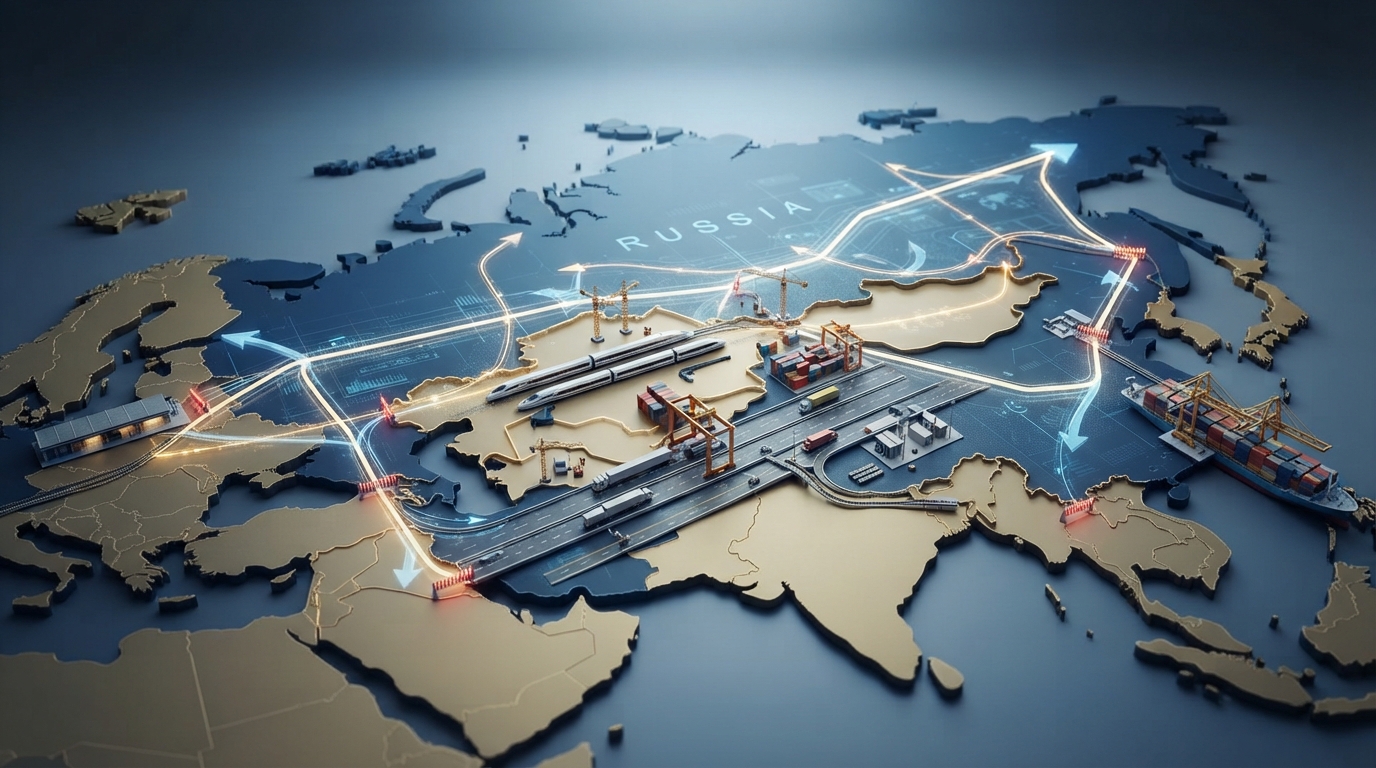
Eurasia is entering a massive transport restructuring. While at the beginning of the century the region's countries mostly upgraded individual roads, stations, and border crossings, now it is about creating an interconnected network of corridors between China, Europe, Russia, Central Asia, and the Middle East.
In other words, the continent is gradually moving away from a collection of scattered construction sites toward the formation of a single transport framework. At least, this is exactly the picture shown by the updated Transport Projects Observatory of the Eurasian Development Bank (EDB).
At a recent webinar, it was reported that as of July 1, 2026, there were 402 projects in the database with a total value of $345 billion. Over the year, the list was replenished with another 70 initiatives worth $74 billion. In 2025, facilities worth more than $10 billion were put into operation.
Another $100 billion is accounted for by projects that are still in the planning stage. This simultaneously shows the scale of future construction and serves as a reminder that the declared investment portfolio cannot automatically be considered as already secured with financing.
### A road is good until it hits a barrier
The EDB Observatory covers 13 countries — from Belarus and Russia to Iran, Afghanistan, and Mongolia. It includes railways and highways, airports, seaports, logistics centers, and border infrastructure. For each project, the cost, timeline, implementation stage, sources of funding, business participation, and affiliation with international corridors are taken into account.
But the main point of this work is not in counting kilometers and billions. A transport route yields an economic effect only when it functions along its entire length.
Alexander Zaboev, Head of the EDB Centre for Integration Studies, compared a transport corridor to an electrical circuit, where all sections must have comparable throughput capacity. Even a modern road within one country will not solve the problem if the cargo then stops at a congested border, a single-track railway line, or a port with insufficient capacity.
The comparison is accurate. You can build an ideal highway, but if at the end the driver stands in line at the border for twenty-four hours, the economic effect will gradually begin to disappear along with the fuel. You can lay second railway tracks, but the cargo will still be delayed at a congested station or in a port that does not have time to receive it.
Therefore, as Alexander Zaboev notes, it is not enough for countries to improve only their own sections. They need to coordinate projects with neighbors. Otherwise, a multi-billion dollar construction project does not eliminate the bottleneck, but merely moves it a few hundred kilometers further.
### Almost half of investments go to rails
Now, perhaps, to specific figures. According to EDB experts, rail transport remains the most capital-intensive area. It accounts for 42.8% of the total portfolio, or almost $150 billion.
This is not surprising. Railways carry the bulk of container cargo over long distances. But to increase the flow, it is not enough to simply add new trains. Second tracks, electrification, modern stations, powerful border crossings, and digital traffic management are needed.
Russia remains the largest investor: it accounts for $225.2 billion, or 65.3% of all investments. Eight out of the ten most expensive projects of the Eurasian transport framework are being implemented on Russian territory. Among them is the modernization of the Eastern Polygon of railways.
The Northern Eurasian Corridor became the most capital-intensive direction with an investment volume of $84.8 billion. This is more than a quarter of all costs for the formation of the transport framework.
$52.8 billion has been invested or is planned to be invested in the projects of the North-South corridor, excluding the Moscow – St. Petersburg high-speed railway. Interest in this route is growing for an obvious reason: countries need alternative trade routes, especially when familiar directions become longer, more expensive, or politically more complex.
### How Central Asia is accelerating construction
Central Asia accounts for more than 21% of all declared investments — over $71.75 billion. 114 projects are being implemented or planned in the five countries of the region. In 2025 alone, facilities worth about $6 billion were commissioned here.
Among them is the modernized Dostyk – Moyynty railway line in Kazakhstan, where after the construction of second tracks, the throughput capacity increased fivefold. In Turkmenistan, the Ashgabat – Mary – Turkmenabat highway and a section of the North-South corridor from Turkmenbashi to the Kazakh border were commissioned. In Kyrgyzstan, a tunnel was opened at the Kök-Art pass, and in Tajikistan, sections of the Obigarm – Nurobod road. Uzbekistan electrified the Bukhara – Urgench – Khiva line and launched high-speed passenger traffic.
For Central Asia, transport is not just a matter of convenience. None of the countries in the region has direct access to deep-sea maritime routes. Therefore, any extra day in transit, a congested crossing, or a mismatched tariff quickly turns into additional costs for business.
Almost 56% of regional investments are directed into highways — about $40.6 billion. Another 29.8% are accounted for by railway projects. More than $5 billion is planned to be invested in airports, terminals, and related infrastructure.
TRACECA, including the Trans-Caspian International Transport Route, remains the largest direction. Projects worth $42.8 billion are associated with it. At the same time, the ten most expensive facilities accumulate 42% of the entire Central Asian portfolio. Such concentration allows for the rapid creation of new capacities, but makes the system vulnerable to delays. If a major project falls behind schedule, the consequences are felt not only by the country of construction, but by the entire corridor.
### Kazakhstan captured almost half of the region's portfolio
Kazakhstan occupies a central place in this transport restructuring. About 55 Kazakh projects worth $32.6 billion are included in the Observatory — more than 45% of investments in the whole of Central Asia.
Highways account for approximately $22.7 billion, and railway projects for over $6 billion. In parallel, airports, the ports of Aktau and Kuryk, dry ports, logistics centers, and checkpoints are being developed.
According to Aidos Omarov, Senior Analyst at the EDB Centre for Integration Studies, about 85% of land transit between China and Europe passes through Kazakhstan.
Geography allows the country to simultaneously connect China, Russia, the states of Central Asia, and European markets. Therefore, Kazakh construction projects are important far beyond the national economy. But the map provides an opportunity, not a guarantee of income. A cargo owner chooses not the most beautiful route on the diagram, but the one where the goods will reach the buyer faster and more predictably.
A case in point is the Dostyk – Moyynty line. It serves several directions at once, including the Central Eurasian Corridor and routes to the Caspian.
The next important section should be the Moyynty – Kyzylzhar line, which will allow straightening the traffic and reducing delivery times. The Bakhty – Ayagoz railway is also under construction. It should create a third railway crossing on the border of Kazakhstan and China.
Currently, the main flows go through Dostyk – Alashankou and Altynkol – Khorgos. As traffic grows, these crossings themselves risk becoming system limiters. The new route will help distribute the load — provided that it is immediately equipped with modern technology and digital clearance systems. Otherwise, the country will get not a third effective crossing, but a third place to stand in line.
The EDB believes that in the medium term, routes through Kazakhstan will retain their advantage in terms of cost and delivery times. However, there are no eternal transport advantages. They have to be constantly confirmed by the speed of border crossing, schedule reliability, and service quality.
### The state builds, business chooses warehouses
Despite the interest of investors, national budgets remain the main source of funding for transport infrastructure. They account for more than 62% of the cost of projects of the Eurasian transport framework.
In Central Asia, the state must provide about 56% of investments. The remaining 44% is expected to be attracted from borrowed, private, and foreign sources.
In Kazakhstan, 21 projects are funded with budget participation, 34 provide for debt financing, and 14 involve international development banks. In total, international banks participate in 48 Eurasian projects. Another 29 initiatives expect to attract their funds. In Central Asia, 43 out of 114 projects rely on financing from such banks.
Private capital participates in 123 projects of the transport framework. Almost half of its investments are in warehouses and logistics centers. Another 27 projects can be implemented in the format of public-private partnership.
The logic of business is clear. A trunk railway requires huge investments and pays off over decades. A warehouse, terminal, or dry port is capable of starting to generate income much faster. Therefore, the state gets the rails, bridges, and a long planning horizon, while the private sector gets facilities with a clearer payback.
### China brings more than just loans
China participates in more than 20 transport projects in Central Asia. The total value of initiatives with Chinese participation exceeds $12 billion. About $7 billion was attracted directly from Chinese sources. The Chinese model is not limited to loans. It includes grants, technical assistance, contractor participation, public-private partnerships, and direct investments.
In Kazakhstan, Chinese capital is involved in the development of the port of Kuryk and other infrastructure facilities. One of the most famous examples is the construction of light rail transit in Astana, a project with such a long history that it could itself claim the status of an individual transport corridor.
The largest regional project with China's participation remains the China – Kyrgyzstan – Uzbekistan railway worth $4.7 billion. Its length will be 523 kilometers. Given the difficult terrain, 27 tunnels with a total length of 103 kilometers and 48 bridges with a length of about 16 kilometers are to be built. Half of the cost is to be covered by a Chinese loan. The rest will be funded by a joint venture in which China owns 51%.
The new road will change the transport configuration of the region, but in the near future it is unlikely to displace Kazakhstan from its position as the main land route between China and Europe. Rather, it will create an additional direction and increase competition. And competition in logistics usually makes not only trains move faster, but officials as well.
### Why billions do not yet mean fast transit
The scale of the transport restructuring is impressive. More than 62% of projects by value are already in the implementation stage. Another 8.8% are undergoing documentation preparation, and 29% remain at the planning level. This means that almost a third of the declared transport future currently exists mainly in calculations, diagrams, and presentations.
But even the implementation of all projects does not guarantee fast movement of goods. The next stage will require not only money and construction equipment. Countries will have to synchronize timelines, technical standards, tariffs, border procedures, and digital systems.
For Kazakhstan, the stakes are particularly high. The country already possesses a favorable position and a significant part of the necessary infrastructure. However, geography begins to bring a steady income only when it can be traveled through without unpredictable stops.
Eurasia is building roads worth hundreds of billions of dollars. Now it faces the most difficult part — teaching these roads to work as a single route, rather than as a collection of national achievements.