

From China to Europe in 3 days: Kazakhstan launches new $35 billion route
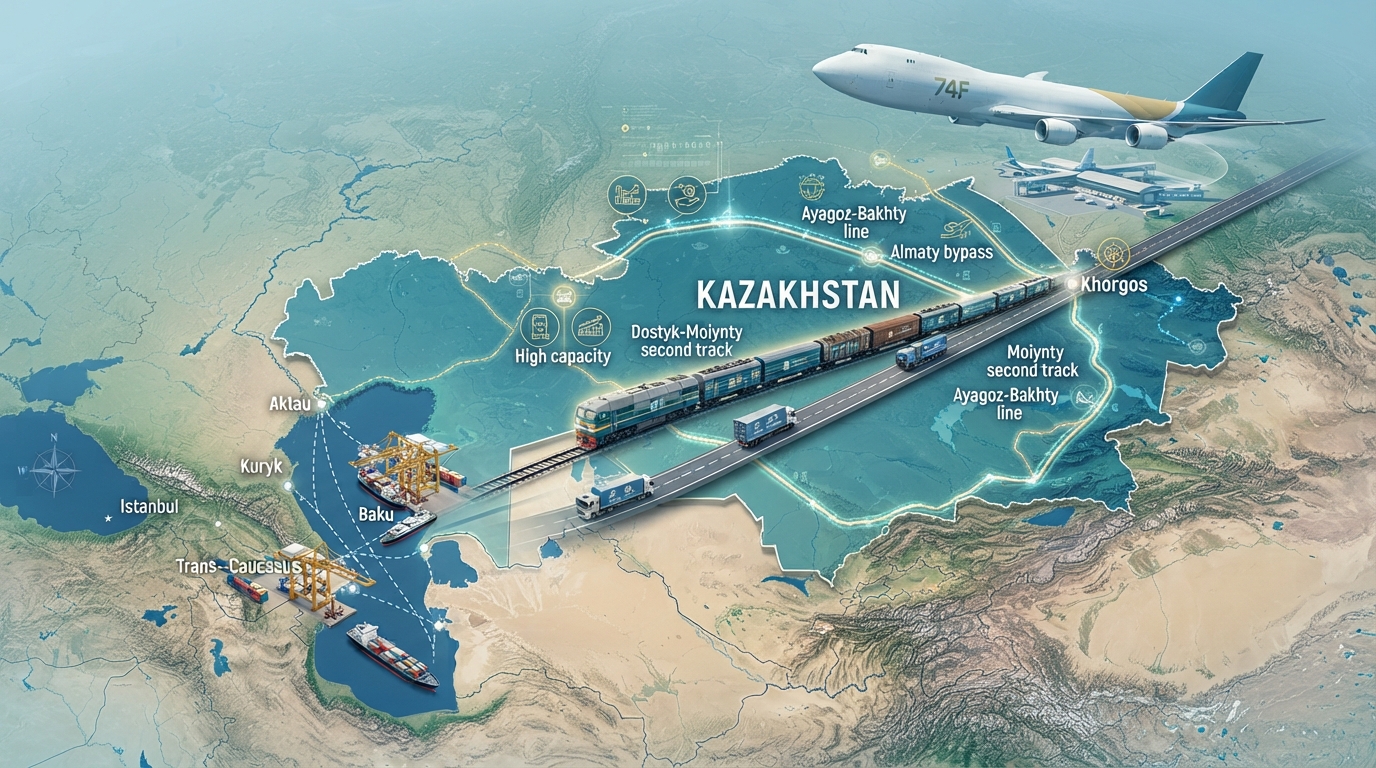
Kazakhstan is launching a new $35 billion route that will reduce the time it takes to transport goods from China to Europe by up to 3 days, Zakon.kz reported.
The country is investing heavily in transport infrastructure to strengthen the Middle Corridor between China and Europe. New roads and railways are being built, and ports and airports are being modernized.
Kazakh President Kassym-Jomart Tokayev said that the Beinyu-Saxaul highway, the construction of which has begun, will serve as a “golden bridge” connecting China and Europe. Upon completion of this project, the distance for transporting goods will be reduced by 1,000 kilometers, and the delivery time will be reduced to 3 days.
Over the past seven years, Kazakhstan has invested about $35 billion in transport infrastructure. As a result, the volume of cargo transported along the Middle Corridor has increased 5-fold, reaching more than 4.5 million tons in 2025.
**Railways and digitalization**
The second branch of the $1 billion Friendship-Muyinty railway was recently completed. This increased the capacity of trains from 12 to 60 pairs per day. A 75-kilometer bypass railway around Almaty and a 300-kilometer Ayagoz-Bakty route are also being built. The Khorgos land port has also been expanded.
Customs procedures and digital systems have also been streamlined. As a result, containers from China are arriving at Georgian ports in just 11-13 days.
**Roads and aviation**
A 2,787-kilometer section of the Western Europe-Western China corridor has been modernized in the country. More than $1.5 billion has been allocated for the expansion of roads under the TRACE program. This will reduce transit time from 11 to 5 days.
The aviation sector is also developing rapidly. In 2025, Kazakhstan's airports served about 32 million passengers and 173,000 tons of cargo. Almaty and Astana airports are being expanded. The world's largest cargo airlines, such as Cargolux and Pacific Cargo, have launched flights to Astana. In 2026, the number of international routes will reach 135.
**Caspian ports and strategy until 2030**
The ports of Aktau and Kuryk have been modernized. A new container hub has been built in Aktau. The total capacity of the ports has exceeded 21.6 million tons per year. This infrastructure is being integrated with the ports of Azerbaijan and Georgia and the Baku-Tbilisi-Kars railway.
According to the Organization for Economic Cooperation and Development (OECD), Kazakhstan accounts for 83 percent of land freight traffic between China and Europe. The country aims to become a major transport and logistics hub of Eurasia under its 2030 strategy.