

El Niño is strengthening: where is drought and where is heavy rain expected?
According to the assessment of the World Meteorological Organization (WMO), El Niño has already formed and is expected to strengthen further in the coming months. The phenomenon could reach its peak intensity near the end of the year, and its impact on the climate may continue into 2027. This increases the likelihood of drought in some regions and heavy precipitation in others.
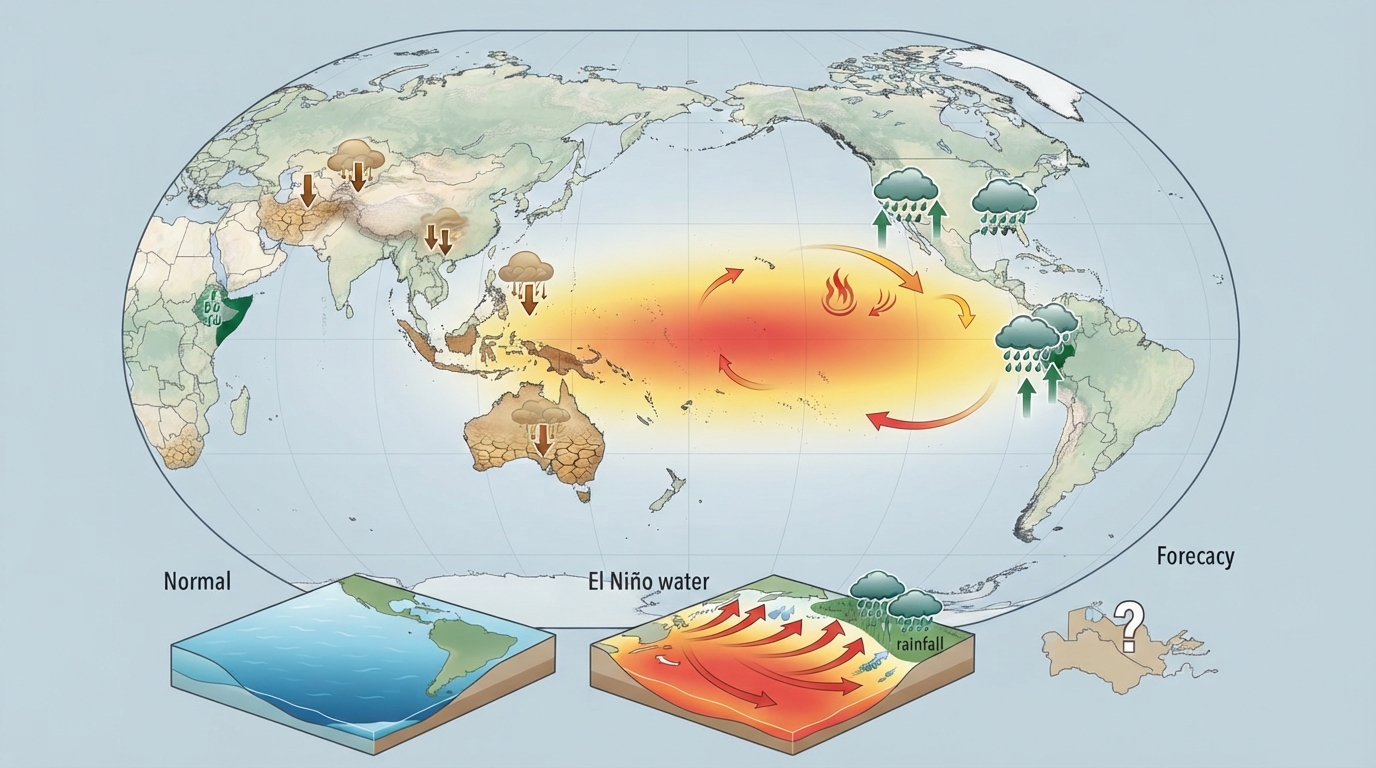
El Niño is strengthening: where is drought and where is heavy rain expected?
According to the WMO report dated September 3, 2026, while the probability of El Niño's development was mentioned at the beginning of summer, by September it was noted that this phenomenon had reliably formed.
Models from forecasting centers within the organization's system estimate the probability of El Niño persisting until February 2027 at nearly 100 percent. Such high confidence is explained by the consistency of results from various models.
At the same time, this indicator does not mean that a flood, drought, or temperature record will definitely be observed in a specific city. It only signifies the probability of the El Niño phase continuing.
What is El Niño?
El Niño is the warm phase of a climatic oscillation related to the interaction between the tropical part of the Pacific Ocean and the atmosphere.
During this period, the water surface in the central and eastern equatorial parts of the ocean warms up more than usual. As a result, the location of winds and active precipitation zones changes.
Through atmospheric air circulation, these changes can also affect regions far away from the Pacific Ocean. The cold phase of this oscillation is called La Niña, and neutral conditions are also observed between them.
In which regions will the probability of precipitation increase, and where will drought?
WMO materials emphasize that the regional impact of El Niño will not be uniform.
The probability of wetter-than-normal conditions may increase in some parts of South America, East Africa, and the southern United States.
Meanwhile, drought-prone conditions may arise in Australia, Indonesia, parts of southern Africa, and some regions of Asia.
The exact situation depends on the season, the strength of El Niño, and other processes in the atmosphere and ocean. For this reason, the map of typical impacts cannot be taken as a precise schedule showing when and where natural disasters will occur.
A separate forecast is needed for Uzbekistan
The presented global forecast does not provide a specific conclusion for Uzbekistan. It is impossible to conclude from it that drought, heavy rain, or record heat will definitely be observed in the country.