

Does the marketplace show the most suitable product or the one it needs?
When a buyer searches for a product they need on a marketplace, is the first item that appears really the best offer? It could be, but not always. At this very point, the interests of the platform clash with the interests of the consumer. In an article provided to Kun.uz, lawyer Humoyunmirzo Eshboyev examines this topic from the perspective of consumer rights.
Does the marketplace show the most suitable product or the one it wants to?
You take your smartphone, open the marketplace app you usually use, and search for "dress," "shoes," or "smartphone." In a second, dozens of products appear on the screen. Some of them have attractive labels like "Top Recommendation," "Best Seller," or "Fast Delivery." Most of us start making our choice by looking at these products in the very first row.
This means that where and how a product appears on the screen is not just a simple technical matter — it can directly influence the buyer's final decision.
But here, a simple yet important question arises: why are these products being recommended to us? Are they truly the cheapest, highest quality, or the ones that have received unbiased customer ratings across the entire market?
The order in which the platform displays products has a powerful impact on consumer choice. Even if a user utilizes multiple platforms, which product is shown to them first is highly important.
The relevance of this issue is further increasing with the rapid expansion of digital commerce. In 2024, the volume of B2C e-commerce reached 4.12 trillion dollars, and the number of online buyers reached 2.5 billion people. At a time when e-commerce and internet usage are also expanding in Uzbekistan, the "order" on the screen is not just a simple technical tool: the position in which a product is displayed can affect the buyer's attention, the seller's sales, and the competitive environment.
How does a digital platform differ from a regular store?
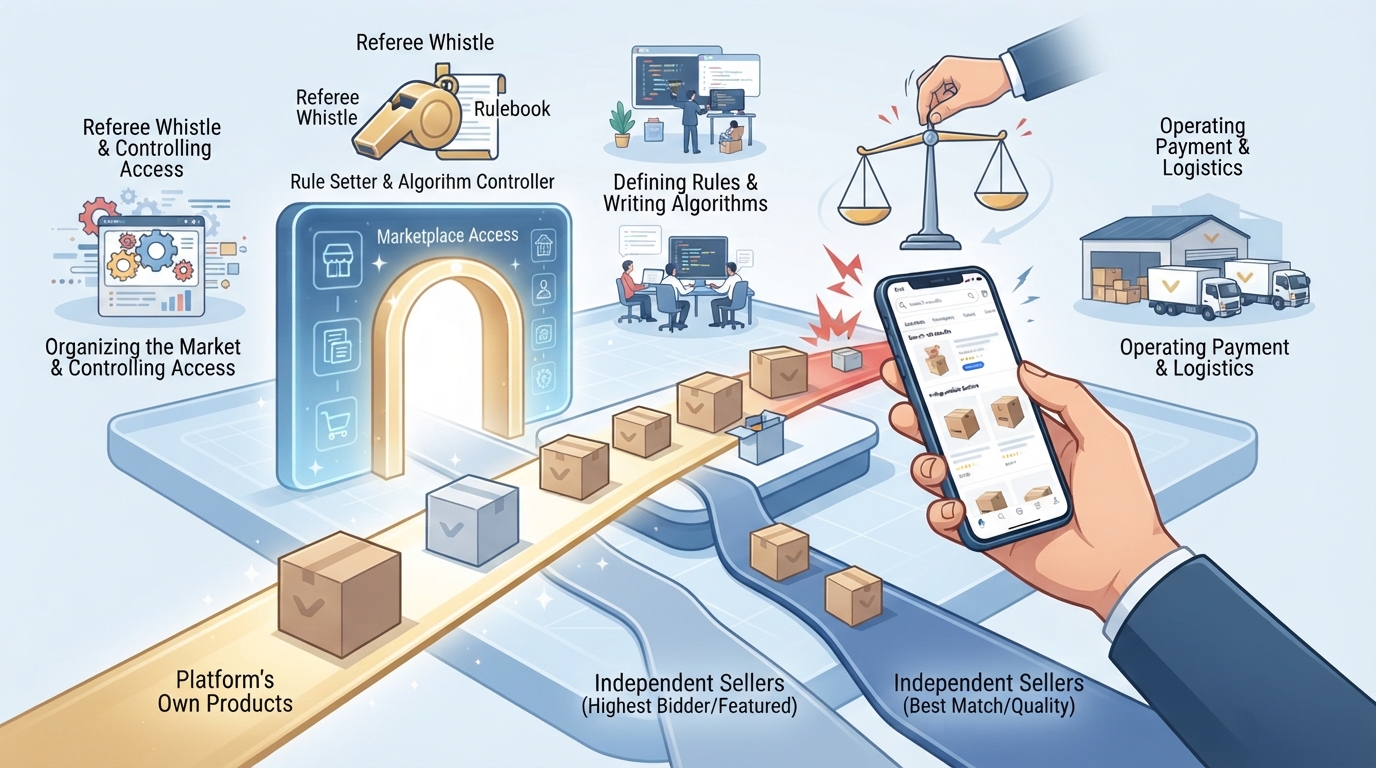
A marketplace is not just a trading space. It performs four roles simultaneously: it organizes the market and controls the entry gate through the app; it sets internal rules and writes the algorithms that decide which product stands at the top of the search window; it introduces its own payment and courier networks; and it enters the field with its own products (private labels) to compete with independent entrepreneurs for the very same buyer.
Metaphorically speaking, a digital platform simultaneously becomes the owner of the field, the referee who sets the rules, and an interested player kicking the ball on that very field.