

"Depends on passenger flow." Officials on bus intervals and night routes in Tashkent
In Tashkent, entrepreneurs' proposals regarding the launch of night buses are being studied. By 2027, "Toshshahartransxizmat" plans to bring 200 electric buses. In addition, Russian and Chinese companies are also expressing interest in bringing buses to the capital.
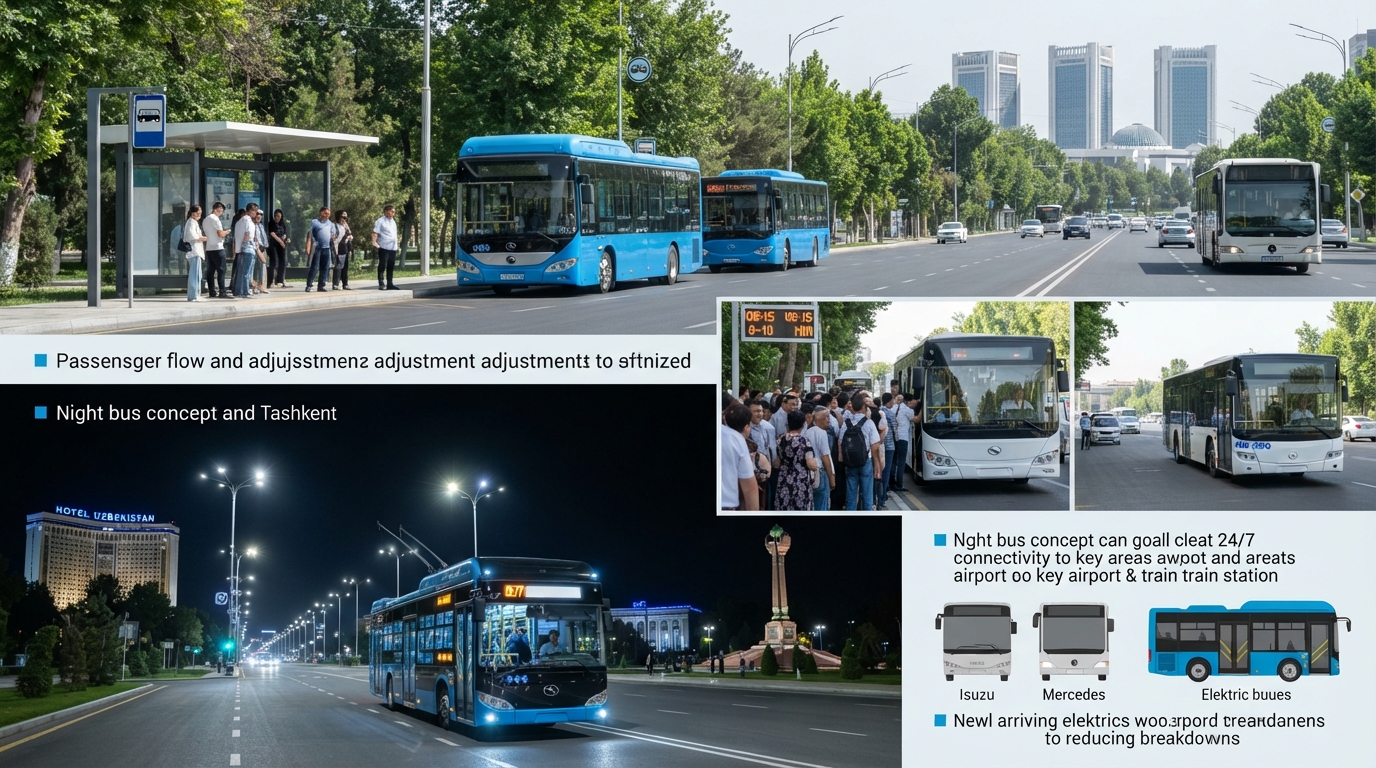
“Depends on passenger flow.” Officials on bus intervals and night routes in Tashkent
By the end of 2026, Tashshahartransxizmat plans to import 200 electric buses, while private entrepreneurs plan to bring in 100 buses. This was announced at a press conference held on October 16 at the Content Preparation Center with the participation of the leadership of the Ministry of Transport, a Gazeta correspondent reports.
According to First Deputy Minister of Transport Mamanbiy Omarov, special attention has been paid in recent years to reducing the time interval between buses. While efforts were made to keep the interval at an average of around 13 minutes when the new system was introduced in 2022, this figure has now been reduced to 8–10 minutes.
“On some routes, the interval may be 12–14 minutes, and on others, 6–8 minutes. The average figure has reached 8–10 minutes. We have abandoned the previous practice of waiting 20–30 minutes for a bus,” he says.
According to Omarov, the interval is determined based on the total distance of the route and the number of buses allocated to it. The number of buses, in turn, depends on the passenger flow. Among the 170 routes in Tashkent, there are also routes with a 15–16 minute interval.
Mirakbar Ikromov noted that the schedules of some routes are currently being reviewed. In particular, the possibility of maintaining an 8–10 minute interval between buses during morning peak hours and extending it to up to 15 minutes after the passenger flow decreases is being studied.
“By extending the interval to 15 minutes after peak hours, an opportunity will be created to extend the operating time of buses by another half hour,” says Ikromov.
According to him, such an experiment is currently being tested on three routes. During hours when passenger flow drops, their operating time can be extended by 30–40 minutes due to a more efficient use of the daily mileage of the buses.
Mamanbiy Omarov emphasized that one of the factors determining the interval is the age and technical condition of existing vehicles. In addition to Mercedes-Benz, Isuzu, and MAN buses produced in various years, Tashshahartransxizmat also has Yutong, King Long, and Foton buses imported in recent years. A breakdown in older buses can affect the movement schedule.
According to him, in previous years, instances of buses carrying more passengers than their capacity were observed. Currently, the daily number of passengers on buses has reached 1.5 million. Therefore, it is important to renew aging vehicles and reduce delays caused by technical breakdowns.
Omarov noted that the service life and technical condition of buses affect the efficiency of their use. The arrival of new vehicles is expected to help reduce the number of breakdowns on routes.
He stressed that traffic jams on roads and road accidents are also causes of bus delays. In some cases, the simultaneous arrival of two or three buses at a single stop is also related to this. Omarov explained that if the first bus is delayed, the following bus does not wait for it, but continues to move according to its own schedule. Otherwise, the delay could affect subsequent trips and lead to long wait times for passengers.
“Bus movements are monitored via GPS. Monitoring center staff control the situation on the routes. If a bus stops, they contact the carrier to determine the cause. In the event of a malfunction, a backup bus must be dispatched from the depot,” he says.
According to him, the performance of carriers is evaluated based on quality indicators such as the timely arrival of the bus, its cleanliness, and the driver wearing the prescribed uniform. If requirements are not met, deductions may be made from the funds paid to the carrier by the state.
Despite promises that the first night bus route in the city of Tashkent would begin operating by the end of 2025, it has not yet been launched.
Mirakbar Ikromov reported that organizing night routes is planned, and proposals from entrepreneurs in this regard are currently being studied. Additionally, the feasibility studies for such routes are being developed.
“Night routes should cover the airport, train station, and streets operating 24/7 that are being established, ensuring regular service in these areas,” he says.
The head of the department noted that 164 routes are served by Tashshahartransxizmat. Work is also being carried out to attract private carriers: while in 2022 they were granted one route, currently six routes are managed by private entrepreneurs.
Ikromov emphasized that the gross-contract system plays an important role in attracting private carriers. Under it, the carrier is paid for the volume of work performed based on a predetermined tariff. This system makes serving routes more attractive to entrepreneurs.
Once work on identifying the carrier, establishing the routes, and calculating their economic foundations for night buses is completed, the project is planned for implementation. However, he did not specify an exact date for when night trips would begin.
According to Mirakbar Ikromov, 500 buses are needed in the capital to cover the current demand. In addition, there are plans to purchase another 500 buses.
A feasibility study for the procurement of 200 electric buses by the beginning of 2027 has been developed by Tashshahartransxizmat. This proposal is currently being discussed in the Scientific Council of the Ministry of Transport. Ikromov said that the requirements for electric buses are being studied separately.
First Deputy Minister of Transport Mamanbiy Omarov also said there is a plan to import 200 new electric buses to Tashkent this year or in the first quarter of 2027.
Ikromov emphasized that an increase in the number of buses is also envisaged through the involvement of private carriers. By the end of the year, private entrepreneurs plan to bring in another 100 buses. They are expected to operate mainly on routes connecting the city of Tashkent with the Tashkent region.
“Currently, about one million cars move in the capital, while the number of cars entering and leaving from the Tashkent region daily is about 400 thousand. This increases the load on our main streets,” says Ikromov.
He noted that in order to reduce traffic flow and cover suburban agglomeration areas with public transport, there are plans to open another 13 routes. With the arrival of new buses, these routes will be launched in stages.
Furthermore, companies from Russia, Kazakhstan, and China have expressed interest in bringing buses to Tashkent and serving passengers. Their proposals are currently being studied. According to the head of the department, another major carrier competing with Tashshahartransxizmat may emerge in the future.