

**Demographics Give Food for Thought**
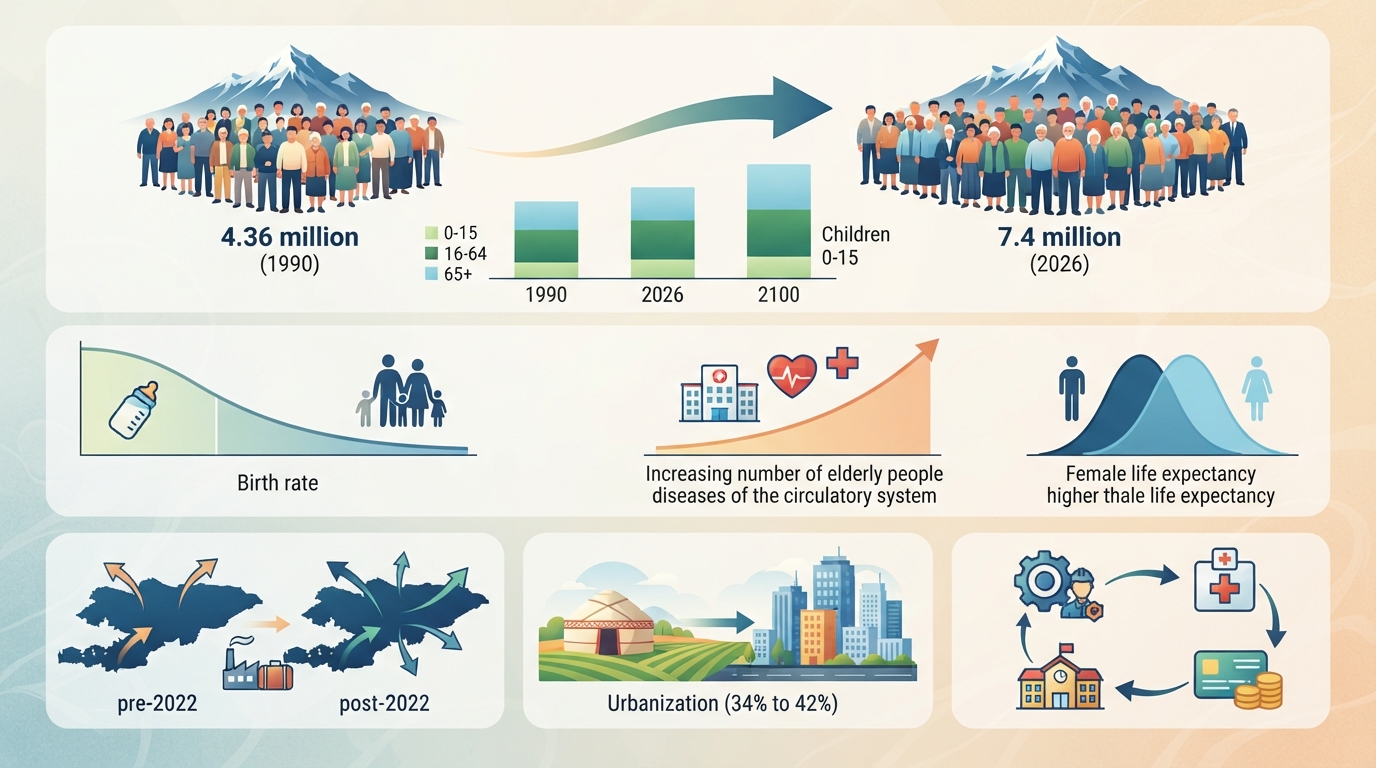
Kyrgyzstan's population has reached 7.4 million people, which is approximately 70% more than in 1990. However, behind this generally positive picture lie processes that, in the long term, are capable of affecting the labor market, the pension system, healthcare, and education. Population growth is gradually slowing down, the proportion of children is decreasing, and the number of elderly residents is growing.
This was reported at a media training for journalists organized by the United Nations Population Fund (UNFPA) in Kyrgyzstan by Azhar Zholonbaeva, Candidate of Economic Sciences and acting Associate Professor at the Academy of Public Administration under the President of the Kyrgyz Republic. In her speech, she relied on data from the National Statistical Committee, the 2022 population and housing census, as well as UN demographic forecasts from the World Population Prospects 2024 study.
According to Zholonbaeva, since the early 1990s, the country's population has increased from 4.36 to 7.4 million people. However, to understand the demographic situation, it is important to look not only at the total size, but also at the annual growth rates. In recent years, they have remained at approximately 1.5-1.7%. Against the backdrop of nations where the population is shrinking, this remains a positive indicator. At the same time, a gradual slowdown in growth is noticeable in Kyrgyzstan.
In parallel, the number of births is decreasing. According to data from the National Statistical Committee, about 140-141 thousand children are born annually in the country in recent years. The expert stressed that a decrease in the absolute number of births does not always mean a drop in fertility intensity. For a correct assessment, one must take into account the number of women of reproductive age and changes in the age structure of the population.
According to the data presented by Zholonbaeva, in 1990, the proportion of residents younger than working age was 40%, and by 2026 it had declined to 33%. Over the same period, the share of the working-age population grew from 50 to 57%. The share of residents older than working age has remained almost unchanged and stands at about 10%. At the same time, in absolute terms, the size of this group has increased significantly.
The expert noted that such shifts have long-term consequences. A reduction in the share of children in the future may slow down the replenishment of labor resources. Simultaneously, the growth in the number of elderly people will require additional solutions in the sphere of pension provision and social support.
It is also important to consider these changes when developing educational infrastructure. In particular, Zholonbaeva suggested reflecting on how much the construction of new schools corresponds to the projected number of children in specific regions and age groups.
Despite a relatively young population structure, Kyrgyzstan is gradually approaching the threshold of demographic aging. According to the National Statistical Committee, at the beginning of 2026, the average age of a resident of the country was 28.9 years. For men, this figure was 28.2 years, and for women — 30.1 years. The proportion of the population aged 65 and older is 6.4%.
Zholonbaeva explained that according to the UN classification she cited, a society where the proportion of people over 65 is in the range of 4 to 7% is considered to be on the threshold of demographic aging. Thus, Kyrgyzstan is gradually approaching the seven-percent mark. The expert cited the reaching of retirement age by the generation born in the 1960s as an additional factor driving the growth of the elderly population.
Among residents older than working age, women account for about two-thirds, and men for about one-third. As the expert explained, the differences become noticeable after about 40–45 years and intensify over time. An especially pronounced predominance of women is observed among people over 80 years old.
She addressed the differences between men and women separately.
According to the statistical data presented, approximately 103–104 boys are born in Kyrgyzstan for every 100 girls each year. However, this ratio changes with age.
Female life expectancy at birth in Kyrgyzstan is almost eight years higher than that of men. According to Zholonbaeva, these data raise questions about the causes of higher male mortality, the age-related characteristics of diseases, and factors affecting life expectancy.
According to the indicators of the National Statistical Committee, in 2025 the crude death rate was 4.6 cases per thousand population. At the same time, 53.2% of all deaths were due to diseases of the circulatory system. The maternal mortality rate was 22.1 cases per 100 thousand live births, and infant mortality was 11.6 cases per thousand live births.
Migration remains another factor influencing the demographic situation.
Zholonbaeva emphasized that when analyzing migration processes, it is necessary to distinguish between the usual resident population and the present population. The former indicator includes temporarily absent residents, while the latter reflects the number of people actually present in the corresponding territory at the time of the enumeration.
According to the results of the 2022 population census, about 1 million 94 thousand people were temporarily absent from their place of permanent residence. Of these, 80% were outside Kyrgyzstan. The main reason for absence was labor activity — it accounted for 88% of cases.
The expert also drew attention to changes in external migration statistics. While a migratory outflow previously prevailed in the country, since 2022 the number of arrivals has begun to exceed the number of departures.
At the same time, Zholonbaeva stressed that migration indicators must be interpreted taking into account the specifics of statistical accounting and external circumstances.
The example of the changing share of the urban population is no less telling. According to the data presented, in 2022 urban residents constituted 34% of the population of Kyrgyzstan, and in 2025 — already 42%.
However, the expert warned against concluding that such growth necessarily means an acceleration of urbanization. An administrative-territorial reform had a significant impact on the indicator, as a result of which certain settlements became part of cities. Therefore, an increase in the share of the urban population is not always associated with the actual relocation of people from rural areas.
Speaking about long-term prospects, Zholonbaeva presented UN forecasts up to 2100. According to the scenarios reviewed, the population of Kyrgyzstan will continue to grow, but the growth rates will gradually decline. At the same time, a further increase in the number of elderly residents and a change in the ratio of age groups are expected.
According to projections, the working-age population may increase until approximately the 2060s-2070s, after which it will stabilize. The share of children and youth in the more distant future will decline. At the same time, the expert emphasized that the forecasts are based on assumptions about fertility, mortality, and migration, so the actual dynamics may differ from the calculated ones.
Kyrgyzstan also has a concept of demographic policy that provides target indicators up to 2040. According to the document presented by Zholonbaeva, the benchmarks include increasing life expectancy to 79 years, maintaining the total fertility rate at a level of no less than 2.15 children per woman, and reducing working-age mortality and migratory outflow.
According to the expert, demographic data should be used not only to describe the current situation, but also to develop state policy. Changes in the age structure of the population require long-term solutions in the fields of employment, healthcare, education, and pension provision.