

Fewer payers, more pensioners
More pensioners, fewer taxpayers: the worrying arithmetic of Kyrgyzstan
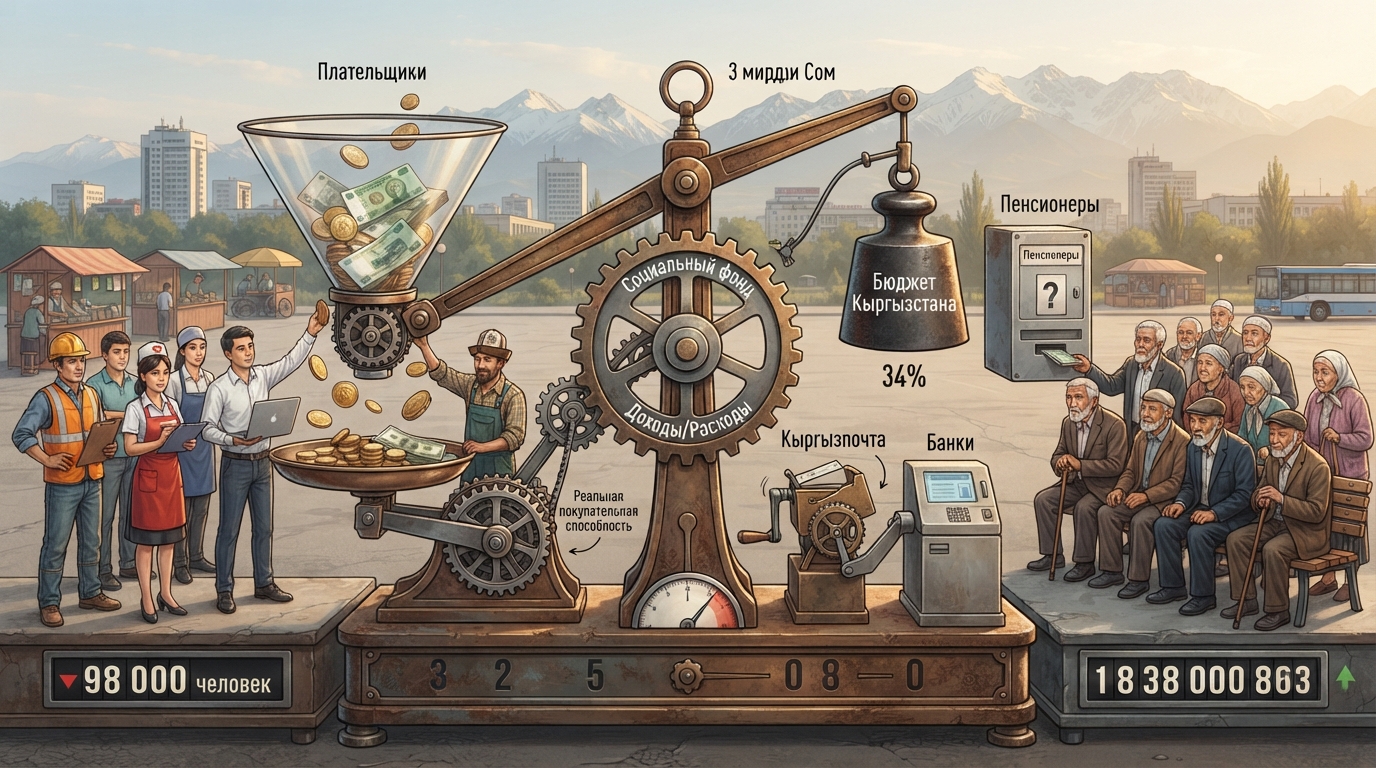
**The number of payers is decreasing, while the number of pensioners is increasing**
Kyrgyzstan's pension system concluded the year 2025 with a surplus; however, behind this outwardly favorable figure lies a more complex dynamic.
The Social Fund's revenues amounted to 130.1 billion soms, expenditures stood at 127.1 billion, and the remaining balance was about 3 billion soms. Formally, the system received more funds than it spent. Yet, almost simultaneously, the number of insurance contribution payers decreased by approximately 98,000 people to 1.464 million, while the number of pensioners rose to 816.6 thousand. As a result, there are about 1.8 payers per pensioner. This indicator helps to view the pension system not merely as a single-year report, but as a mechanism designed for decades.
In a solidarity-based system, pensions largely depend on how many people are currently working officially, what salaries employers report, and how much in insurance contributions is received from these incomes. Therefore, the reduction in the number of payers by nearly 100,000 in a year appears more significant than the 3 billion som surplus. The paradox is that the insurance receipts themselves did not decrease in 2025; instead, they grew by 12.4% to reach 82.9 billion soms. The Social Fund attributes this primarily to wage growth among employees of legal entities. This creates an unusual situation: there are fewer people contributing, but each remaining participant, on average, brings more money into the system. In the short term, wage growth can compensate for a shrinking base. In the long term, everything depends on whether the decline in the number of payers becomes a sustained trend.
The revenue structure reveals another characteristic. Out of the Social Fund's 130.1 billion soms in revenue, direct insurance contributions accounted for 82.9 billion, another 2.8 billion came from other receipts, and 44.4 billion soms were transferred from the republican budget. Thus, the state budget provided approximately 34% of all the fund's revenues. In fact, about every third som on the revenue side is linked to budget funding. In itself, this does not indicate a financial crisis: the state is fulfilling its legally mandated obligations, and the pension systems of many countries combine insurance receipts with budget transfers. The question lies elsewhere—how quickly will the need for such transfers grow if the number of pensioners continues to increase faster than the insurance base. Today, the gap between 1.464 million payers and 816.6 thousand pensioners remains substantial, but the 1.8 to one ratio already indicates the limitations of the demographic reserve. These 1.8 people should not be taken literally as workers supporting one specific pensioner: contribution sizes vary, there are different categories of employment and pension payments, and part of the obligations is covered by the budget. However, the figure is indicative for assessing the overall structure. If there are fewer payers, more pensioners, and life expectancy is gradually rising, the state is forced to choose between increasing insurance receipts, growing budget funding, and changing the parameters of the system itself.
Demographics make this issue particularly important. Kyrgyzstan still remains a relatively young country, but the age structure of the population is gradually changing. According to UN projections, the share of residents aged 65 and older could grow from about 6% to 10.1% by 2050. At first glance, an increase of 4.1 percentage points over a quarter of a century looks moderate. In reality, this represents an increase in the share of the elderly population of nearly 70% relative to the current level. At the same time, the future burden is determined not only by the number of elderly people. For the pension system, it is critical what portion of the working-age population is in the formal economy. A person may work, earn an income, and even have stable employment, but if their income is underreported, their contribution to the insurance system is significantly lower than its potential.
Kyrgyzstan is additionally characterized by high labor mobility. A significant portion of its citizens work abroad, while a large segment of self-employment, small business, and informal employment persists within the domestic economy. Therefore, a demographically young person does not always automatically become a full-fledged payer of insurance contributions. This explains why expanding the insurance base is becoming a distinct task that cannot be reduced solely to job creation. For the pension system, what matters is not just the availability of work, but its formalization, the size of the official salary, and the regularity of contributions.
Equally important is the question of what is happening to pensions that have already been granted. In 2025, the average pension grew by 6.1%, but its real purchasing power, according to MP Dastan Bekeshev citing the Chamber of Accounts, decreased by about 2%. This is the fundamental difference between nominal and real pensions. A pensioner receives more soms, but the quantity of goods and services that can be bought with this money may shrink. For elderly people, inflation is particularly sensitive because their spending structure differs from the average consumer basket: food, utilities, medicines, medical check-ups, and transport play a significant role. Therefore, even a relatively small lag of indexation behind the rising cost of living quickly becomes noticeable for a household.
In 2026, a significantly larger increase is planned: from October 1, the insurance portion of pensions is scheduled to increase by 20%, and the total size of the old-age pension after recalculation must be at least 8,800 soms, excluding bonuses. Such indexation will raise pensioners' incomes, but will simultaneously increase the Social Fund's expenditure obligations. This reveals a dependency typical of pension policy: the faster the state compensates pensioners for rising prices, the more funds the system requires; the slower the indexation, the more the real purchasing power of payments falls. Therefore, sustainability is no longer defined simply by the ability to deliver pensions on time, but by the capacity to simultaneously maintain an acceptable payment size and finance it without a constant acceleration of budget transfers.
Against this background, administrative expenses, which might have previously seemed secondary, become particularly noticeable. In 2025, 83% of pensioners received payments through banks, and the delivery of this money cost about 298 million soms. Another 17% used the services of Kyrgyzpochtasy (Kyrgyz Post), but expenditures on this channel amounted to nearly 430 million soms. In other words, 132 million soms more was spent on a significantly smaller group of recipients. Based on the pensioner population of 816.6 thousand people, about 678 thousand used the banking method, and approximately 139 thousand used the postal service. In a rough calculation, the cost is about 440 soms per year per bank recipient versus approximately 3.1 thousand soms per postal recipient. The difference is indeed close to sevenfold. Yet here, too, a simple comparison does not show the whole picture. The post office serves areas where banking infrastructure is less developed, delivers payments to people with limited mobility, and performs a social function that cannot be evaluated solely by the cost of a single transaction. Nevertheless, the figures show the price of maintaining the traditional model. If even a portion of recipients voluntarily switches to banking services, the savings across the system could amount to tens of millions of soms per year. For a fund with expenditures of 127.1 billion soms, this is a small share, but pension sustainability is built precisely from many such line items.
In 2025, the Social Fund directed another 984.2 million soms to the Workers' Health Improvement Fund. This is nearly a billion soms, and the funding was fully executed. Against the backdrop of pension expenditures, the sum may seem small, but it is comparable to about a third of the Social Fund's annual surplus. Therefore, the issue of the efficiency of distributing health resort vouchers goes beyond a private social program. If the state system collects mandatory insurance payments, any direction of expenditure becomes part of the overall assessment of efficiency. It is particularly telling that MPs simultaneously receive appeals from pensioners who face difficulties in obtaining vouchers. A gap emerges between a fully funded budget line and the accessibility of the result for a specific recipient. Such expenditures are not in themselves the cause of the pension system's demographic problems, but they show how important the quality of managing every billion soms becomes when the number of payers is shrinking.
The main risk, therefore, does not lie in the 2025 budget. In it, the arithmetic added up: 130.1 billion soms in revenue against 127.1 billion in expenditures. The problem lies between today's surplus and future obligations. A pension system operates for decades, and the positive balance of a single year says little about what the burden will be in ten or twenty years. If the number of payers continues to shrink at rates comparable to 2025, the current ratio of 1.8 payers per pensioner could change quite rapidly. However, mechanically projecting a reduction of 98,000 people annually into the future would also be a mistake: a single year does not yet form a long-term trend, and statistics can depend on changes in accounting, employment, and payer registration. What is important is something else: the system is already demonstrating several multidirectional processes at once. Insurance receipts are growing by 12.4%, the number of payers is decreasing, the number of pensioners is increasing, the budget provides about 34% of revenues, the nominal pension is rising, but its real purchasing power in 2025 is falling by about 2%. Each figure individually looks manageable. Together, they describe a structure that is gradually becoming more expensive for the state.
In this sense, Kyrgyzstan is facing the problem before it becomes an old country in the demographic sense. This is an important circumstance. Usually, a pension crisis is associated with societies where the share of the elderly is extremely high. The Kyrgyz situation shows that pressure can also arise in a young country if the formal insurance base grows slower than obligations. By 2050, the share of the population over 65 may reach 10.1%, but the pension system must prepare for this structure much earlier, because the people who will retire in 20–25 years are already in the labor market today, forming their insurance rights. Therefore, the reduction in the number of payers by 98,000 people is not just a loss of part of the receipts in one reporting period. It is a signal of how fully the economy translates population employment into insurance revenues. A surplus of 3 billion soms against the background of 44.4 billion in budget transfers clearly shows the scale of the issue: financial equilibrium is already largely supported by state resources. As long as the state is able to provide these transfers, payments remain stable. But as the number of pensioners grows, the pension system will increasingly compete for budget money with education, healthcare, infrastructure, and other public expenditures.
This is precisely why the Social Fund's report for 2025 is interesting not so much for its 130.1 billion soms in revenue, but for the structure of these funds and the number of people on both sides of the system. 1.464 million payers, 816.6 thousand pensioners, 82.9 billion soms in insurance contributions, 44.4 billion in budget funding, nearly a billion soms for health improvement, and 728 million soms in total expenditures on the two main pension delivery channels come together to form a single picture. Kyrgyzstan is not yet in a situation where the pension system stops meeting its obligations. On the contrary, payments are funded, revenues exceed expenditures, and insurance receipts are growing. But the sustainability of the pension model is not determined by today's ability to end the year with a plus. It is determined by how many workers will fund payments tomorrow, how official their incomes will be, how quickly the number of pensioners will grow, and what share of the entire structure will have to be paid directly from the state budget. In this sense, the year 2025 gave Kyrgyzstan two figures at once: a bookkeeping plus of 3 billion soms and a demographic-financial ratio of 1.8 payers per pensioner. For assessing the future of the pension system, the second figure may turn out to be much more important than the first.