

Pension reform of Uzbekistan. Economist explained why raising the age is not the only solution
Uzbekistan's Pension Reform. Economist Explains Why Raising the Age is Not the Only Solution
In Uzbekistan, raising the pension age by several years is being discussed: by 3 years for men and by 4 years for women, so that pensions begin to be paid at 63 and 58, respectively. For a person who has worked for many years, made mandatory contributions from their salary, and is of pre-retirement age, this is significant. The question arises as to why, and along with it a number of others: what is the pension age in other countries? What happens to a person's pension contributions during their working life? How much will they be able to receive after retirement? And what are the options for structuring a pension system in general?
Ravshanbek Dalimo explained how the pension system is structured, who finances the payments to current pensioners today, and what might happen in 15–25 years when the ratio of workers to pensioners changes.
A pension system is a set of financial institutions — pension funds — in which employees make contributions during their working life and receive pension payments upon its completion, with a service record designated by the International Labour Organization (ILO) at 40 years. That is, workers begin their career at age 20 and retire at age 60.
The calculated 40 years was introduced at one time, among other things, due to the so-called survival period — the difference between average life expectancy and retirement age. In the 20th century, people lived an average of 65–67 years, but now they live significantly longer. The better the living conditions and wealth, the longer people live, for example in Japan. At the same time, the higher the life expectancy, the more funds the pension system requires.
Currently, life expectancy in Uzbekistan is 75.4 years, which is 9 years more than in 1991. This is the first reason for the proposal to raise the retirement age in the country.
The trend toward increasing the retirement age in the world has been observed since the late 1990s: the transition to 63–65 years occurred, for example, in Belarus, the Russian Federation, France, and Japan, and in many cases — to 67 years, as in the EU and the US. Retirement at 60 and 54 years for men and women, respectively, is still maintained in the PRC, but even there, an increase in the retirement age is expected by 2050.
So, in a pension system, there are one or several pension funds that collect contributions from workers and, upon the onset of retirement age, calculate and pay pensions to elderly citizens. An inquisitive person will ask a logical, non-trivial question: what happens to the contributions during the interval of these very 40 years? Contributions are either redistributed or accumulated — this is the essence of the two existing models of pension systems.
The Redistributive Pension System
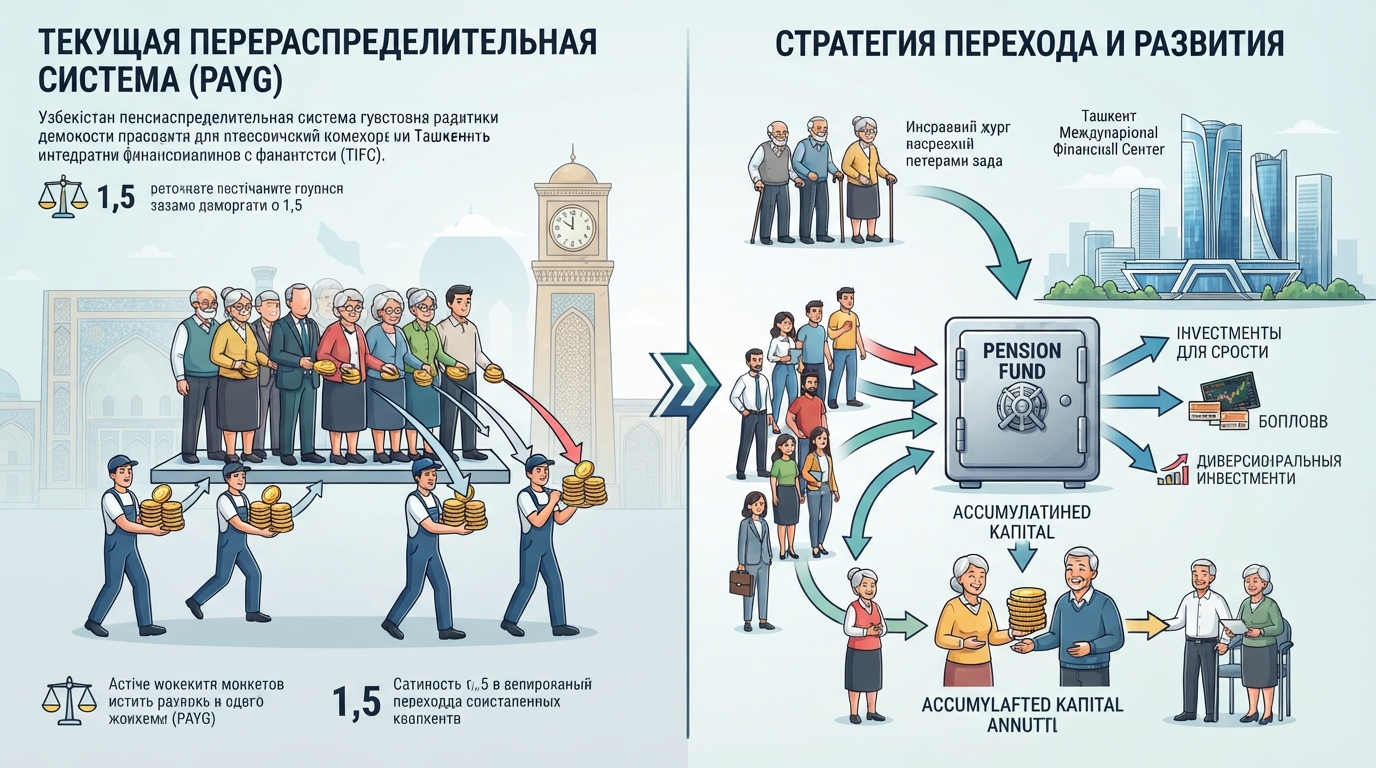
(otherwise called a pay-as-you-go pension system, and abroad — PAYG or Pay as you go) collects contributions from workers at a fixed percentage of their salary during their period of employment. In Uzbekistan, the tax rate for the pension system is 12% for businesses and 25% for budget organizations.
The received amounts are divided equally among those who have acquired the right to a pension. Thus, contributions to the pension system are accounted for some and immediately paid to others. Therefore, the system is called redistributive. To receive a pension here, so-called pension rights have been introduced, which are primarily determined by length of service and a certain final period of contributions before receiving it (10–20 years, due to existing inflation over the entire observation period). The fact is that the ILO has established a rule: the pension amount must be at least 40% of the average salary for the period taken into account, which means it is important to know the size of the pre-retirement salaries of workers.
The efficiency of the redistributive system depends on the collection of contributions, which is determined by the timeliness of salary payments and, therefore, reflects the efficiency of the country's economy. Another factor is the ratio of working employees to pensioners.
In Uzbekistan, this coefficient is 1.5, meaning that the contributions of three workers determine the payments of two pensioners. Of course, this is not enough, and it characterizes the coverage of the current pension system. For example, if the salary is seven million soums, then for three people it will be equal to 21 million soums, and their contributions to the pension system at 12% and 25% of the salary will amount to 2.52 million and 5.25 million soums, which is clearly insufficient.
In total, there are 4.4 million pensioners in the country in 2026, and their number increases annually by 160–180 thousand people. At the same time, the number of workers making contributions to the pension system currently does not exceed six million people. The deficit is covered by state budget transfers to the pension system, which in 2025 amounted to 20 trillion soums. According to IMF estimates, if current trends continue, by 2030 the deficit of the pension system will reach 38 trillion soums.
At the same time, the population of Uzbekistan is now at least 39 million people, of whom approximately 14 million are employed in the economy, and 3–4 million work outside the country. Accordingly, the coefficient in reality should be within the normal range of 3.18–4.09 (14/4.4 – 18/4.4). The coefficient of 1.5 indicates the need to expand the coverage of the pension system to all categories of able-bodied citizens and increase the total amount of contributions to the pension system. Or to make making contributions to the country's pension system mandatory and/or attractive for all citizens.
Age structure of the population of Uzbekistan.
For comparison: in Kazakhstan, the coefficient is 4.95, in Chile — 4.7, in Sweden and Denmark — 3.0, in the US — 2.8. The highest ratio of workers to pensioners is observed in African countries — from 7 (Tunisia and Morocco) to 21 (Uganda, Niger, and Côte d'Ivoire). In the Russian Federation, on the contrary, due to population aging, the coefficient is currently 1.2, which is an extremely low indicator for the effective operation of a pay-as-you-go pension system.
1 shows that when the payment period comes for the population groups that are currently 30–45 years old, that is, in about 15–25 years, the number of workers will equal the number of pensioners, and Uzbekistan's redistributive system will face a shortage of contribution amounts. And this is despite the high birth rate in the country: a population increase of over 700 thousand people per year.
Age structure of the population of the PRC and Chile.
A similar analysis is regularly conducted by countries, from which it is clear that in developed nations, due to declining birth rates, the problem with pension payments is already growing. At the same time, in countries with a high level of economy in the last two decades, such as the PRC, Singapore, and others, the pension system will inevitably face a crisis in about 25–30 years due to population aging: there will be more pensioners than working citizens.
To reduce the financial burden on redistributive pension systems, since the mid-1990s, many countries have begun to fully or partially transition to the funded principle of forming pension contributions.
The Funded Pension System
(Fully Funded Pension Scheme) is characterized by contributions from workers that are accumulated and accounted for in pension funds, indexed through investments in various bonds, and, upon reaching retirement age, paid to pensioners on an annuity basis. The latter means that the accumulated amount is divided by the survival period and paid to pensioners in equal monthly installments.
As noted above, it is proposed to raise the retirement age in Uzbekistan. One of the possible effects of such a step is easing the burden on the pay-as-you-go pension system in the next 15–25 years. However, the question remains as to what will happen after this period, when the number of pensioners continues to grow faster than the number of contribution payers. Then the state will again face the question of the sufficiency of revenues, the size of contributions, and the structure of the pension system itself.
Therefore, it is obvious that a funded pension system should become one of the solutions to the deficit problem of the pay-as-you-go pension system. This refers to a significant expansion of the capabilities of the current funded component in the amount of 1% of the payroll. This will require significant funds, as well as changes in investment rules, the creation and introduction of new financial instruments, primarily the bond market.
There are other considerations in favor of the arguments set out above. On March 30, 2026, a decree was signed on the creation of the Tashkent International Financial Centre (TIFC). Among the officially stated goals are the development of the capital market, attracting long-term foreign investment, integrating Uzbekistan into the global financial system, and turning Tashkent into a regional financial hub. Already on July 13, 2026, the law "On the Tashkent International Financial Centre" was adopted. It explicitly states the desire to turn it into a leading international financial center.
The Tashkent International Financial Centre provides for the development of operations with securities, investments, banking, and insurance instruments, as well as attracting long-term international capital. The new financial center is not just about foreign money. For a sustainable financial market, domestic long-term capital is also needed.
The task of developing Uzbekistan's capital market and creating an international financial center is being solved through pension savings, and accumulated international experience speaks in favor of this. Monthly pension contributions gradually form a type of capital that can remain in the system for decades. Therefore, in many countries, it is pension funds that have become some of the major institutional investors in the market for bonds and other financial instruments.
As indicated above, making a decision to carry out fundamental changes in the pension system is political and implies a carefully balanced approach in terms of the balance between the income and expenditure parts, investment methods, and the development of the country's financial system as a whole. On the other hand, limiting changes only to raising the retirement age postpones the essence of the problem for two decades and may make it significantly more expensive. Meanwhile, the country's economic growth and ongoing reforms are aligning in favor of more significant changes to Uzbekistan's pension system.