

“If the retirement age is not raised, taxes will be increased” — economist
“If the retirement age is not extended, taxes will be increased” — economist
If the retirement age is not extended in Uzbekistan, there will be a need to raise taxes. Economist Otabek Bakirov shared his opinion on this during the “Lolazor” podcast on YouTube.
Currently, a draft presidential decree envisages changes to the pension system has been released for public discussion. The document also provides for raising the retirement age by 2039 from 60 to 63 for men, and from 55 to 58 for women.
During the conversation in the podcast, it was noted that the increase in pension expenditures is also putting pressure on the state budget. In response to the question, “What if more than 90 percent of the public does not want the retirement age to be extended?”, Otabek Bakirov emphasized that otherwise taxes would be increased.
“Then taxes will increase. Let me tell you why I believe this should be accepted. A balance must be maintained between expenditures and revenues. There are various ways to maintain this balance. The easiest way is to increase taxes, that is, to raise the social tax from 12 percent to 15 percent. I do not accept this at all and consider it wrong. The second radical way is to raise the age abruptly. That is why they want to raise the age gradually and gently, without touching the tax rate,” the analyst said.
During the conversation, the director of the Pension Fund, Murodbek Otajonov, also stated that the fund's revenues are not sufficient to fully provide the population with pension payments. According to him, about 26 percent of the expenditures are covered by the state budget. This will amount to approximately 23 trillion soums for 2026. If no changes are made to the system, the deficit could increase up to 40 percent by 2030.
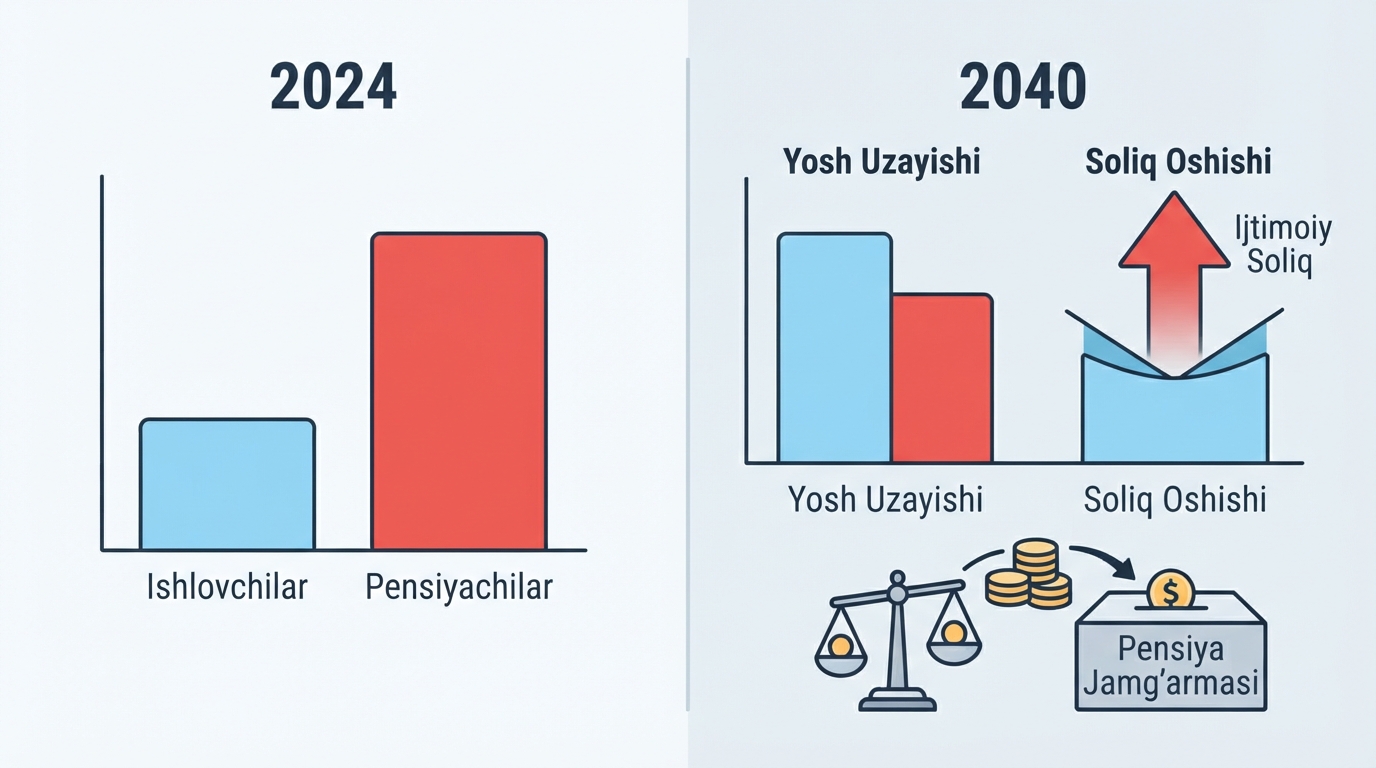
“As I understand it, one of the main goals of raising the retirement age is that, according to calculations, by 2040 the number of pensioners will increase sharply compared to the number of employed people. Because of this, the social taxes paid by the employed will not be enough to support pensioners. As a result, the fund will run into an even larger deficit than now. In the end, the state will say: ‘friends, let's stop this, let's increase taxes, let these working people pay more taxes to support pensioners’,” lawyer Khushnudbek Khudoyberdiyev expressed his opinion.
Otabek Bakirov also touched upon one of the risks associated with the increase in pension amounts.
“Year by year, the indexation percentage of pensions is decreasing. For example, it is projected to increase by 5.9 percent next year. This year, it was indexed by 7 percent. Next year, the indexation will be even lower. That is, as the deficit continues to grow, naturally, the state will start cutting expenditures and slowing down indexation,” the economist said.
In the country, pension funds are formed off-budget, that is, through the transfer of social tax to the account of the Pension Fund. In other words, a system is currently operating in Uzbekistan where officially employed people pay benefits to pensioners.
“The statement that the state is giving us a pension is not entirely correct. In fact, the state is just facilitating taking money from my pocket and giving it to someone else,” Murodbek Otajonov said.
However, since pensions are guaranteed in the Constitution, funds are allocated from the state budget because payments are insufficient.
Earlier, the increase in the average life expectancy of the population and the extension of the pension receipt period were cited as reasons for raising the retirement age.
Currently, there are 4.3 million pensioners in Uzbekistan. They make up 11.2 percent of the total population. By 2040, the number of pensioners is projected to reach 8 million, and their share in the total population is expected to increase to 15 percent.