

Democracy passed us by. God is our judge…
The main outcome of the 35 years of Uzbekistan's state sovereignty is the sad fact that over all these years, the people have never become the source of power. And not only in Uzbekistan
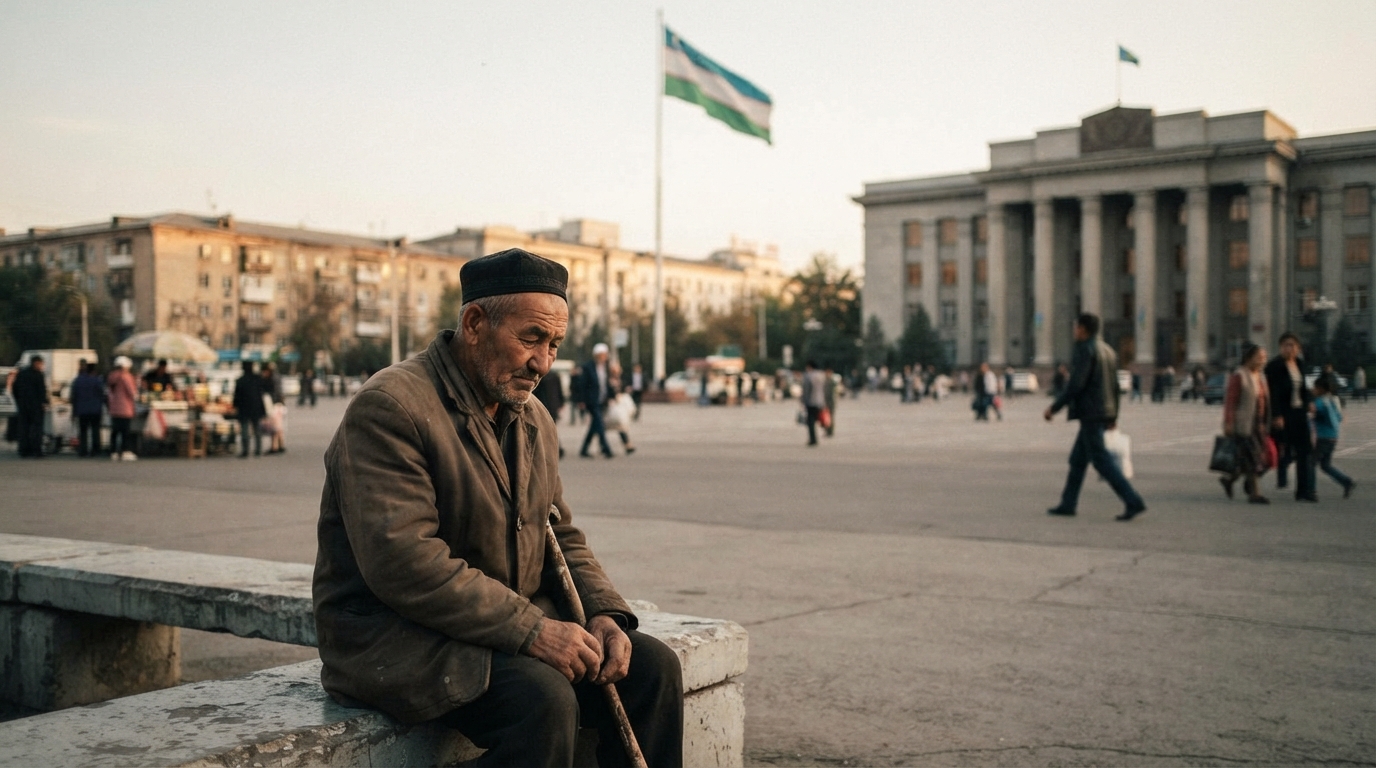
Democracy passed us by. God is our judge…
Sometimes it seems to me that in the autumn of 1991, we all became participants in one big historical play, the script of which no one had really read. The Soviet Union still formally existed — with a single army, economy, party system, and familiar ideology. But on the map, independent republics were already appearing one after another, each with its own flag, coat of arms, anthem, and almost identical declarations of freedom, democracy, human rights, and a market economy.
The word "democracy" was pronounced with bated breath back then. It seemed that it was enough to declare a state democratic, adopt a Constitution, hold elections — and everything would gradually work itself out. The people would become the master of the country, the official would be their servant, parliament would begin to control the executive branch, the court would become independent, and the president would be first among equals. A sort of temporary manager.
We did not yet assume back then: the independence of a state does not necessarily mean the freedom of its citizen. You can change the flag and the anthem, write a new Constitution, and at the same time preserve the old political culture. This, perhaps, became the main outcome of the last 35 years.
Democracy passed us by. And it didn't pass by somewhere far away. In the early 1990s, it was literally close. There were rallies, independent newspapers, political movements, heated debates about the future. In Uzbekistan, there were "Birlik" and "Erk", in Kazakhstan — democratic and national movements, in Kyrgyzstan, political competition was more noticeable, in Tajikistan, a powerful opposition emerged.
I remember the atmosphere of those years well. Suddenly it turned out that people could have completely different visions of the country's future. Some spoke of national revival, others of democracy, others of religious values, others of the market, and still others simply wanted to get rid of the dictates of the party apparatus and the burden of the USSR. This was the main meaning of that time: for the first time, society had the opportunity to debate the future.
But very soon it turned out that the state machine understands the price of political competition much faster. At first, everything was explained by the need to maintain stability. The country is too young. The economy is collapsing. It is turbulent all around. Interethnic conflicts must not be allowed. Afghanistan is nearby. Radicals must not be allowed to take advantage of the weakness of the state.
The arguments were not far-fetched. The threat of chaos did exist. But an imperceptible substitution of concepts occurred: the emergency need to maintain stability gradually transformed into a permanent need to maintain power.
The opposition was disappearing from the political field. Some were imprisoned, others were forced to leave, others fell silent, and others dissolved into everyday life, realizing that you cannot kick against the pricks. The state became more stable, the economy gradually developed, and interethnic conflicts did not destroy the country. But the formula "from a strong state to a strong society," derived by Islam Karimov, somehow did not work. Stability arrived. Democracy did not.
And in this respect, Uzbekistan turned out to be not an exception, but part of a general post-Soviet pattern.
Kazakhstan built a powerful presidential vertical. Nursultan Nazarbayev, who also emerged from the Soviet party-state system, managed to create a political structure in which the power of one person remained the central element of the state for decades. Subsequent reforms, including the dismantling of part of Nazarbayev's legacy after the events of January 2022, demonstrated the scale of the problem rather than canceled it.
Kyrgyzstan took a different path. Here, presidents were indeed overthrown, but revolutions in themselves did not bring democracy. After a parliamentary experiment, the country returned to the presidential model once again.
Tajikistan turned out to be a hostage of an even more difficult circumstance — a civil war. It allowed the authorities to use the same argument for decades: political struggle is dangerous because it can return the country to the past. As a result, the political system gradually turned into a family one.
And then something happened that just a few decades ago seemed impossible even for post-Soviet politics.
In 2022, Turkmenistan became the first among the Central Asian states to carry out a virtually dynastic transfer of presidential power from father to son: Serdar Berdimuhamedow succeeded his father Gurbanguly Berdimuhamedow. On the eve of the elections, this was already viewed as a prepared transfer of power within the family, and after Serdar's election, the fact of family succession became a political reality.
But Turkmenistan is interesting not only for the very fact of the transfer of power from father to son. Another detail is much more important — the gradual transformation of the state leader into a figure existing, as it were, above ordinary politics. First, "Turkmenbashi" appeared — the head of all Turkmen (Saparmurat Niyazov). Then the next leader got "Arkadag" — the patron (Gurbanguly Berdimuhamedow). In Tajikistan, Emomali Rahmon is officially called the "Founder of Peace and National Unity – Leader of the Nation." In Kazakhstan, there was the title "Elbasy" — "Leader of the Nation" (Nursultan Nazarbayev), secured by a special constitutional law, although this status was subsequently abolished.
In themselves, loud titles may seem like mere Eastern political exoticism. But this is not exoticism. This is a symptom.
An authoritarian regime is capable of being effective. Sometimes even very effective. It can quickly make decisions, concentrate resources, carry out unpopular reforms, build roads, launch large projects, and achieve its goals without long parliamentary discussions. But such a system has one fundamental condition: authoritarianism must not turn into a cult of personality.
As long as power belongs to an institution — even an extremely strong one — the system retains the ability to correct mistakes. When the state begins to be identified with a specific person, criticism of the leader gradually begins to be perceived as criticism of the state, and disagreement with the decision of the first person — as disloyalty to the Motherland.
This is where the dangerous road begins. Yesterday the official said: "The president decided so." Today he says: "The president cannot make mistakes."
In Uzbekistan, similar sentiments also existed. I remember how back in the days of Islam Karimov, one of the local newspapers tried to give the president the status of a padishah. There were also songs performed by a famous Uzbek singer: the first was dedicated to the national leader of Uzbekistan, the second — presumably to his eldest daughter. Back then, this did not pass; the idea remained more of a curiosity than a state trend. But the very fact is indicative. Where a cult of personality exists, there are always people ready to deify this personality. And most often — not out of love for the state and not even out of love for the leader, but out of a completely understandable desire to be closer to the source of well-being.
I have not had the chance to hear songs in praise of the current president of Uzbekistan, but we all remember how quite recently some patriotically minded citizens began to name newborns after the head of state and members of his family. The initiative was received with gratitude, and local authorities began to present those who entered the top ten with passenger cars of domestic production. The gifting campaigns were stopped only when it became clear that either the auto industry would go bankrupt, or the naming landscape in the country would fundamentally change. By the way, something similar, but on a smaller scale, also happened during Islam Karimov's tenure.
There is no certainty that what once did not pass cannot pass today or tomorrow. History generally has a bad relationship with the words "never" and "impossible."
In Soviet times, such faith in the infallibility of political promises also seemed natural. In 1961, at the XXII Congress of the CPSU, it was solemnly proclaimed: "the present generation of Soviet people will live under communism." The party program linked this with the prospect of building communism within two decades.
Time passed. Communism never arrived.
From the same series, in my opinion, is the slogan: "the official is for the people, not the people for the official." The phrase sounds wonderful. Moreover, it contains the very essence of the relationship between the people and the state. The official indeed must not be the master of a person, but their employee. The state apparatus exists not for its own convenience, but for the citizen. The authorities must work for society, and not society serve the authorities. That is what I think.
The problem is not only in specific officials. The problem is in the design of the system, in which an official depends not on the choice of a citizen, but on the influence of a higher boss. And then the constitutional formula about the people as the source of power begins to resemble a beautiful inscription on the facade of a building inside which a completely different mechanism has long been operating.
…In the Soviet system, power was not inherited, but almost always transferred on the principle of personal loyalty. After the collapse of the USSR, this practice did not disappear. It simply changed its clothes. Instead of the Central Committees of the Communist Parties of the union republics, presidential administrations appeared (sometimes with fantastic powers). Instead of the party secretary — the head of state. Instead of a party congress decision — a presidential decree or a referendum. Instead of guaranteed rotation — endless legal constructs allowing to explain why the former restrictions are no longer restrictions. The Constitution, meanwhile, continued to speak of the people as the source of power.
But here a simple question arises: if the source of power is unable to change the direction of its movement, is it really a source?
Today, the limited capabilities of authoritarian systems can no longer be explained only by political emotions. It is visible in international assessments. In the Freedom House rating for 2026, all five Central Asian states received the status of "not free": Kazakhstan scored 23 points out of 100, Kyrgyzstan — 25, Uzbekistan — 12, Tajikistan — 5, Turkmenistan — only 1 point.
The position of Uzbekistan is particularly indicative. Even while recognizing the reforms of recent years, Freedom House notes that the country remains an authoritarian state, legal political opposition is absent, the legislative and judicial branches are virtually dependent on the executive, and the media retain strict restrictions.
Of course, a rating is not the absolute truth. But when different international assessment systems show the same picture year after year — the weakness of political institutions, limited civil liberties, problems with the independence of courts and media, corruption risks — it is difficult to continue pretending that we are talking exclusively about temporary growing pains.
An authoritarian system is indeed capable of ensuring order. It can quickly make decisions, build roads, launch reforms, mobilize resources. But it has a fundamental limitation: it is bad at correcting its own mistakes if admitting a mistake threatens its power.
In a democracy, the losing president leaves. In an authoritarian system, there is usually no one to lose to. Therefore, the state gradually begins to live not by the principle of competition of ideas, but by the principle of loyalty.
And here arises the most unpleasant question, which in the early 1990s we simply could not ask ourselves. What happened not only to the authorities, but also to us?
Over 35 years, a new generation has grown up. People born after the collapse of the USSR are today working in government structures and business, becoming officials, entrepreneurs, journalists, teachers. They have never lived in the Soviet Union and do not perceive it as a personal experience.
This generation grew up and was formed in a completely different coordinate system. Since childhood, they have observed a simple and highly convincing practice: power is more important than the law, money is more important than principles, connections are more important than competition, loyalty is more important than independence. And a person who wants to achieve something quickly makes a practical conclusion: it is pointless to fight the system.
This is already a completely different political culture. A person who grew up in a democratic environment perceives freedom as a natural right. A person who grew up in an authoritarian environment often perceives it as a potential problem.
We have talked for too long about the authorities not wanting democracy. But we have much less often asked whether we ourselves need democracy. In 1991, the answer seemed obvious. There were people who understood the main thing: power must depend on the citizen. Today, such people are practically invisible.
This does not mean that we do not want a better life. We do. It does not mean that we do not want justice. We do. It does not mean that we are not tired of corruption, official arbitrariness, or social inequality. We are. But the desire to live better does not yet mean the desire to live freer.
Democracy never comes on its own. It exists only where a citizen is inwardly convinced that they have the right to say "no" to the authorities. In 1991, democracy was indeed an opportunity. Today, this opportunity has formally not disappeared anywhere. But the public need for it no longer looks obvious.
And here we come to the most painful aspect of the problem. Let's be honest, for most people, bread remains more important than freedom. And to blame them for this is foolish, to say the least. Besides, if people gravitate toward freedom, it is no more than 15% of the total population in any country. The rest are either led or indifferent. Therefore, outwardly spectacular slogans calling for popular rule rarely find understanding and support in practice. Simply because people need bread every day.
Based on the fact that all power is from God, and the devil, who might play a joke while God is sleeping, might just change his mind, people always hope that fate itself will carry them where they need to go. Sometimes, coming into conflict with my own beliefs, I think that this is generally the great wisdom of the peoples of the East, developed over millennia. It is precisely the position of non-resistance that allowed them to preserve themselves, their culture, religion, customs, and traditions — what is commonly called national identity today. Something that not everyone managed to do. In the end, rulers come and go…
Or is it not so?