

## Kazakhstan: Choosing Between Governability and Development
A new Kurultai, a unicameral parliament established under the Constitution of March 15, 2026, has been formed in Kazakhstan. Five of the seven parties participating in the elections cleared the 5% threshold. It is clear that the composition of the new legislative body will be determined in accordance with Akorda's political course.
However, according to local experts, key political processes in the country remain opaque to the public and are focused on intra-elite agreements. Political scientist Dosym Satpayev notes: "The absence of public policy inevitably leads to the weakening of political institutions. In all likelihood, the new parliament will also function as a controlled element of the state system, continuing the established tradition of centralization and political control. Thus, updating Kazakhstan's constitutional structure does not yet mean a fundamental change in the governance model itself. The main question remains whether the new Kurultai will become an independent political institution or will primarily ensure the legitimacy of decisions made within the presidential vertical."
At the same time, Kazakhstan's main problem is its inability to control global markets, climate change, water shortages, human capital migration, technological backwardness, and the decisions of international investors.
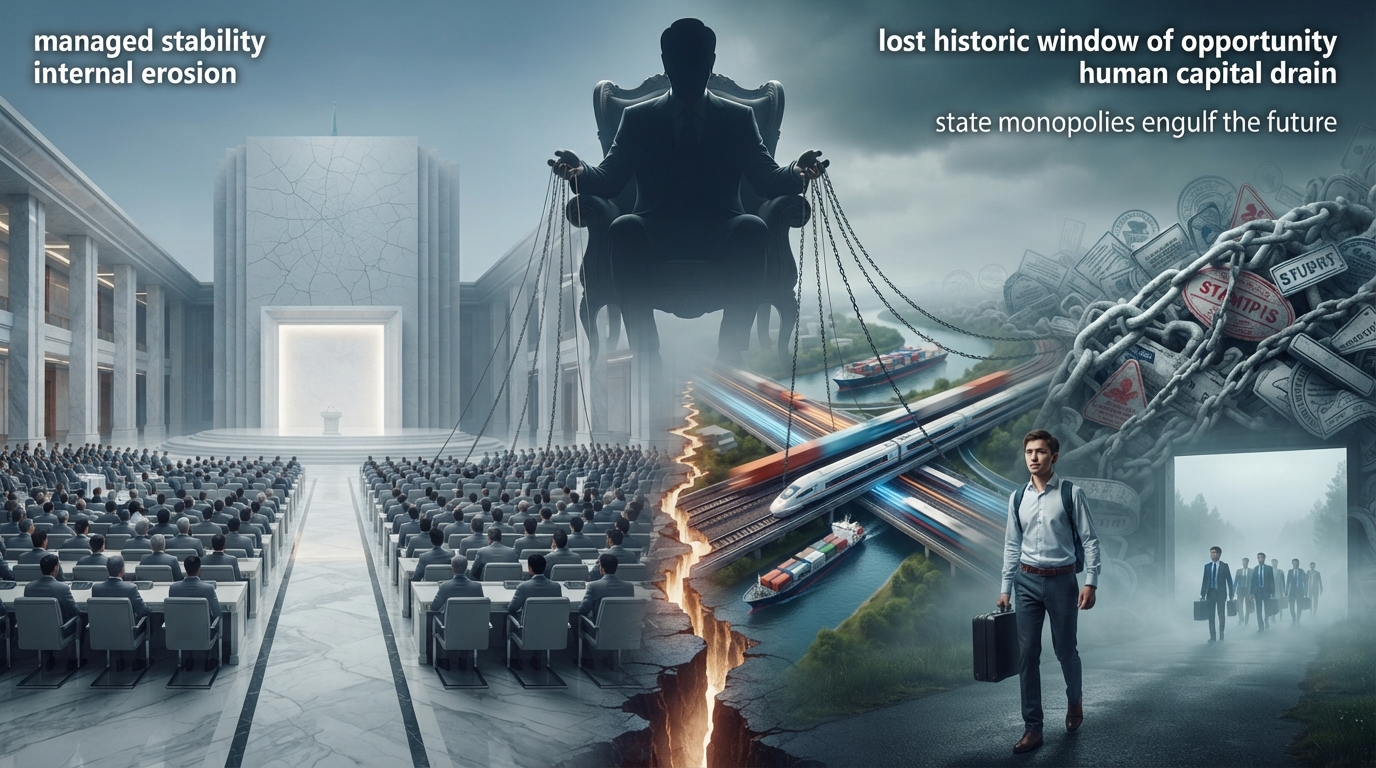
### Most Likely Scenario: External Stability and Internal Erosion
If Kazakhstan continues to increase pressure on society, limit media independence, curtail political competition, and maintain state dominance in the economy, the country will certainly not collapse. GDP growth, the implementation of infrastructure projects, the conclusion of major international agreements, and the maintenance of a seemingly stable political system are even possible.
However, beneath this external stability, processes that are more difficult to measure will begin to intensify: a decline in the quality of government decisions, a "brain drain," technological backwardness, the accumulation of hidden liabilities of state-owned companies, and the inability of institutions to prevent crises before they arise. This will not be a sudden collapse, but a gradual loss of capacity.
### Kazakhstan risks repeating Russia's mistakes
The assertion that Kazakhstan is following Russia's path is too categorical, given the differences in scale, demographics, economic structure, foreign policy, and historical circumstances of the two countries. However, Kazakhstan does risk replicating the mechanism that made the Russian system dangerous, first and foremost, to Russia itself.
This mechanism begins with the belief that political competition threatens the state. Independent institutions are then gradually replaced by personalized governance. Parliament becomes part of the executive vertical, the courts become an instrument of administrative regulation, big business becomes dependent on the state, and the media becomes an object of control. After this, the system loses the ability to receive unbiased information.
Management is told not what is happening, but what it is ready to hear. Officials seek not to solve a problem, but to avoid responsibility for its existence. Experts tailor their conclusions to fit a decision already made. Businessman invests not in the most effective project, but in the most secure relationships. Mistakes stop being corrected and begin to accumulate.
### First Consequence: A Missed Historic Window of Opportunity
Today, Kazakhstan has a unique window of opportunity. Changing trade routes, competition for critical resources, the development of the Trans-Caucasian Transport Route (TCTR), and attempts by European and Asian countries to diversify supplies and shipping chains are increasing Kazakhstan's importance. The country has every chance of becoming not only a supplier of raw materials, but also a transport, manufacturing, financial, and technological hub for Eurasia. However, geography offers an opportunity, not a guaranteed outcome.
If Kazakhstan maintains its privileged economy, it will enjoy transit but not development. Freight will pass through the country, but the bulk of the added value will be generated outside its borders. Foreign companies will view Kazakhstan as a transportation hub, a raw materials base, or a temporary location, but not as a location for complex production, research, and management centers.
This window of opportunity will not remain open forever. Alternative routes are developing, technologies are changing, and international capital is rapidly redistributing. Kazakhstan may discover that its geopolitical advantage was lost not because of an external enemy, but because of an internal failure to create functioning institutions.
### Second Consequence: State Monopolies Will Absorb the Future
State presence in certain industries is inevitable. However, a problem arises when state ownership becomes a system of exceptions: special access to loans, government contracts, infrastructure, land, licenses, and political decisions. As a result, entrepreneurs quickly realize that it is more profitable to access existing state resources rather than create a new market. Thus, the economy begins to produce intermediaries rather than innovations.
The best legal, financial, and management personnel are focused not on product development but on building relationships with regulators and quasi-state companies. Banks prefer to finance state-backed projects. Small businesses remain in trade and services, unable to grow into independent industrial or technology companies.
Over time, a state monopoly becomes political. A large independent company is capable of funding research, media, public projects, and expert organizations. Therefore, an authoritarian system inevitably begins to perceive independent business as a potential source of uncontrollability.
### Third Consequence: Loss of Competent People
The main deficit of the 21st century is people capable of creating complex systems and making independent decisions. Whether an engineer, scientist, doctor, entrepreneur, programmer, or qualified manager decides to emigrate, it's not just about the salary. People leave when they see no professional prospects, distrust the courts, fear arbitrary rule, distrust the quality of their children's education, and understand that social advancement depends on connections and loyalty.
For the authorities, the emigration of critical citizens may seem convenient for a time. The political landscape becomes calmer. But along with the critics, so do the competencies. It won't necessarily be the most loyal who remain. Those who remain will be those with fewer opportunities to relocate, less education, less mobility, or greater dependence on the state system. This will change the quality of society as a whole.
Large projects will increasingly depend on foreign contractors. Even managing national infrastructure will require outside specialists. The most dangerous emigration is that which hasn't yet physically occurred. A person may live in Kazakhstan, but no longer see their future there. They don't build long-term businesses, don't participate in public life, don't invest in institutions, and don't prepare their children for departure. Thus, the country loses citizens long before they even cross the border.
### Fourth Consequence: Officials Will Stop Telling the Truth
Increasing pressure on society inevitably changes the state apparatus. When a journalist, activist, or expert is punished for inconvenient information, the official also receives the signal. They understand that the bad news is dangerous for the bearer. Thus, improved reports begin to flow upward. The problem is rebranded as an "isolated shortcoming," a failure as a "temporary deviation," and public discontent as the result of external manipulation.
The minister receives a distorted picture from the departments. The government receives it from the ministers. The president receives it from the government and administration. As a result, the head of state may have a limited understanding of the country's real situation.
Continued pressure on independent media exacerbates this problem. Free journalism is unpleasant for the authorities. By destroying it, the state doesn't eliminate the problem. It destroys the channel through which it could have been learned about before the disaster.
### Fifth Consequence: Protests Will Become Less Manageable
Akorda may restrict the activities of opposition politicians, public organizations, and the media. But the absence of an organized opposition does not mean the absence of conflict. On the contrary, organized groups make public discontent more understandable and manageable. They have representatives, demands, a program, and a responsibility to their supporters. Negotiations with them are possible. But if all intermediaries are destroyed or discredited, society atomizes. People lose trust not only in the state but also in each other.
In this state, protest is triggered not by a political leader, but by a specific event: rising prices, a utility breakdown, a labor dispute, an unfair court decision, the death of an individual, or the actions of a local official. Such protests may lack a program and negotiators. They spread faster than the state can understand their nature.
The economy becomes the de facto organizer of protests. You can refuse to register a party, but you can't avoid seeing rising prices in your family budget. You can shut down independent media, but you can't administratively abolish unemployment. You can restrict rallies, but you can't prevent people from comparing their own lives with official statements.
### Sixth Consequence: The President Will Become a Hostage to the System They Created
The more institutions depend on a single center, the more difficult it is for that center to change policy. Any genuine reform begins to threaten the interests of officials, state-owned companies, security agencies, and privileged groups that have formed around the existing order.
So, one day, the president discovers that he is unable to implement his own decisions without risking upsetting the balance within the elite. At this stage, authoritarianism becomes a trap not only for society but also for the head of state himself.
States rarely collapse because of a single mistake. They collapse when several unresolved problems converge, and the institutions and people capable of action are no longer present.
If the political and economic course remains unchanged, the following sequence is most likely.
**Phase One: The Triumph of Governability**
Political reforms will proceed as planned. The government will retain control over the main economic flows. Quasi-state structures will continue to play a central role. Economic growth and investment agreements will allow the authorities to claim that the chosen model is effective. However, the danger is that external successes will strengthen the belief that institutional reforms can be replaced by administrative management.
**Phase Two: The Decline in the Quality of Growth**
In a few years, it will become clear that infrastructure investments and resource revenues have not created a sufficient number of productive jobs. Small and medium-sized businesses will remain dependent on domestic demand and government decisions. The most profitable markets will be controlled by large groups. The innovation economy will continue to lag behind official strategies. Growth will continue, but it will become expensive: increasing government spending, subsidies, loans, and administrative incentives will be required.
Stage Three: Personnel Shortage
The exodus of qualified specialists and the decline in the quality of education will begin to take its toll. The state will respond by raising salaries for certain categories, inviting foreign specialists, and creating new training programs. But these measures will not solve the main problem: the lack of an environment in which professional independence is rewarded. Kazakhstan will find it increasingly difficult not only to create new industries but also to maintain the existing infrastructure.
Stage Four: Crisis of Trust
The gap between the official language and the everyday experience of citizens will become all too obvious. Any extraordinary event will be perceived as proof of the incompetence or injustice of the entire system. Even the best government decisions will be met with mistrust because for years the state has prevented the public from verifying their validity.
The authorities will respond with additional information control. This will have a short-term effect, but will further impair feedback.
**Stage Five: External Impact**
The decisive factor will be an event beyond Kazakhstan's control: a drop in raw material revenues, a regional conflict, disruption of export routes, a water crisis, a climate catastrophe, or a global financial shock. An external impact in itself does not destroy a stable state. But it does expose all the accumulated weaknesses.
At this point, it will become clear that parliament is incapable of making independent decisions, officials are afraid of initiative, businesses are dependent on government contracts, public intermediaries have been destroyed, and a significant number of competent people have left or distanced themselves from the country. There will be no one to correct these mistakes.
### What the President and the Government Can Still Change
1. **Recognize that manipulated elections create a parliament that is convenient for the administration but useless in a crisis.** The Kurultai must genuinely investigate the government's activities, reject its initiatives, and demand the resignation of ineffective officials. 2. **Ensure judicial independence in economic and administrative disputes.** If citizens and entrepreneurs can win cases against the state, this will create the foundation for a real constitutional order.
3. **Establish a timetable for reducing the quasi-public sector.** Privatization must be transparent and competitive, otherwise the state monopoly will simply turn into a private monopoly tied to officials.
4. **Stop viewing independent media and civil society as a threat.** Their job is to identify problems before they become a threat to national security.
5. **Restore professional autonomy to the civil service.** Officials should be held accountable for illegal decisions, but not afraid to inform management that a presidential or government initiative is not working.
6. **Allow real political competition, at least at the local level.** The country needs to learn to change leaders through procedure, not through crisis. 7. **Make the preservation and restoration of human capital a national priority.**
The government will win all the coming political campaigns. But this will be a victory within the system, the rules of which the government itself sets. Beyond that, there is a different reality.
There, Kazakhstan competes not with its own activists and journalists, but with its closest neighbors—the countries of the Caucasus, Eastern Europe, the Persian Gulf, and Asia—for investment, routes, technology, and talented people.
There, the decision is made not by the electoral commission, but by the investor. There, it is not the parliamentary majority that votes, but the young professional choosing a country to live in. There, the state is assessed not by the official television channel, but by the latest accident, drought, economic crisis, or logistical disruption. This reality is indifferent to the percentage of votes the ruling party received, the name of the parliament, or the persuasiveness of the Constitution.
If Kazakhstan continues to increase pressure and maintain its administrative economy, it will likely not collapse tomorrow. He will do something less noticeable, but perhaps just as dangerous: he will miss a historic chance to become an independent center of power and development.