

Cotton growing in Central Asia in 2016–2025
CERR has prepared a review dedicated to the dynamics of cotton production development in the countries of Central Asia in 2016-2025.
Cotton Growing in Central Asia in 2016–2025
Cotton growing is one of the basic sectors of the agricultural economy of Central Asia. The capacity utilization of textile enterprises, the demand for irrigation water, employment in rural areas, and the position of the region's countries in global value chains depend on it. At the same time, the sector underwent structural changes in 2016–2025.
The key trends of the decade in Central Asian cotton growing were:
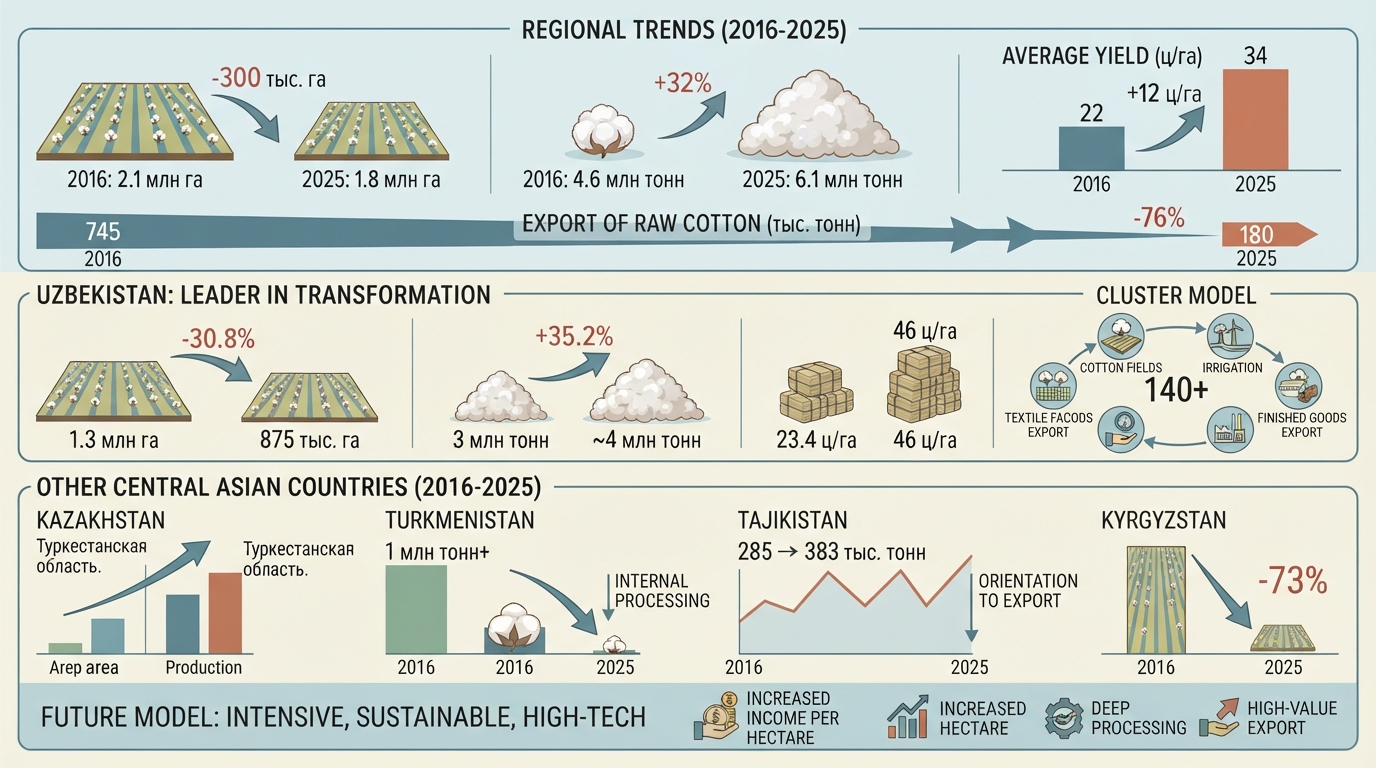
- a reduction in the region's sown areas by 300 thousand hectares — from 2.1 million hectares to 1.8 million hectares,
- an increase in cotton harvest volumes by 32% — from 4.6 to 6.1 million tons, and as a consequence, a growth in average yield by 12 centners/ha — from 22 centners/ha to 34 centners/ha.
This shows that the economic model is gradually moving away from extensive, water-intensive production toward increasing the return from each hectare.
Another structural regional trend was a noticeable reduction in the export of raw cotton. The combined estimated export volume of the five countries decreased from 745 thousand tons in 2016 to 180 thousand tons in 2025, or by 76%.
Uzbekistan — the leading cotton producer in the region (65% of the harvest in 2025) — showed the deepest structural reorganization thanks to reforms carried out in 2017–2025.
During the period under review, the main changes in the systemic transformation of the sector were the abandonment of mass mobilization of public sector workers, the introduction of market mechanisms into the cotton chain, and the reduction of areas under cotton by transferring them to other agricultural crops.
The cotton area decreased from 1.3 million hectares in 2016 to 875 thousand hectares in 2025 (−30.8%), while the harvest grew from 3 to approximately 4 million tons (+35.2%). As a result, the yield almost doubled — from 23.4 to 46 centners/ha, which became a historically high figure.
The main element of the structural reorganization of economic relations in cotton growing was the testing and subsequent nationwide expansion of the cluster model with the formation of a vertically integrated textile industry. Today, more than 140 cotton-textile clusters operate in the country.
At the same time, during the period under review, the country virtually ceased exporting raw fiber (in 2016, exports of cotton fiber amounted to 416 thousand tons worth 637 million USD) and built a full textile cycle based on its own raw materials, focusing on the export of higher value-added products. For reference, during the period under review, exports of textiles and clothing grew more than 3-fold and reached 3 billion USD.
According to FAO data, the sown area increased from 545.6 thousand hectares in 2016 to 580 thousand hectares and has remained almost unchanged in recent years. Production held at a level of 1.1–1.28 million tons until 2022, then decreased to 661 thousand tons in 2023 and 600 thousand tons in 2024. In 2025, according to media reports, it was planned to harvest 1.2 million tons. Based on this, the calculated yield grew from 19.6 centners/ha and amounted to 21.6 centners/ha last year.
According to mirror data, cotton exports during the period under review decreased significantly — from 175 thousand tons in 2016 to less than 10 thousand tons in recent years. Given that cotton harvest volumes remained above 1 million tons, it can be assumed that Turkmenistan also took measures to increase domestic processing with the subsequent output of higher value-added products.
During the period under review, Kazakhstan increased production 1.6-fold — from 287 thousand tons in 2016 to 466 thousand tons in 2025. At the same time, it should be noted that a significant increase in harvest was recorded in 2025 — by 54%. In recent years, production has been fully concentrated in the Turkistan Region. The area grew by 32.8% — to 145.6 thousand hectares, and the yield — from 26.2 to 32.0 centners/ha. Thus, growth was ensured simultaneously by the expansion of crops and an increase in productivity.
External supplies of fiber remain significant: exports increased by 46%, to 75.1 thousand tons, and in value terms — by 56%, to 111 million USD. At the same time, it should be noted that in 2025, a decrease in exports was observed compared to 2024 by 20% in volume and by 25% in value.
In recent years, Kazakhstan has been striving to increase domestic processing. Cotton-textile clusters are being created in the Turkistan Region.
In Tajikistan, in 2017–2025, production increased by 34% — from 285 thousand tons to 383 thousand tons. However, the dynamics were unstable: after 405 thousand tons in 2022, the harvest decreased to 344 thousand tons in 2023 and 254 thousand tons in 2024. Sown areas during the period under review remained at the level of 160–187 thousand hectares. The yield at the end of last year was 20.5 centners/ha — higher than a year earlier, but below the maximum of 2021 (22.4%) for the period under review.
Tajikistan maintains a pronounced orientation toward fiber export — 93 thousand tons in 2025. Exports decreased slightly compared to 2024 by 6.5%. In value terms, exports during the period under review grew from 120 million USD in 2016 to 203 million USD in 2021, and then steadily declined in subsequent years to 142 million USD at the end of last year.
— is the only country in the region where both area and output decreased sharply over the decade. Moreover, a highly pronounced policy of withdrawing areas from cotton has been observed after 2022. Overall, crops decreased from 24.4 thousand hectares (the maximum for the period under review) to 6.4 thousand hectares last year (−73%). The harvest over the same years decreased from 80 thousand tons to 23.5 thousand tons (−70%). At the same time, the yield grew from 31.4 centners/ha in 2016 to 36.6 centners/ha in 2025 and remains one of the highest in the region.
To summarize, it can be stated that in 2016–2025, the countries of Central Asia began a transition to a more intensive model of cotton growing. The reduction in sown area was accompanied by growth in harvest and yield. The main contribution to this shift was made by Uzbekistan.
Given the water-intensive nature of the cotton crop, the transition to a more productive model is vital. Further harvest growth should rely not on the expansion of irrigated areas, but on drip and discrete irrigation, laser leveling, drought-resistant varieties, digital monitoring, and economically justified water accounting. This is reflected in the plans for 2026. In particular, in Uzbekistan, the target bar for the harvest has been raised to 4.5 million tons for the current year. In Tajikistan, yield growth is also projected, taking into account the placement of cotton on 186.8 thousand hectares and plans for harvesting at the level of 393 thousand tons.
It is also necessary to note that the region is striving to reduce raw material exports and transition to cotton processing within the country, while for Kazakhstan and Tajikistan, the task of deepening the value-added chain remains more urgent.
Overall, the Central Asian cotton complex retains significant potential, but its further growth must be measured against the increase in income per hectare, the depth of processing, the export of high value-added products, and the reduction of the water footprint. The combination of productivity, transparency, and sustainability will allow the region to develop competitive cotton growing under limited land and water resources.