

Cooling systems at stations, safety barriers, and five-car trains: what was said at the metro press conference?
According to Tashkent Metro, plans to reduce congestion include adding a 5th carriage to trains, installing cooling systems at crowded stations, and erecting glass barriers at the "Shahriston" station. Clarification was also provided regarding reports that the metro chairman receives a salary of 700 million UZS.
Cooling systems for stations, safety barriers, and five-car trains: What was said at the metro press conference?
Each car of the Tashkent metro is designed for 300 passengers. However, during rush hours, up to 400−500 people try to board it. This situation not only creates discomfort for passengers, but also affects the movement of trains. Mirhokim Mirhusanov, Chief Engineer of "Tashkent Metropoliteni" JSC, announced this at a press conference held on November 3, Gazeta's correspondent reports.
At the press conference, journalists requested clarification regarding messages circulated on social networks in July stating that the Chairman of the Metro, Rakhmonbek Usmonov, would receive a salary of nearly 700 million UZS in November 2025, and that nepotism and corruption were rampant in the system.
According to Yuldosh Yusupov, Deputy Chairman of the Board of "Tashkent Metropoliteni" JSC, issues of hiring personnel, transferring them to other positions, and preventing conflicts of interest are under constant monitoring in the system. A dedicated responsible deputy head and a commission operate for this purpose.
"When hiring personnel or transferring them to another position, the deputy head responsible for safety issues gives his conclusion. Throughout the year, a commission also works to prevent such situations. It conducts studies and submits reports to the management and relevant authorities. This issue was also studied after the appeals were received," says Yusupov.
He emphasized that there are cases of relatives working in the metro. However, they do not work in positions that report to each other or where mutual interest exists.
"True, there are cases in the metro where representatives of three generations — grandfather, father, and child — work. But they operate in unrelated areas. It has not been identified that members of one family work in positions where they give orders to each other or have mutual interests," he says.
Yusupov denied the information circulated on social networks that the head of the metro receives almost 700 million UZS in salary. According to him, this amount is a loan allocated under a collective agreement for the restoration of the leader's health, which must be returned within a year.
"652 million UZS is not the leader's monthly wage. It is considered loan funds granted for the restoration of health, subject to repayment within one year, in accordance with the procedure established in the collective agreement," says Yusupov.
According to Chief Engineer of the Metro Mirhokim Mirhusanov, over the last seven years, the number of stations has reached 50, and the length of the network has reached 71 kilometers. While in 2020−2021 the daily passenger volume of the metro was 280−300 thousand people, currently this indicator exceeds 1.2 million people.
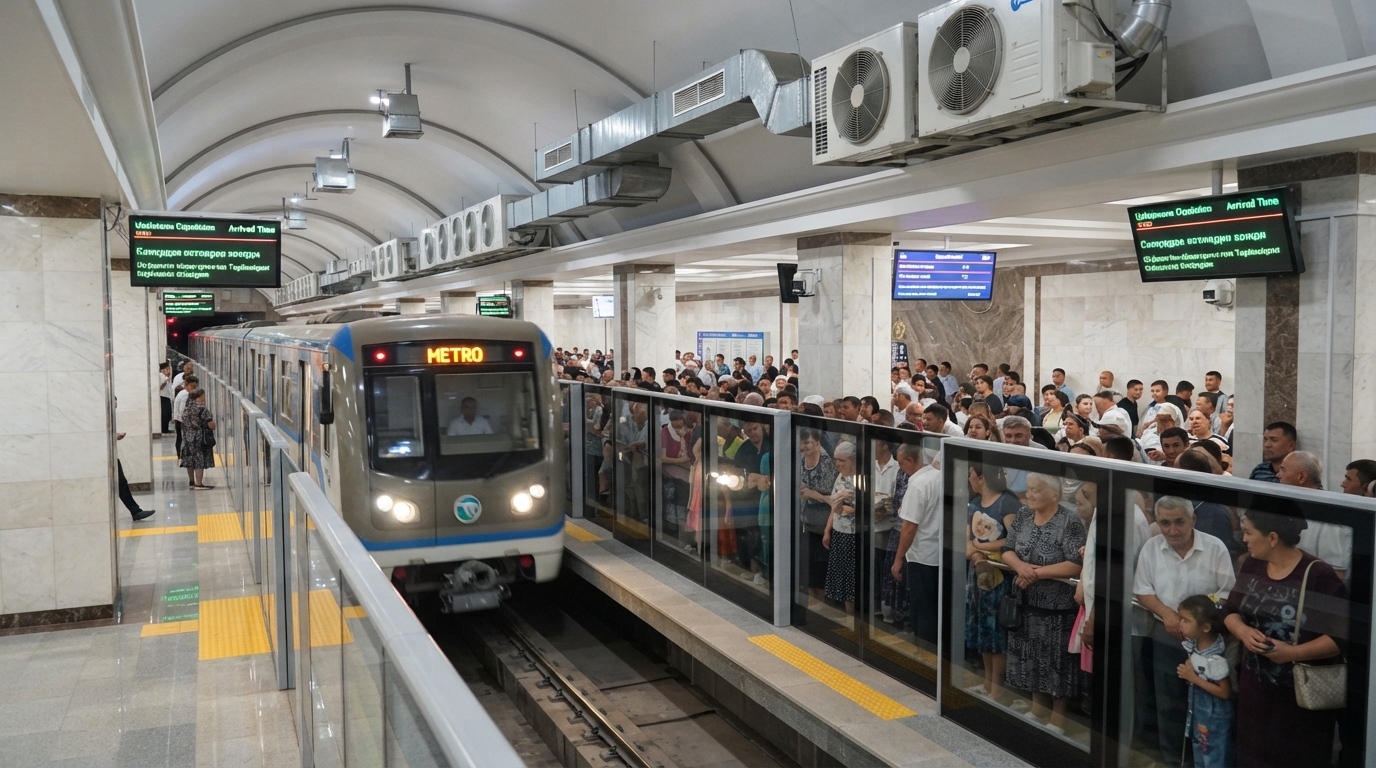
The sharp increase in passenger flow has intensified congestion at certain stations. Videos showing overcrowding at the Alisher Navoiy station are also frequently circulated on social networks. The chief engineer explained this by the simultaneous arrival of trains from two lines and the accumulation of passengers at one station.
Mirhokim Mirhusanov.
"At the Alisher Navoiy station, trains arrive sequentially according to the schedule. When trains from two lines arrive at the same time, the number of passengers increases sharply," says Mirhusanov.
As one of the measures to reduce congestion, it was proposed to add extra cars to the trains. In particular, the possibility of converting existing rolling stock into five-car trains is being considered.
"Currently, we are working on launching five-car trains on each line. The 14 rolling stock purchased from Moscow consist of four cars. We proposed adding an extra car to their composition as a solution," says the chief engineer.
According to him, during peak hours, the interval between trains on the Chilanzar line has been reduced to one and a half minutes. Current technical capabilities do not allow for a shorter interval than this. Up to 28 trains are dispatched to this line during the busiest hours.
Mirhusanov noted that each car is designed for 300 passengers. However, during peak hours, up to 400−500 people try to get into it. Besides creating discomfort for passengers, this also affects the movement of trains.
"We ask our passengers to respect each other and make way for those getting off the train. In many cases, arguments arise due to standing right in front of the door and not letting those getting off pass. Sometimes passengers hold the doors with their hands. Such situations can cause an artificial increase in the train interval," he says.
The chief engineer added that items getting stuck in doors, passengers causing damage to the rolling stock, and malfunctions in escalators also affect the movement schedule. In such situations, train traffic may be temporarily suspended or restricted to ensure safety.
Journalists also asked about the ventilation system in old metro cars not working well, leading to a lack of air, especially for elderly passengers.
Mirhusanov emphasized that the air exchange system exists and is functioning even in old rolling stock. However, the fact that significantly more passengers board the cars than the established norm negatively affects air circulation. According to him, the main time of morning rush hour has also shifted recently, being observed around 07:00—07:30.
The press conference also raised the issues of high air temperature at metro stations in summer, as well as water leakage in certain areas during rain and snow in winter.
According to the chief engineer, the ventilation systems at the stations are working. However, due to climate change and the increase in passenger flow, the possibilities of installing additional cooling equipment at certain busy stations are being studied.
"We see installing a chiller system based on modern technologies at the busiest stations as a solution. Especially at transfer points from one line to another, the passenger flow is very high. We are studying the application of such systems at such points," says Mirhusanov.
He cited Pushkin, Amir Temur, and Bodomzor stations as places that remain cool even in summer due to their natural conditions.
Answering the question regarding water leakage in stations and tunnels, Yuldosh Yusupov emphasized that work is being carried out in cooperation with the relevant public utilities of the Tashkent city khokimiyat to eliminate such cases.
According to Yusupov, 1−2 billion UZS are spent annually on routine repairs of tunnels and structures in the metro. At the same time, 3.3 billion UZS have been allocated from the republic's budget to identify places in need of repair and study the hydrogeological condition.
"Currently, project design and cost estimation documentation has been developed at the expense of these funds. In the next stage, that is, in 2027, it is planned to allocate more than 20 billion UZS for repair work and eliminating problems in tunnels and structures," says Yusupov.
The issue of part of the ceiling collapsing at the "Turon" station in July 2026, the damage caused as a result of the incident, and the restoration of the station were also raised.
According to Yusupov, the causes of the incident are being studied by the client and the construction organization involved in the construction. Although the metro is currently using the Ring Line, the process of fully accepting it into operation has not been completed.
"After the Ring Line is fully commissioned, its maintenance and operation will fall under our responsibility. For now, this situation is being studied by the construction entity and the client," he says.
In connection with the transition to an electronic payment system, it was also asked how much the staff working at metro ticket offices was reduced.
Yuldosh Yusupov reported that during the transition to a cashless payment system, 735 cashier staff units were reduced over the past two years. At the same time, ticket inspector positions consisting of 417 staff units were introduced to monitor passenger payments.
"A portion of the employees under the reduced positions were transferred to other services, while some were provided with other jobs. There are also employees whose workplace changed due to maternity leave and other reasons," says Yusupov.
According to him, a total of 5,826 employees work in the system. 2,068 of them, or 35.5 percent, are women. Currently, 15 women work as train drivers.
According to Yusupov, training is being continued to increase the number of female drivers. It is planned to gradually involve trained employees in driver positions.
Journalists also asked about plans to increase passenger safety at metro stations, including installing glass barriers at the edges of platforms.
According to Yusupov, the initial project for installing such barriers is planned to be implemented at the "Shahriston" station of the Yunusabad line. Design and estimate documentation has been developed and submitted for expertise.
"After receiving the conclusion of the expertise, it is planned to carry out installation works next year by involving specialists from developed countries," says Yusupov.
If this project is found to be effective, the issue of installing safety barriers at other stations with high passenger flow will be considered later.