

Construction of Strategic Importance
26 tunnels and 40 bridges: how the construction of the China–Kyrgyzstan–Uzbekistan railway is progressing in 2026
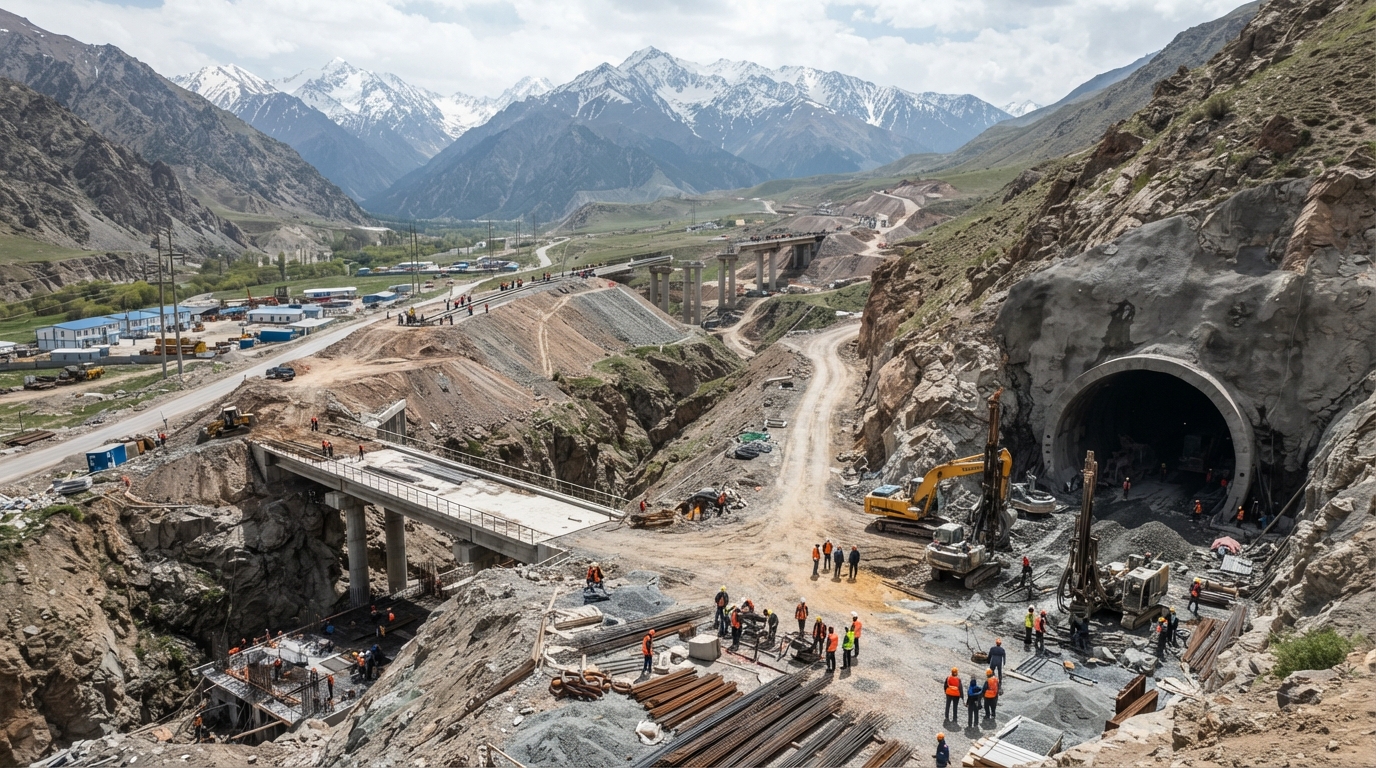
**Construction of Strategic Importance**
The construction of the China–Kyrgyzstan–Uzbekistan (CKU) railway has entered an active phase. The 304.84 km Kyrgyz section will run from the Torugart Pass through Jalal-Abad to the border of Uzbekistan. A representative of China Railway International Co., Ltd. spoke about the current progress of the project, infrastructure facilities, and social initiatives during a Kyrgyz-Chinese press tour in the city of Manas.
The CKU railway is a strategic project for the whole of Central Asia. The new line is designed to connect China and Uzbekistan through Kyrgyzstan, forming the shortest transit corridor. The project provides for the construction of a single-track railway with diesel traction and the possibility of further electrification. The design speed of trains will be up to 120 km/h. On the Kyrgyz section, 20 stations are planned, including the border stations of Torugart and Jalal-Abad, as well as the large Makmal transshipment station.
### What has already been done at the CKU construction site by August 2026
Full-scale construction of the Kyrgyz section started in June 2025. Since then, the pace of work has been constantly increasing. The main indicators today are as follows:
- Temporary access roads and power supply facilities along the entire route have been fully completed and put into operation.
- Tunnels: out of 29 planned, work is underway at 26 sites. One tunnel has already been fully excavated.
- Bridges: construction is underway on 40 out of 50 planned bridges.
- Subgrade: work is being carried out on 83 out of 107 sections.
The railway passes through the Moldotoo, Khailebeit, and Fergana mountain ranges, and also crosses numerous water arteries. Builders have to work in high-altitude conditions, extremely low temperatures, strong winds, and high seismic activity. Additional difficulties are created by high geological stress and areas of permafrost.
A separate technical challenge is the integration of two gauge standards: European (1435 mm) and broad (1520 mm). To work in such conditions, specialists use special technologies for tunneling, bridge construction, and subgrade preparation, as well as modern solutions for water drainage and soil stabilization.
### Jobs and economic impact for Kyrgyzstan
The construction of the CKU has a noticeable impact on the country's economy. According to the project management, the volume of material purchases and equipment rentals on the local market has already exceeded 10 billion soms.
- More than 60% of cement and other construction materials are purchased from local manufacturers.
- Fuel and explosive materials are purchased entirely within the republic.
- More than 1,700 units of machinery and over 1,200 residential premises have been rented for the work.
Special attention is paid to the training of national personnel. Practical classes and advanced training courses have been organized on the basis of three specialized training centers. More than 1,800 local specialists have already completed training.
In total, about 3,000 citizens of Kyrgyzstan are involved in the construction of the railway and related sectors. They are trained in heavy equipment operation, reinforcement and concrete work, geodesy, and strict compliance with safety regulations. The CKU project has become one of the largest employers in the region.
### Social initiatives: assistance to the regions
The CKU project is not just about rails and sleepers. As part of the construction, social programs are being actively implemented in the settlements located along the future route. Since the beginning of 2026, 27 local projects worth 7.73 million yuan (about 100 million soms) have been completed.
The areas of assistance vary:
- 19 projects — infrastructure development (repair of roads, bus stops, drainage channels).
- 3 projects — education and advisory support.
- 5 projects — poverty reduction and humanitarian aid.
For instance, in the village of Molotof in the Ak-Tala district, a 3 km irrigation canal was built and a 3 km water pipeline was laid. This provided clean drinking water to more than 400 residents (118 households). In other districts, canals are being built, and lighting and communication systems are being installed. Local schools are being provided with computers, interactive panels, furniture, textbooks, projectors, and sports equipment.
### Results and prospects
The China–Kyrgyzstan–Uzbekistan railway is a strategic transport corridor. Large-scale work continues on the Kyrgyz section: tunnels, bridges, and subgrade are being built in parallel.
Simultaneously with the railway, regional infrastructure is developing, thousands of jobs are being created, and local residents are gaining access to modern educational and social benefits.