

"Communication is no longer a scarce service"
About seven solutions that Uztelecom initially did not intend to create and how all of them came together on a single screen
"Connectivity is no longer a scarce service"
Until recently, the main question asked to a mobile operator was very simple: when will the internet work well? Today, almost everyone has internet access, and its speed has increased one and a half times in a single year. This issue is off the agenda. At the same time, the role of the telecom operator that we have grown accustomed to is also changing.
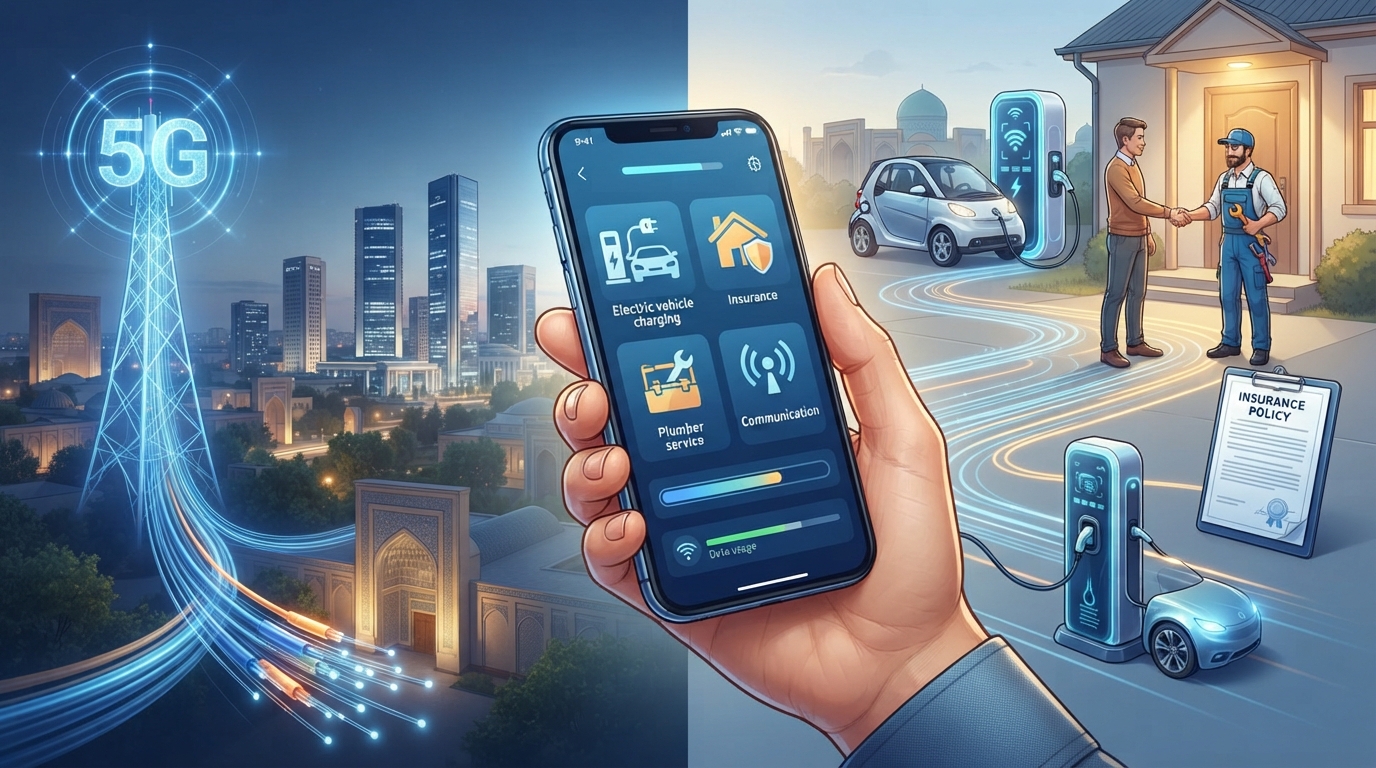
And the most interesting part is just beginning. A company that has been providing telecommunication services for years is now charging electric vehicles, making it possible to issue insurance policies, and even call a plumber to your home. All these services are now gathered in one place — within an application that until recently was opened only to check the account balance.
"Electricity was also once a miracle"
– Around the world, telecommunications seems like an industry that has reached its peak. There is no room left for growth, tariffs are under pressure, and the most interesting processes are happening above the networks — on the side of those creating services on top of them. Do you agree with this description?
– Partially. There is a limit, but it usually doesn't lie where most people think. Connectivity has indeed ceased to be scarce, and people stop being grateful for something that is no longer scarce — such is the fate of any successfully established infrastructure. Electricity was also once a miracle, but today we only remember it when it goes off. Is it frustrating for a company? Perhaps. But in reality, it is proof that the job has been done.
From here, the paths diverge. One can accept it as it is and remain merely a connectivity provider. Or one can think about what else can be built on top of the infrastructure that has already been created. The industry is mainly choosing the second path: almost a third of the revenues of the world's largest operators comes from non-connectivity services — in seven years, their share increased from 18 percent to 28 percent.
It is precisely at this point that it is important not to confuse cause and effect. We did not start searching just to find where else we could make money: the math is different in a state company. There is the "Digital Uzbekistan – 2030" strategy, which in simple language means a very straightforward thing: everyday issues should be resolved equally fast in Tashkent and in Nukus. The services we will discuss below arose not from the search for new revenue streams, but precisely from this need. Solving people's problems comes first, and then the economics. In our case, the reverse order simply does not work.