

How China's mobile economy is moving to a new stage of development
The article analyzes the development of China's mobile economy, the economic impact of 5G and 6G technologies, and the current state of mobile communication and 5G coverage in Uzbekistan.
**How China's Mobile Economy is Entering a New Stage of Development**
In this context, mobile communication is viewed not as an isolated telecommunications sector, but as an infrastructural foundation for the development of industry, artificial intelligence, public services, and energy.
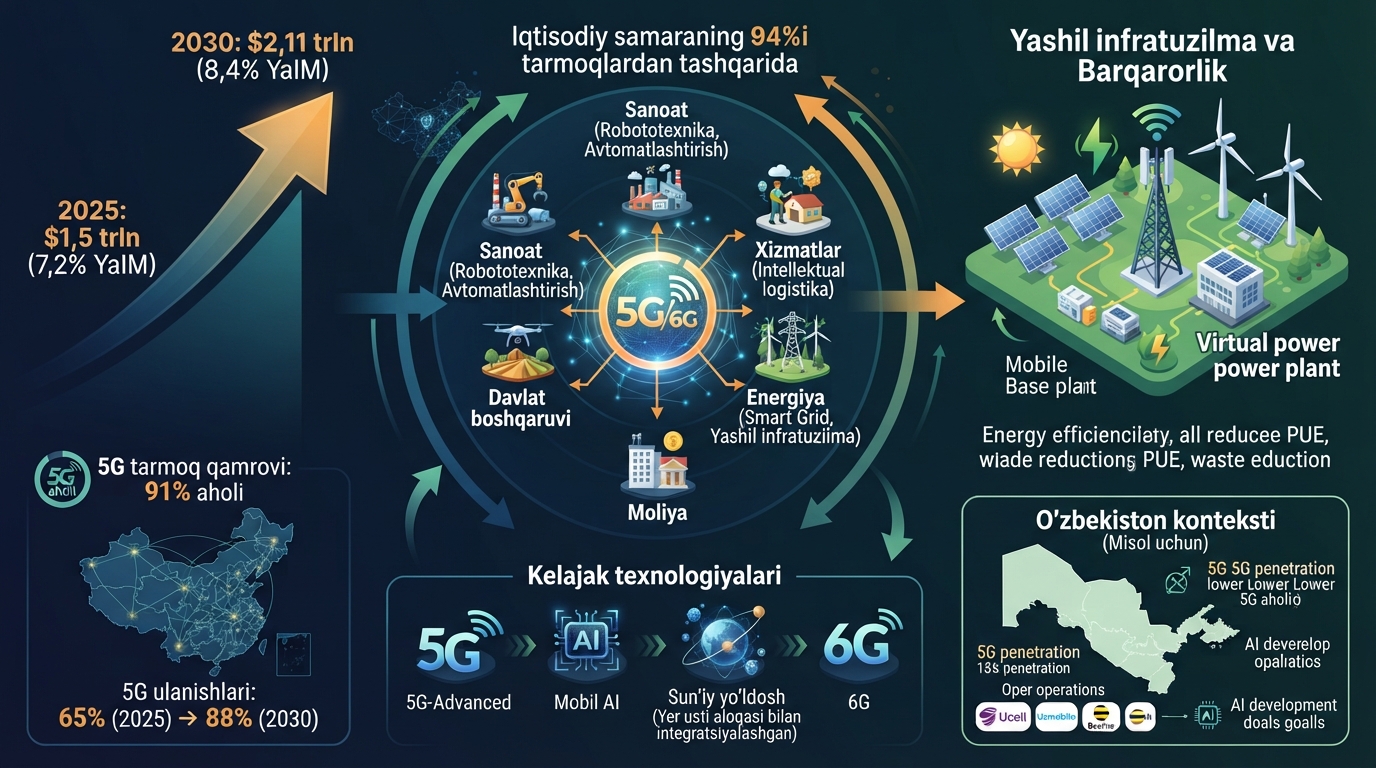
In 2025, mobile technologies contributed **$1.5 trillion** or **7.2%** of GDP to the Chinese economy. By 2030, this figure is expected to reach **$2.11 trillion** or **8.4%** of GDP.
China accounts for **more than 40%** of global 5G connections, and by 2030, their number in the country will exceed **1.7 billion**. Subsequent growth will primarily be driven by the deployment of **5G-Advanced**, mobile artificial intelligence, edge computing, satellite networks, and **6G** technologies. **94%** of the economic impact will occur outside the telecommunications sector, including in industry, services, construction, agriculture, finance, and public administration.
### Macroeconomic Context
In 2025, China's economy grew by **4.7%**, while global economic growth stood at **3.1%**. At the same time, the growth rate slowed down significantly compared to 2021.
The main reasons are related to weak domestic demand, the real estate market crisis, the debt burden of regions, and low investment activity.
In 2026–2030, China is prioritizing domestic demand, technological independence, advanced manufacturing, semiconductors, artificial intelligence, and computing infrastructure. The contribution of mobile technologies to the economy is expected to increase from **$1.5 trillion to $2.11 trillion**, and their share in GDP from **7.2% to 8.4%**. This indicates a transition from expanding communication coverage to a stage of increasing economic productivity.
### Digital Inclusion and the 5G Market
In 2024, **91%** of China's population was covered by the internet. While the gap in network coverage was about **1%**, the gap in actual internet usage remained at **8%**. As a result, priorities are shifting from network construction toward developing digital skills, demand, and the practical use of online services.
The share of 5G connections will reach **88%** by 2030, up from **65%** in 2025. In mainland China, their number will be nearly **1.7 billion**, which is equivalent to almost one-third of global 5G connections. The decline in China's global share will be due to the faster adoption of 5G technologies in other regions, rather than a weakening of the domestic market.
### Operator Revenues, Investments, and Employment
The revenues of Chinese mobile operators will increase by **16.6%**, from **$191 billion** in 2025 to **$222.8 billion** in 2030. Over the five-year period, capital expenditures will amount to **$194.1 billion**.
Operators' revenues are expected to grow by an average of **3.1%** per year, while the overall economic impact of mobile technologies is projected to grow by **7%**. This indicates that the bulk of the added value is created outside the communication network.
In 2025, the mobile ecosystem supported nearly **7.9 million** jobs and generated **$160 billion** in tax revenues, representing **5.8%** of budget revenues. Digitization contributes to the growth of the tax base by expanding employment, electronic payments, and the ability to track economic turnover. The employment figure of **7.9 million** is presented in the GSMA report as the sum of direct and indirect jobs.
### Cross-sectoral Impact and Productivity Growth
In 2025, the direct contribution of China's mobile ecosystem was **$380 billion**, and the indirect contribution was **$130 billion**.
The impact resulting from increased productivity amounted to **$990 billion**, or **66%** of the total result.
The contribution of infrastructure and equipment suppliers was **2.6 times** higher than that of mobile operators.
By 2030, **94%** of the economic impact of mobile technologies will occur outside the telecommunications sector. The contribution of industry and services will be **59%**. The main economic impact of 5G technology will be achieved through its integration with robotics, machine vision, intelligent logistics, and digital manufacturing control systems.
### Satellite Communication and Non-Terrestrial Networks
By the end of 2025, China Telecom served **8.2 million** direct-to-satellite communication users and **more than 26 million** connected devices. The technology was supported in **more than 40** smartphone models. BeiDou satellite services entered the mass market, enabling the transmission of messages, voice, and images.
In 2026, semantic coding technology allowed the transmission of voice and images at a speed of just **2.8 Kbps**. Satellite communication also covered **more than 100,000 vehicles**.
Applications to establish constellations of **more than 200,000** satellites indicate that China is transitioning to a stage of widespread use of satellite technologies in transport, agriculture, energy, and emergency situations.
### "Green" Mobile Infrastructure
In 2025, China's major operators significantly increased the energy efficiency of their digital infrastructure.
China Mobile purchased **5.5 TWh** of "green" energy and saved **15 TWh** of energy, reducing the PUE in data centers to **1.285**.
China Telecom increased its use of clean energy by **56%**, reducing emissions by **more than 16 million tons**. Joint use of networks by China Telecom and China Unicom saves nearly **24 TWh** of electricity annually.
Some data centers operate mostly or entirely on renewable energy sources. A virtual power plant in Zhejiang integrated nearly **8,000** base stations, saving **28.3 million yuan** and reducing emissions by **30,000 tons**.
Telecommunications infrastructure is thus transforming from an energy consumer into one of the tools for managing the energy system.
### Frequency Policy and 6G Prospects
In May 2026, China allocated the **6,425–7,125 MHz** band for **6G** testing. The radio frequency spectrum is viewed as a strategic resource for technological development.
Additional bands of **4.5 GHz** and **7–8 GHz** are planned for consideration in 2027.
The mass deployment of 6G technology is expected to begin **from 2030**. By 2040, the number of connections could exceed **5 billion**, of which nearly **1.6 billion** connections will be in China. To meet the growing demand, the country may require up to an additional **3.7 GHz** of mid-band spectrum.
### Uzbekistan's Mobile Economy
In Uzbekistan, the process of providing basic communication coverage is almost complete.
Nearly **99%** of the population is covered by mobile communication, **98%** by mobile broadband internet, and nearly **97%** by LTE networks.
In 2024, 5G coverage was only **18%**, the share of 5G connections was **4–5%**, and there were about **54.2 thousand** base stations in the network.
At the beginning of 2025, **30.1 million** people used mobile communication services, which means 81 subscribers per 100 people. Active internet subscriptions stood at **109** per 100 people.
In 2025, GDP grew by **7.7%** to **1,849.7 trillion soums**, telecommunication services grew by **8.6%** to **22.6 trillion soums**, and communication and information services grew by **22.7%** to **79.5 trillion soums**.
### 3G/4G/5G Coverage Map
**93–94%** of major operators' traffic is accounted for by 4G. Although 5G has been launched in all regional centers, the coverage level is not uniform.
Ucell serves **more than 11 million** subscribers, Uzmobile nearly **9.2 million**, Mobiuz **more than 8 million**, and Beeline **7.7 million**. Beeline's EBITDA margin is **37.5%**.
Within the framework of the artificial intelligence strategy until 2030, it is planned to bring the volume of products and services to **$1.5 billion**.
The main gap is the lack of a unified calculation system to assess the contribution of mobile technologies to GDP, employment, tax revenues, and labor productivity.