

Coffee, being late, and students with children. What surprises foreign teachers in Uzbekistan
Coffee, Lateness, and Students with Children. What Surprises Foreign Teachers in Uzbekistan
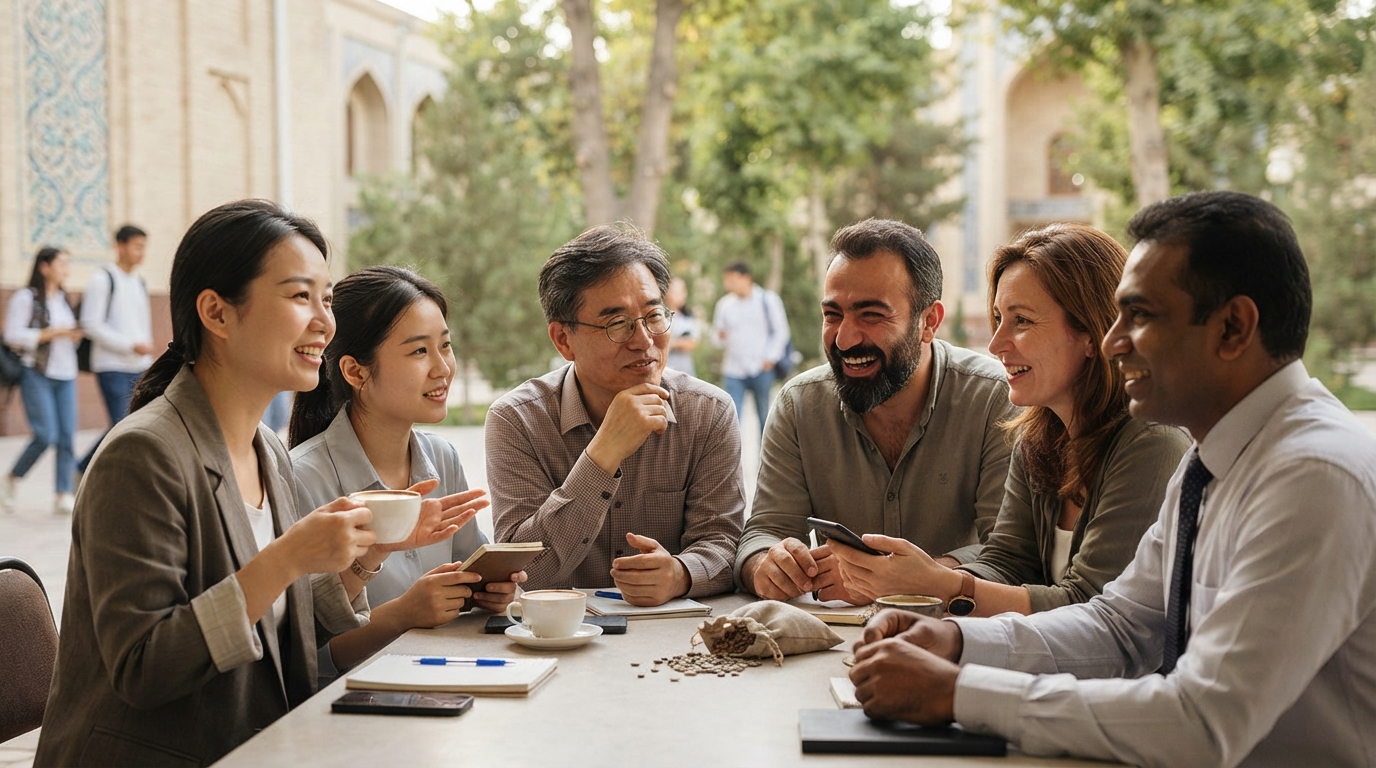
A teacher from China has gotten used to drinking coffee here, a Turkish sociologist carries seeds of Uzbek trees with him, and a professor from South Korea has learned to be more relaxed about lateness. On the eve of Teacher's Day, a Podrobno.uz correspondent spoke with six teachers from three Tashkent universities about what changes the habits of foreign educators and what they themselves learn in Uzbekistan.
## The Number of Foreign Teachers Is Growing
Foreign teachers have long ceased to be a rarity in the education system of Uzbekistan. According to the official response of the Ministry of Preschool and School Education to a request from Podrobno.uz, by mid-September, more than 1.4 thousand foreign specialists from over 40 countries were working in the country's general education schools. More than 35 foreign educators are currently working in Tashkent schools. They teach English, Korean, French, Chinese, German, and Japanese, and also participate in joint language programs.
In the 2026/2027 academic year, the number of foreign specialists in schools is planned to increase to 2 thousand. Looking not just at the current staff but at the entire period of 2023–2026, a total of about 2.2 thousand foreign specialists were attracted to the country's schools, with approximately 1.1 thousand of them in Tashkent. Separately, the ministry notes the results of language training: in the 2025/2026 academic year, more than 10 thousand eleventh-graders in the capital who participated in foreign language proficiency assessments demonstrated a level of B1 and higher.
Our protagonists do not work in schools, but in universities. Therefore, the official figures here indicate the scale rather than describe their specific environment. We deliberately did not try to reduce the six interviewees to a single "portrait of a foreign teacher." On the contrary, it turned out to be more interesting to see how different the paths to one city can be: some came on assignment, some followed their family, some had been looking for Central Asia for many years, and some simply chose between several job offers.
## University of World Languages
At the Uzbekistan State University of World Languages, we met three protagonists at once. Two female teachers came from China, and Professor Na Sam-il came from South Korea. All three work with language, but it quickly becomes clear: language in their classes is only the first layer. Beyond it begin conversations about family habits, discipline, food, attitude toward time, and how quickly a student adopts part of the teacher's culture — and the teacher, part of the student's culture.
### Ma Lei: Wanted to Be Strict, but Decided to Become a Friend to Her Students
Ma Lei comes from Hebei Province. In China, she studied Russian — it was this specialization that eventually brought her to Uzbekistan for the first time. She arrived in Tashkent back in 2018, worked at a cultural center, and taught Chinese. Then she left for China, returned again, met her future husband here, and gradually connected not only her profession but also her family with the city.
Her husband is also Chinese and knows Russian. Many years ago, he moved to Uzbekistan with his parents and later started a business. This is where they met. After the birth of her children, Ma Lei temporarily dropped out of the working rhythm. When the department started calling her and inviting her to the university, she initially refused: the children were small. Then she caught herself thinking that all her decisions had long been made only around her family.
"I thought, I need to start thinking about myself. What I need, what to do, not just think about the children. Then I decided — I will work here," she recalls.
Her first lesson was not easy. Ma Lei admits she was afraid of making mistakes in Russian. But the students, according to her, helped her relieve the tension. Over time, the fear went away, and with it, the initial plan to be a "strict Chinese teacher" disappeared.
"In China, teachers are very strict. When I first moved here, I thought: if I am strict, they will listen to me. But it is very difficult for me to scold them. Most of all, I wanted to become friends with them," says the teacher.
At the same time, she does not lower the academic bar. In the first year, she helps students with Russian, and already in the second year, she tries to conduct classes only in Chinese. "They understand everything. They are very smart and always try hard," says Ma Lei.
She noticed one of the first cultural differences not in textbooks, but in the personal lives of her students. Ma Lei was surprised that some of the girls get married while still studying. In her Chinese university experience, it was different: students usually finished their education first and only then thought about marriage, moving, or family.
An even more memorable moment was a simple conversation with a student. He said that he had given his younger brother about 100 dollars and did not expect it back. Ma Lei asked why he did not consider this money a debt. "He said: he is my little brother. I have to help him," she recalls. For the teacher, this became one of the clearest explanations of the place family occupies in the local culture.
Tashkent changed her in small ways too. Before moving, Ma Lei hardly drank coffee. Then she saw how colleagues easily replaced a full lunch with coffee, bread, salad, or somsa. For someone from a culture where, in her words, "eating is the main thing," such a working rhythm seemed strange. Now she can spend her day in much the same way.
Ma Lei's children are growing up between two languages: Chinese is their native tongue, while Russian came from the Tashkent environment and became so natural that they freely mix both. Family is one of the reasons why the teacher is not considering a quick departure. The second is the work itself. She says she has gotten used to the university, loves her students, and especially values the department, where colleagues help each other. When an acquaintance from China asked if it was worth going to work in Uzbekistan, Ma Lei answered without long preambles: it is worth at least coming and seeing.
Ma Lei came to the university through family and her own knowledge of Russian. Lyu Xiaomei's story is structured almost the opposite way: she arrived from Beijing on a professional assignment and from day one looked at Tashkent primarily as a new audience.
### Lyu Xiaomei: "By Loving Me, They Also Fell in Love with the Chinese Language"
Lyu Xiaomei arrived in Uzbekistan in 2022. Before that, she worked in Beijing, and she was sent to Tashkent by the Chinese side. At the University of World Languages, she teaches Chinese and quickly noticed a feature that changes a lot for a language teacher: a significant portion of the students already live in several language environments at once.
According to her observations, Uzbek students often speak Uzbek, Russian, and English, and some study Turkish or Arabic in parallel. Lyu Xiaomei admits that study habits differ from Chinese ones, and Chinese students seem more diligent to her, but she singles out the local students for their readiness to communicate and try new languages.
She remembers her first lesson not by the curriculum. She remembers the faces. The students, the teacher says, looked at her "full of curiosity" and wanted to know not only the rules of Chinese but also what lies behind them — another country, culture, history, and daily life.
"The deepest impression on me was made by the fact that they show enthusiasm and love for me. By loving me, they also fell in love with the Chinese language," says Lyu Xiaomei.
Due to classroom conditions, part of the usual methodology had to be restructured. Where there is a lack of multimedia equipment, she combines online and offline tools and tries not to turn the language into mechanical memorization. Her principle sounds simple: the material must be understandable, fun, and easy to remember.
She also has specific reasons to be proud. According to Lyu Xiaomei, some students received the HSK 4 certificate in one year, and individual sophomores reached HSK 5 and the HSKK oral exam. She directly calls two of her groups the best in the year.
But the most interesting part of her story appears where the roles are reversed. "They teach me Uzbek and Russian, and in return, I teach them Chinese. We help each other and make progress together," says the teacher.
If ten years from now students remember only one thing about her, Lyu Xiaomei would like it to be love and friendship. And if one day she has to return to China, she plans to take away not only new words in Russian and Uzbek, but also an experience that cannot be packed in a suitcase: the memory of groups with whom the language gradually ceased to be just a school subject.
For the two Chinese teachers, adaptation is built around language and closeness with students. Na Sam-il from South Korea faced a difference much earlier — literally in the first minutes of his first class.
### Na Sam-il: 26 Students on the List, Three People in the Classroom
Professor Na Sam-il teaches Korean at the Department of Korean Studies and supervises student theses. His interest in Central Asia appeared even before Uzbekistan. As the chairman of a scientific society in Korea, he participated in an international conference in Kyrgyzstan, then worked for a week with Korean language teachers in Kazakhstan, and thought more and more about how he would like to engage here not only in language but also in the methodology of training teachers themselves.
His first major experience in Uzbekistan was in Fergana, where he taught at the Korean International University. Later, the professor moved to Tashkent and continued his work at the University of World Languages. He says that he is still kept here by his interest in the education system and the desire to "guide students correctly."
He remembers his first lesson in the country all too well. There were about 26 people on the list. When it was time to start, three or four people were sitting in the classroom. The rest pulled in one by one. But he was surprised not so much by the lateness as by the entry into the classroom itself.
In Korea, Na Sam-il explains, a late student tries to walk to their seat as quietly as possible. Here, students walked in, said hello, called out to acquaintances, hugged, talked — and only after that sat down.
"I found it amusing. At first, I was a little confused. Then I realized that this is also a culture, just one unfamiliar to me," the professor recalls.
Accepting the culture does not mean giving up his own rules for him. Na Sam-il continued to demand that students arrive for classes on time. Now, he says, the problem has practically disappeared. "Guiding and leading them is also part of education," the teacher explains.
His attitude toward time outside the classroom has changed much more. In Korea, the punctuality of agreements was almost automatic for him: an appointment is made — meaning everyone arrives on time. In Uzbekistan, he encountered a more relaxed rhythm and initially took it painfully. Then he came up with a formula that became almost a personal philosophy.
"The aesthetics of waiting, the aesthetics of slowness. I am understanding this anew," says Na Sam-il. Now he tries to perceive waiting not as wasted time, but as part of the environment in which he lives.
Food became another separate school. Before arriving, the professor knew almost nothing about plov, somsa, and shashlik. Plov initially seemed too greasy, and meat without a large amount of vegetables was unusual. Gradually, tastes changed, although he retained his Korean caution: in plov, he still tries to leave the greasiest pieces, and adds vegetables to shashlik whenever possible.
Yet, Na Sam-il's strongest impression of the country is connected neither with food nor with punctuality. In Fergana, he was struck by how strangers, hearing that he was from Korea, came up to talk and offered help. In Tashkent, this was joined by a sense of safety and the comfort of a big city. To acquaintances in Korea who ask about Uzbekistan, he answers briefly: "Come, don't worry."
One day, the professor would like to take Uzbek ceramics — lyagans, cups, and painted tableware — back home to Daejeon. He likes their colors and shapes, and he is sure that Korean friends will like such things. But judging by his story, the main souvenir will not be ceramics. A man who came from a culture of precision has already learned to wait sometimes.
At the University of World Languages, a foreign teacher works literally every day on the border of cultures. For Musa Yavuz Alptekin from the University of Journalism and Mass Communications, this border began even before the first lecture: for many years, he perceived Central Asia as a place connected with his own history.
## University of Journalism and Mass Communications
### Musa Yavuz Alptekin: A Sociologist Who Collects Seeds by the Roadside
Musa Yavuz Alptekin is an associate professor and PhD from Karadeniz Technical University in Turkey, who currently works at UZJOKU in Tashkent. Before moving, he taught in Turkey for 18 years and visited universities in the US, UK, Malaysia, Germany, and other countries. But for many years, he kept Central Asia in mind as a separate destination.
"I was very curious to learn about Central Asia, especially Uzbekistan. For years, I thought about coming here," he says.
In 2023, the interest turned into a decision. Alptekin wanted to teach sociology and pass on to local students the knowledge he had accumulated in Turkey and abroad. But there was also a personal reason. He perceived Uzbekistan as part of the space with which his historical roots are connected.
"I taught for 18 years in Turkey, and it became a bit monotonous. I wanted to change my life. Uzbekistan was an important country for me because my national roots were here. I wanted to see the lands where my ancestors lived," says the teacher.
The plan was cautious: to live here for at least a year. Then Tashkent unexpectedly reminded him of Ankara, he liked the people, and his own students appeared. Thus, one year gradually stretched out. Now Alptekin is already talking about his fourth year in Uzbekistan.
He saw the first serious difference from Turkey in the students' attitude toward the teacher. Alptekin calls the local youth sincere and particularly notes their respect for educators. It was also surprising how much family remains a part of university life: some students come together with their parents, and among the girls, there are those who get married and become mothers while still studying.
He was even more impressed by the languages. Many students, Alptekin says, freely switch between Uzbek, Russian, and English, so the next language comes easier to them. He even believes that some Uzbek students speak English more confidently than many of his students in Turkey.
Musa himself also had to adapt. In Uzbekistan, he began using Uzbek in classes, and made his teaching much more visual: more presentations, materials on the screen, and less purely oral lecturing.
Despite all the differences, one thing, in his opinion, has no nationality. "Students are students. They want to work less but get the highest grade," Alptekin laughs.
But following this joke, he lists the things that local students have taught him: kindness, helping others, and respect. It is this, and not academic performance, that he calls the most important part of his experience several times.
When asked what students should remember about him in ten years, Musa answers almost without a pause: it is important to him that they understand he did not come here for a salary. "Not for money, not for material things, but out of cultural, civilizational, humanistic motives. If they remember this, I will be happy."
And the most unusual answer appears when we ask what he will take home one day. Traveling around Uzbekistan, the teacher noticed tree seeds on the roadsides and began collecting them in his bag. He still carries several with him. He plans to take them to Turkey, distribute them to friends, and say: "If you want to grow a Turkestan tree in your garden, plant it." This is perhaps the most literal way to take a piece of the country with him.
Musa came to Uzbekistan because he had wanted to come here for many years. For the two teachers at Ajou University, the starting points are completely different.
## Ajou University
### Natalia Wisely: A Surname from Ireland, a Second Marriage, and a New Life in Tashkent
Natalia Nikolaevna Wisely comes from Kazakhstan. Her surname indeed sounds unexpected for Central Asia, and it was immediately noticed at the university. Natalia explains this simply: the surname remained from her first husband from Ireland. Later, her life changed — she married again, this time a man from Uzbekistan, and it was this new marriage that eventually brought her to Tashkent.
Before that, Natalia lived and taught abroad for many years. Her biography includes the United Arab Emirates, Kuwait, and Saudi Arabia. She worked with music, acting, and drama, and taught in various educational systems — from British programs and the International Baccalaureate to Montessori. In Kazakhstan, she worked in a professional music school.
In Tashkent, everything had to be started from scratch. Natalia found the vacancy at this university not through an international agency or an academic recommendation, but on OLX. She applied, came for an interview, and got the job. Now she runs the Dance Club and the Music Club.
This is her first experience of living in Uzbekistan, so her story contains many observations of a person who is still putting the city together piece by piece. She studies bus routes, travels with her husband to new places, takes photos of Tashkent, and posts them in her statuses. Friends from Kazakhstan, the Emirates, and Kuwait then ask what these places are and why the city looks so beautiful.
The first thing she noticed at the university was the attitude toward a new person. "Friendliness. They will always listen, suggest, and help. In all this time, there has not been a single instance where I needed help and it was not provided," says Natalia.
Despite the new city and the new audience, she did not change her own methodology. Over the years of working in different countries, she has developed a principle that, in her opinion, is almost independent of nationality.
"Children are the same everywhere. You need to interest them, captivate them — and then they open up completely," the teacher explains.
She calls encouragement her main tool. A student receives new material, copes with it, immediately feels that the teacher has noticed this, and wants to move forward. For Natalia, this chain works in music, in dance, and in the most diverse school systems where she has had the opportunity to work.
At the same time, she is learning too. Local students, Natalia says, have made her react faster to what is happening. "They taught me to think faster, adapt to the situation, and make decisions faster. We are already the old guard, and they are young — you have to keep up with the rhythm of life."
From her daily impressions, she particularly remembers the cleanliness of the streets and parks. Natalia compares this with the Middle East, where cleaning is often done by specially brought-in workers, and notes that in Tashkent she sees how the residents themselves look after the space. It is important that she is talking specifically about the cleanliness of the streets, and not about ecology — she clarifies this separately in the conversation.
In her home life, new tastes have also appeared. Chinese-Uyghur cuisine, which Natalia managed to fall in love with, has become a staple in the family. For now, she links her future with Tashkent: her husband is here, she has a new job, and there is a feeling that the city has not yet finished its first acquaintance.
For Natalia, her profession has changed her country of residence with her many times. For Arshad, it is the opposite: no matter how many countries changed around him, teaching remained a family constant.
### Arshad: "They Are Adults, but for a Teacher, They Are Still Children"
Arshad Syed Muhammad Bukhari Muhammad comes from Sri Lanka and has been teaching English for about 20 years. He has been working at Ajou for three years. Before Uzbekistan, there was Qatar, and during the pandemic, online classes with students from Russia, Japan, China, and other countries. Therefore, he has long ceased to fear a new audience as such.
After COVID, Arshad decided to look for work abroad again and received several offers — from China, Vietnam, and Uzbekistan. He chose Tashkent. Quite serious and very everyday things mixed in his decision: reviews from acquaintances, a sense of safety, and food. Arshad is a Muslim, and it was important for him not to think every day about where to find suitable food. A friend in Uzbekistan explained in advance that there would be no problems with this.
True, food quickly turned into another problem. Arshad laughs that in the first months he got too carried away with Uzbek cuisine and gained noticeable weight. He recalls this episode as perhaps the main everyday difficulty of adaptation.
He praises the university itself for its infrastructure: classrooms, desks, lighting, smart boards, and the general organization of space. He saw similar conditions in Qatar, but by no means in all the Asian countries he has visited.
He deliberately does not idealize the students. There are highly motivated ones, and there are those who would like less homework. For the teacher, this is not a national characteristic, but a common theory of individual differences: people learn differently, and the teacher's task is to understand who is in front of them.
Arshad is particularly pleased with students who come up with ideas themselves. On the day of our interview, several people suggested relaunching the debate and book clubs. Previously, such clubs existed but gradually faded away. Now the initiative has returned from the ground up. Other students suggest conducting part of the classes outside — there are places on the campus territory where a group can sit and work instead of being in a classroom.
"There are students who are very diligent, inquisitive, want to look for scholarships, study abroad, work in big companies, or start a business. I really want to help them in every possible way so that their dreams come true," says the teacher.
Arshad did not choose his profession by accident. His father was a teacher and a school principal. His older brother also taught, and his second brother worked as a teacher for some time after university, although he later became an engineer. In this family, teaching looks almost like an inherited craft.
Hence his main message to students. He constantly tells them about the price of education, not in money, but in time. University age cannot be put aside and then lived through again. "If a person wastes this period, they will no longer be able to return to this age to study," says Arshad.
He sometimes calls students "adult children." Not because he does not consider them independent, but because he recognizes the familiar student mindset in any country: understanding that studying is important does not always mean readiness to actually engage in it. Then the teacher's task, according to him, goes far beyond English — you need to help the person understand why they are studying at all and where it can lead them.
Over the years in Uzbekistan, Arshad has made close acquaintances in Tashkent and Karshi. His family has visited here, and a whole collection of things from Samarkand, Bukhara, and the capital has already gone home: chapan coats, adras, doppi caps, and clothes for his sons. But if you put the souvenirs aside, he still names something else first: "Good memories and wonderful friendship."
## So Why Does Uzbekistan Attract Foreigners?
These six stories do not add up to one convenient conclusion — and that is precisely why they work. Educators describe Uzbek students in different ways. For one, the main thing is respect for the teacher; for another, language flexibility; for a third, curiosity; for a fourth, the speed of the new generation. Some notice the strong role of the family, some the habit of being late, some the desire to get a high grade with minimal effort. These are not contradictions. These are six classrooms, six biographies, and six points of view.
And in almost every conversation, at some point, the roles reversed. We asked the foreign teacher what they teach here. And in response, we heard what they themselves were taught here: to drink coffee, to make decisions faster, to wait, to speak Uzbek, to look more closely at family, or simply to be more relaxed about someone else's rhythm.
Perhaps this is the most important conclusion for Teacher's Day. A person arrives in another country, enters a classroom, and stands at the board. And a few years later, they discover that some of the most important lessons were received not by them from a textbook — but from those who sat opposite.