

Classes have started for first-year university students. Gazeta prepared a report from the streets of Tashkent.
From September 7, classes started for first-year university students. In the city of Tashkent, the first-shift classes were moved to 8:00. Meanwhile, the flow of passengers in public transport has slightly increased. A Gazeta correspondent spoke with students and drivers and prepared a report from the streets of Tashkent.
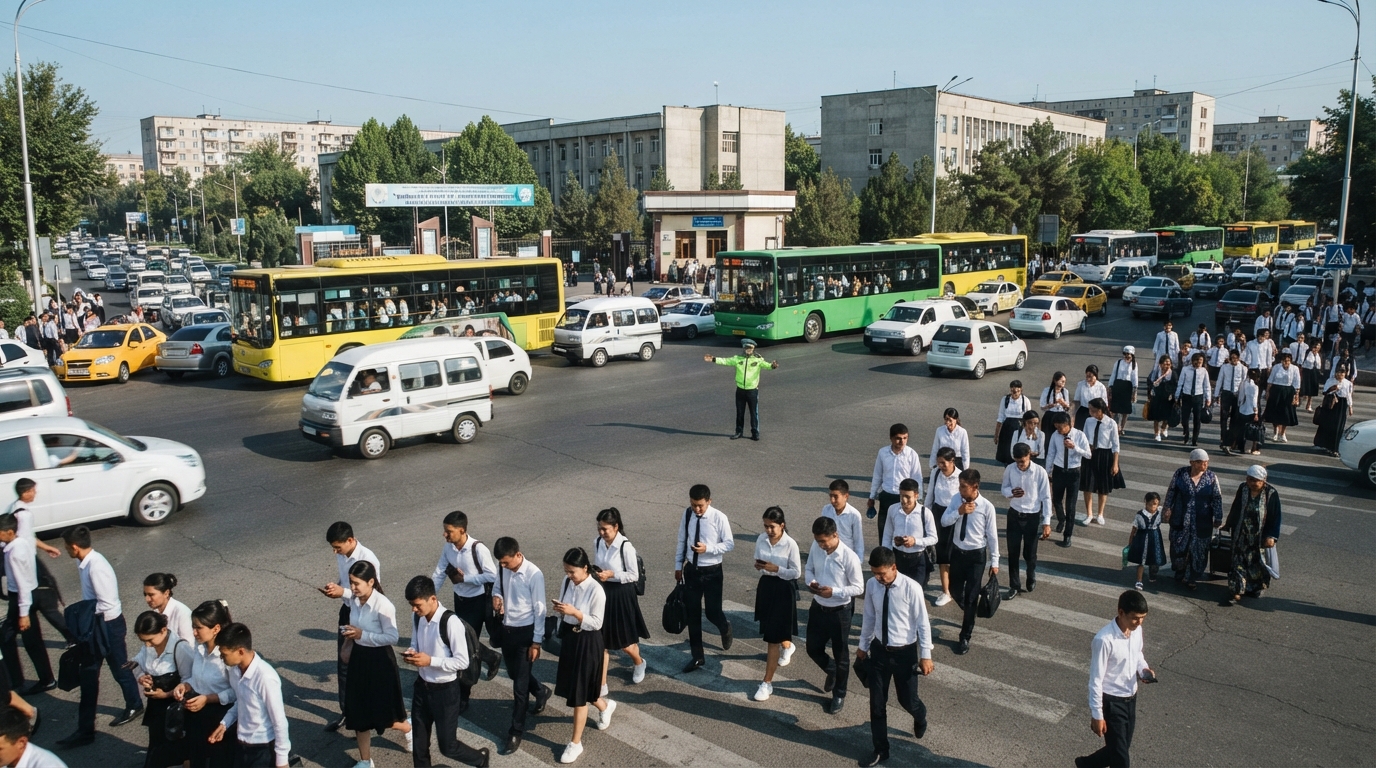
Classes have started for first-year university students. Gazeta prepared a report from the streets of Tashkent
On September 7, the educational process commenced in higher education institutions. However, for now, this is only for first-year students. Upper-year students will start attending classes on September 14. At the same time, starting from the 2026/2027 academic year, first-shift classes in higher education organizations in the city of Tashkent will begin at 8:00 AM.
With the start of the academic year, long traffic jams on the roads and overcrowding in public transport are usually observed. Gazeta correspondent Otabek Turdiyev walked through the streets of Tashkent, spoke with students and drivers, and observed how the first day of classes was going at universities.
Around 07:00 AM, I went down to the "Choshtepa" station of the Chilonzor metro line. It was noticeable that there were slightly more passengers than usual. Among them, those in black-and-white uniforms were in the majority. I let two trains pass and boarded the third one.
In this manner, I got off at "Paxtakor" and observed the flow of passengers between it and the "Alisher Navoiy" station. It was approaching 08:00 AM. Movement did not stop at both stations. The flow of people on the escalators was continuous.
Above ground, traffic was also heavy on Botir Zokirov and Alisher Navoiy streets. Although the traffic light was working, a traffic police officer was regulating the movement in the middle of the intersection.
Following the students, I boarded bus No. 91. Its driver, Ruslan Saidahmedov, says that he set out early in the morning at 07:15 AM, and the bus immediately filled up with students. According to him, the crowding on the bus decreased slightly after 08:00 AM.
The bus stopped, and I got off opposite TUIT (Tashkent University of Information Technologies). Here, first-year students were being sorted according to their fields of study. Parents of young men and women who came from afar were also with them.
Eldor Sahatov, who came from the Olot district of the Bukhara region, said his son was admitted to the marketing department on a contract basis. The father and son set off by bus the previous evening and arrived in Tashkent in the morning. They reached the university via the metro.
"Now my son is getting acquainted with the university environment. Once I arrange his dormitory, I will return to Bukhara. However, during his school years, private universities had taken my son's data, so his information is not appearing for dormitory placement. Now, they are resolving the issue of deleting the data from there over the phone and transferring it to this university. It seems this is not happening only to my son; others are also dealing with this issue," says Eldor Sahatov.
Around 10:00 AM, I went down to the "Minor" metro station. There were relatively fewer people here. The inside of the train was also not very crowded.
Then I visited the "Yunus Rajabiy" and "Amir Temur xiyoboni" stations. These stations are usually crowded and busy. The situation was the same at around 10:30 AM.
I walked around the Amir Temur Square; there were mostly tourists there. On the Broadway side, I met students of the Tashkent State University of Law. They were getting acquainted with the university environment.
Aziz Ismoilov from Samarkand entered the "Criminal Law" department of TSUL on a super-contract basis. He will pay 270 million soums for the first year, and 23 million soums from the following year. Aziz was told that if he pays 50 percent of the 270 million soums now, he can start classes in October.
He arrived from Samarkand the day before by taxi for 250,000 soums. Before coming to Tashkent, he found an apartment online for himself and two friends: near the "Novza" metro station, two-room, with all amenities, priced at 700 USD.
Aziz did not hide that he usually wakes up at 10:00 AM in the mornings. On his first day of study, to arrive on time, i.e., by 08:00 AM, he woke up at 05:00 AM, set out at 06:00 AM, and arrived at the university at 07:30 AM. According to Aziz, now even waking up at 06:00 AM, he can arrive for classes on time. However, if he does not wear a white shirt, a suit, and a tie, no matter how early he arrives, he cannot enter the class. Because that is the rule.
Around 11:30 AM, I walked around Sharof Rashidov Avenue for a bit. There was almost no change in the movement of cars and pedestrians; everything was as usual.
After 12:00 PM, I headed to the "Chilonzor" metro station. At this time, first-shift classes at universities end. The Nizami Pedagogical University is located at the intersection of Bunyodkor Avenue and the Little Ring Road. This intersection has always been busy.
There were also more passengers than usual at the "Chilonzor" bus stop. My attention was drawn to about 5–6 bus controllers working at this very stop. They were checking whether the passengers getting off the bus had paid or not.
Starting from September 1, passengers on all public buses are required to pay the fare at the very beginning of the journey. Controllers will now also monitor fare payment inside the buses.
The controllers work in two shifts — from 07:00 AM to 01:00 PM, and from 01:00 PM to 09:00 PM. If there are few passengers, the controller can also conduct checks among passengers inside the bus.
"Why should payment be made upon boarding the bus? Because when we check the passenger's card using a tablet, it takes at least 2–3 minutes, at most 4–5 minutes, for the payment information to appear. This prevents misunderstandings. Furthermore, when a card that has already been paid with is touched to the validator a second time, a question like 'Do you want to pay again?' appears on the screen. All validators on the bus operate with a single 'brain'," says controller Ja'far Qodirov.
When the controller checks your card, the history of your payments for public transport over a month is also displayed on the tablet. Additionally, the staff are equipped with body cameras.
To check the traffic jams on the roads, I took a taxi at around 01:50 PM. The driver, originally from Jizzakh, had come to Tashkent and was working as a taxi driver today for the first time. He said there was "quite a traffic jam" from Jizzakh until entering Tashkent.
According to the taxi driver, he worked for 1.5 years near a seaport in the Russian city of Saint Petersburg. Since Ukrainian drones kept attacking there, he decided to return home.
"My documents were in order. Young men without documents were being taken to the war if they didn't pay 500–1000 dollars. Their police are very Nazi. When I came to Uzbekistan, I felt like hugging our own police. I will never go back to such places again," says my interlocutor.
We said goodbye near the "Beruniy" metro station. In early September, a video circulated showing this station being so crowded that people could not move. Later, the metro administration stated that this was the situation in 2024.
At around 02:35 PM, although not like in the video, there were a lot of people. They were waiting in line in several rows in front of the platform. In my opinion, the main reason for this is that passengers wait a long time for the train to arrive. At that moment, I witnessed the train arriving after 7 minutes. Due to the passengers getting off the train coming from the opposite direction, the metro became crowded in an instant.
From September 14, classes will also start for 2nd, 3rd, and 4th-year university students. This might well increase the current traffic jams threefold.
As evening began to fall, I called a taxi at 07:00 PM to return home. We reached Beshyogoch neighborhood from Parkent Street at around 07:50 PM. We also got stuck in long traffic jams several times on the roads.