

China plans to build a 74,000-ton self-propelled scientific "island" in the ocean
In China, a contract has been signed for the construction of a self-propelled floating scientific platform with a displacement of 74 thousand tons, designed for long-term deep-ocean exploration. It will house six laboratories and accommodate 238 people, including the crew and researchers.
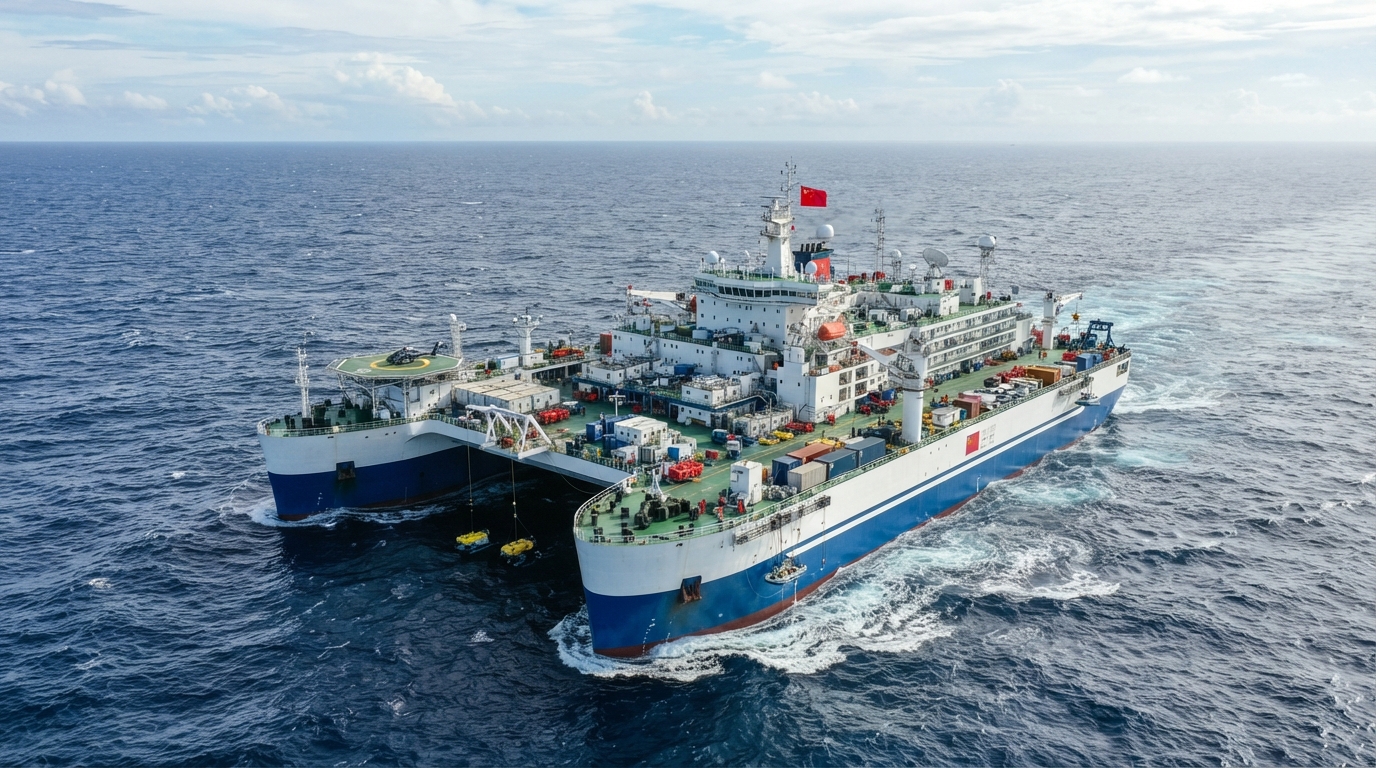
China to build 74,000-ton self-propelled scientific "island" in the ocean
The project is presented as the world's first floating artificial "island" specially created for this type of research. It is expected to combine the capabilities of a large scientific complex with the mobility of a ship.
The platform will be used by Shanghai Jiao Tong University. Its design and construction have been entrusted to Shanghai Waigaoqiao Shipbuilding, a subsidiary of China State Shipbuilding Corporation (CSSC).
Construction is scheduled to begin in 2028, and the finished platform is expected to be delivered to the customer in June 2030.
138 meters long, 85 meters wide
The platform will feature a catamaran twin-hull layout and a semi-submersible main structure. According to the design, it will be 138 meters long and 85 meters wide. The maximum travel speed is projected to reach nearly 20 kilometers per hour.
The twin-hull structure is intended to ensure stability during long-term operations in the open sea.
According to technical requirements, the platform must be able to operate in sea states up to seven on the international scale. Under such conditions, the significant wave height is approximately 6–9 meters.
The structure is also designed to withstand strong typhoons with sustained winds exceeding 260 kilometers per hour.
One of the main features of the platform is its capacity for autonomous navigation. Unlike offshore structures permanently fixed to a single point, it can move from one area to another depending on scientific objectives.
Onboard laboratories, living quarters, and a spacious work deck are expected to allow scientists to conduct long-term research in the open sea without frequent returns to port.
The scientific complex is planned for testing heavy marine equipment and engineering systems, studying hazardous marine phenomena, meteorology, as well as long-term changes in ocean ecosystems.
The research will cover both deep-sea operation technologies and natural processes affecting the condition of the World Ocean.