

China leads in mathematics, Singapore in reading - PISA results announced
In the PISA 2025 international assessment, China's Beijing, Shanghai, Jiangsu, and Zhejiang regions recorded the highest results in mathematics and science. Meanwhile, Singapore took first place in reading literacy. At the same time, a decline in students' basic skills is being observed in many developed countries.
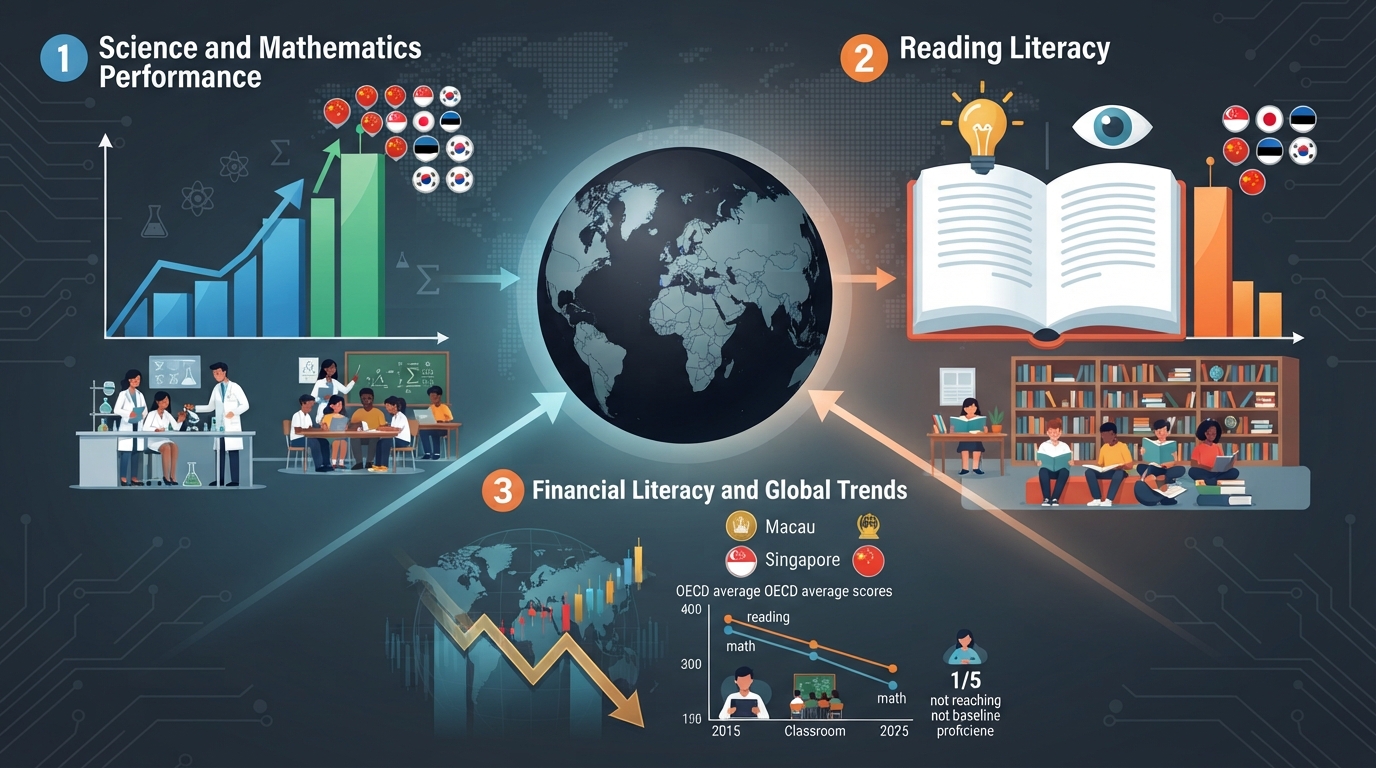
China leads in mathematics, while Singapore tops reading literacy — PISA results announced
The Organisation for Economic Co-operation and Development — OECD published the report in September 2026. Over 760 thousand 15-year-old students from 91 countries and economies participated in the study. Their skills in science, mathematics, reading literacy, and computational problem-solving were assessed.
The four participating regions of China scored 597 points in science and 612 points in mathematics. In Singapore, these figures stood at 560 and 563 points, respectively. In reading literacy, Singapore took the lead with 535 points.
In computational problem-solving, Macao came out ahead with 572 points. Singapore scored 563 points, while the four regions of China gathered 560 points.
Japan, Estonia, and South Korea were also among the top-performing countries. In science, Japan scored 538, Estonia 527, and South Korea 526 points. Good results in this area were also recorded in the United Kingdom, Canada, New Zealand, Australia, and Finland.
At the same time, it is not correct to interpret PISA results as a single overall ranking of educational systems. The assessment compares students' knowledge and skills in individual areas. A country may demonstrate high results in mathematics while holding a different position in reading literacy.
A concerning aspect in the report is the decline of basic learning skills in many developed countries. Between 2015 and 2025, the OECD average score dropped by 28 points in reading literacy and by 22 points in mathematics. The decline in science was relatively smaller.
In OECD countries, roughly every fifth student failed to reach the basic level of proficiency in any of the three main areas — science, reading, and mathematics. In 2022, the share of such students was 16 percent.
The OECD emphasized the need to strengthen basic learning skills, improve teaching quality, and reduce classroom distractions caused by digital devices. Even as technology plays an increasingly important role, reading, comprehension, and numeracy skills remain the foundation of education.