

Central Asia lacks not water, but readiness for its scarcity
Almost four out of five residents of Central Asia depend on transboundary water systems. At the same time, severe droughts in certain parts of the region recur every five to six years, and the water sector lacks up to $2.6 billion in investment.
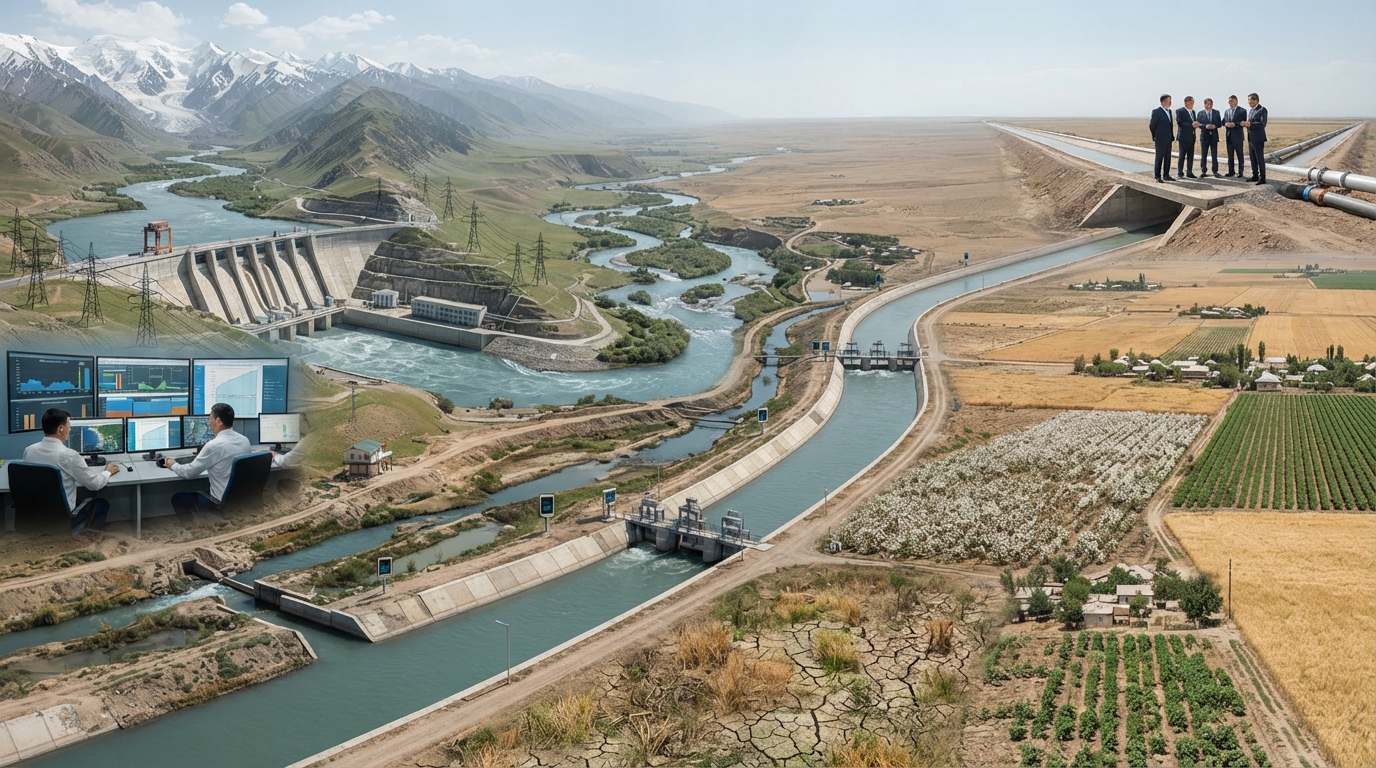
Central Asia is not so much lacking water as it is lacking readiness for its deficit
Nearly four out of five residents of Central Asia depend on transboundary water systems. At the same time, severe droughts in certain parts of the region recur every five to six years, and the water sector lacks up to $2.6 billion in investment. The question is no longer just how much water will remain in the region, but whether its infrastructure will be able to function when water becomes scarcer.
Central Asia already understands where many of its vulnerabilities lie
The discussion on the water issue in Central Asia is entering a new stage. The region no longer suffers from a lack of evidence that climate pressure is intensifying. The much more complex question is whether institutions, infrastructure, and investments can adapt quickly enough to the risks that are already manifesting in water management, agriculture, and energy.
Assessments voiced at the Regional Ecological Summit (RES-2026) and the Central Asian Climate Change Conference (CACCC-2026) in Astana show the scale of this vulnerability. About 81% of the region's population depends on transboundary water systems originating in the Tien Shan and Pamir-Alay. At the same time, the degree of dependence of individual countries on water coming from across state borders varies significantly. This makes water security a regional infrastructural task that cannot be solved solely by the domestic policies of individual states.
This dependence is particularly high in downstream countries. According to estimates presented at the conferences, external water dependence reaches 97% in Turkmenistan and about 80% in Uzbekistan; Kazakhstan is also heavily dependent on transboundary water inflows.
These indicators are important because they show the limits of purely national adaptation: a country can modernize canals, pumping stations, and reservoirs, but the reliability of the entire system is still determined by processes occurring upstream.
Drought must be planned for as a recurring systemic risk
The need to change the management model becomes even more obvious when considering drought not as an exceptional emergency, but as a regularly recurring condition that must be factored into planning. Estimates by the International Water Management Institute show that approximately 30% of Central Asia's territory is characterized by a drought probability of 50% or higher. In certain parts of the region, severe droughts recur every five to six years, and drought accounts for up to 70% of the total number of people affected by emergencies in the region.
With such frequency, responding only after a crisis begins becomes an expensive strategy. Governments and basin organizations must understand in advance which indicators trigger emergency measures, how reservoir operation regimes will change, how the competing needs of agriculture and energy will be balanced, and what information countries commit to sharing. Without pre-agreed procedures, every low-water year risks turning into a new round of negotiations under political and economic pressure.
No less important are the infrastructural consequences. Preparing for drought is not just about forecasting. It requires water storage and transport systems capable of operating under greater variability, digital monitoring, reliable hydrometeorological data, and irrigation networks that reduce preventable losses. In other words, climate adaptation must increasingly be built directly into the physical and operational architecture of water management.
Transboundary dependence creates an economic incentive problem
The water geography of Central Asia shapes a persistent mismatch between where costs are incurred and where benefits arise. Upstream states maintain reservoirs and hydropower infrastructure capable of regulating flow, while downstream economies benefit significantly from summer water releases for irrigation. As climate variability intensifies, fixed allocation mechanisms become less sustainable because the economic value of water storage, delivery timing, and flow regulation also changes.
At CACCC-2026, former Kyrgyz Foreign Minister Alikbek Dzhekshenkulov drew attention to this asymmetry from the Kyrgyz perspective: Kyrgyzstan generates approximately 47% of the Syr Darya flow through the Naryn and Kara Darya river systems, while receiving less than 2% of the allocated basin flow under existing mechanisms. Regardless of the political interpretation of these figures, the underlying problem is clear: cooperation becomes more difficult when the costs of providing regional water services and the economic benefits from them are distributed among different parties.
This is why projects like the Kambarata HPP-1 are important not only from the perspective of electricity generation. Joint investments can create a platform where countries can more accurately determine the value of water storage, seasonal regulation, electricity supply, and downstream water security. The goal is not to turn water itself into a commodity, but to make the services created by coordinated infrastructure measurable enough for negotiations on sharing costs, responsibilities, and benefits.
The investment gap is becoming part of the water security problem
Physical infrastructure will also require a significantly larger volume of capital. According to regional estimates presented at RES-2026, the funding gap for Central Asia's water sector is about $2–2.6 billion. Aging irrigation infrastructure exacerbates the problem: in some systems in Kazakhstan, irrigation efficiency remains at around 55%, and water losses can reach 40%.
These figures show that the region's adaptation challenge is not simply a lack of projects. It is also a problem of financing and preparing investment projects. Modernization competes for capital amid regulatory uncertainty, currency risks, limited access to long-term financing, and underdeveloped risk-sharing mechanisms. Among the tools that could help bridge this gap, climate guarantees, green investment funds, enhanced ESG disclosure, blended finance, and Islamic financial instruments were discussed at the conferences.
The scale of the broader investment agenda is already significant. According to a regional presentation at CACCC-2026, the World Bank's active portfolio in Central Asia includes 79 projects totaling about $10.3 billion in areas such as water security, electricity grid connectivity, land restoration, and climate resilience. The increasingly important question is whether individual investments can come together as elements of a single regional adaptation system, rather than remaining isolated national projects.
Cooperation has an economic price — as does the lack of it
Ultimately, the strongest argument for a more practical regional model may be economics. According to World Bank estimates presented at CACCC-2026, insufficient cooperation in the water sector costs Central Asia at least $4.5 billion in foregone income. At the same time, expanding regional electricity trade could bring at least $15 billion in economic benefits.
These indicators should not be taken as directly comparable categories. However, they demonstrate the same basic principle: coordination has a measurable economic value. Joint infrastructure, electricity trade, reservoir management, and drought planning can generate benefits that individual national systems cannot obtain as effectively on their own.
This also changes the very approach to the conversation about adaptation. Regional cooperation is often perceived as a diplomatic goal, while infrastructure is seen as a technical investment issue. In Central Asia, these two areas are becoming increasingly inseparable. Reservoir operating rules, a transboundary power line, a shared drought indicator, or an irrigation modernization program — all of these can alter the distribution of climate risks and economic value among countries.
Adaptation needs a working model, not another declaration
There is no shortage of regional institutions or political dialogue in Central Asia. The more difficult task is to turn cooperation into systems that will continue to work under water scarcity conditions. This requires shared data standards, agreed drought thresholds, transparent reservoir operating rules, investment portfolios, financing mechanisms, and a clear allocation of responsibilities before a crisis hits. It is these practical elements that are already embedded in the logic of the solutions presented at the conference.
The region's climate future will be shaped by retreating glaciers, changing river runoff, extreme heat, and more volatile drought conditions. However, the economic consequences will depend not only on the volume of available water, but on how effectively it is stored, transported, allocated, and managed at the transboundary level.
The main risk for Central Asia is no longer a lack of information about the approaching deficit. The scale of transboundary dependence, the recurrence of droughts, infrastructural losses, and the investment gap are already largely known.
Now, something else will be tested — the ability of states to prepare the system before another low-water year turns into a crisis. Canals and reservoirs must operate under more volatile flows, water allocation rules must remain resilient under scarcity, and investment mechanisms must finance projects before an emergency occurs, not after.
The price of delay is already measured in more than just cubic meters of water. According to the World Bank, insufficient cooperation in water management deprives Central Asia of at least $4.5 billion in economic benefits. Therefore, the next stage of the region's adaptation will be determined not by the number of new declarations of cooperation, but by whether its infrastructure and agreements withstand the next serious water deficit.