

"What was considered a rare extreme event is gradually becoming the norm." A climatologist on global warming and its consequences.
Climate change won't destroy the planet, but it will make life much more difficult for people. Droughts and floods that previously occurred once every half-century could become annual occurrences. Gazeta spoke with climate scientist Alexey Kokorin about whether this scenario can be reversed.
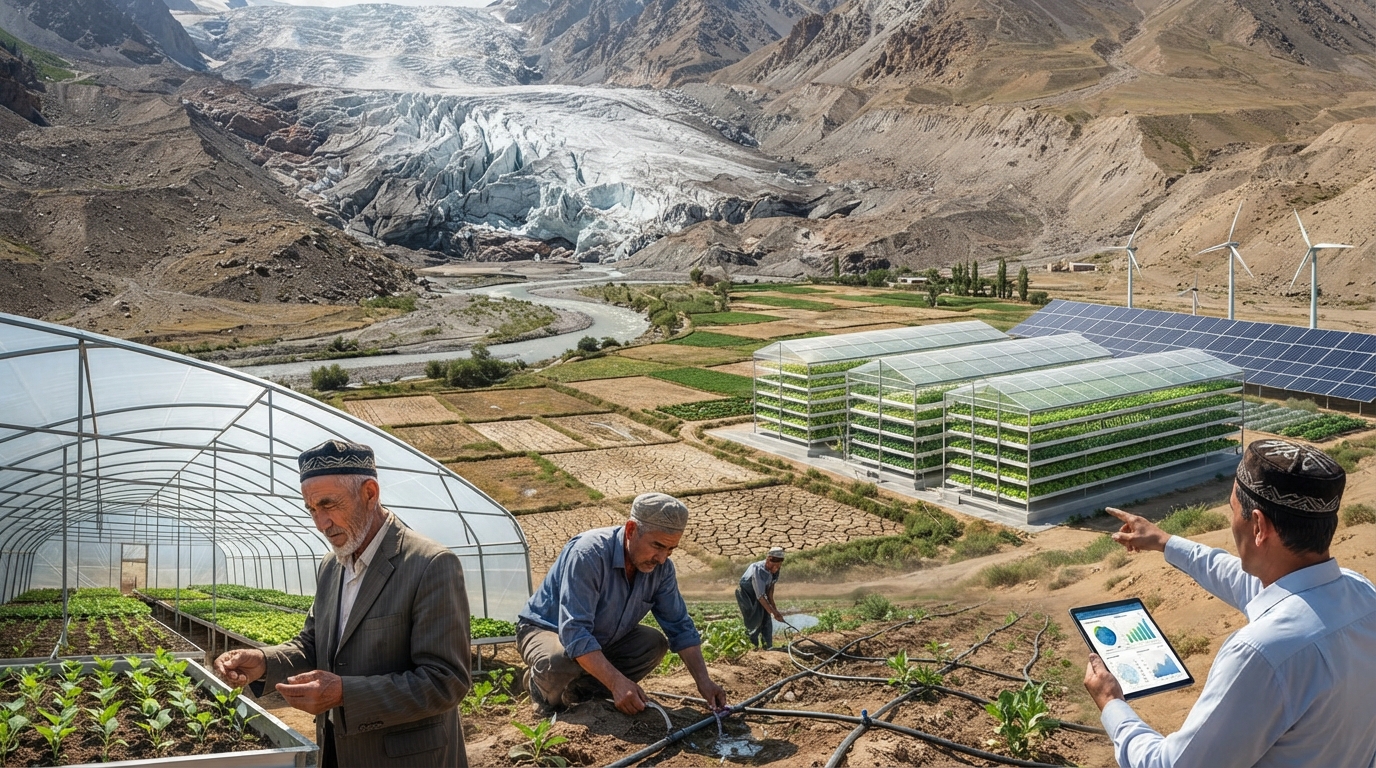
"What was previously considered a rare extreme event is gradually becoming the norm," is how a climatologist described global warming and its consequences.
Central Asia is one of the regions most vulnerable to the impact of climate change. Even with global warming of 1.5 degrees Celsius, temperatures in this region could rise by more than three degrees. Glacier coverage here is shrinking by approximately 0.5% annually.
In Uzbekistan, land degradation is occurring at a rate of approximately 9 square meters per minute, and the amount of available water per capita has almost halved over the past 15 years.
Gazeta spoke with Alexey Kokorin, a climate expert at the Russian foundation "Nature and People," a participant in the negotiations for the UN Framework Convention on Climate Change since 1993, and a lead author of the Intergovernmental Panel on Climate Change (IPCC) reports, which won the Nobel Peace Prize in 2007. He discussed what's really happening with the climate, whether humans are the primary cause of global warming, and what awaits Central Asia and the world.
Alexey Kokorin emphasized: "First of all, it's important to understand: current climate change is not a catastrophe for the planet. The planet has experienced more severe climate change. But this is a serious, scientifically proven problem for human life. For some countries, the consequences will be relatively moderate. For others, they are already becoming a tragedy. In some places, people are facing chronic water shortages, in others, sea levels are rising, and in others, familiar living conditions are gradually becoming untenable."
This is why the global community is currently discussing not only reducing greenhouse gas emissions but also aid for the most vulnerable countries. They already need resources to adapt to the consequences of climate change—from protecting water resources to rebuilding agriculture and infrastructure.
The Paris Agreement, an international treaty adopted by nearly all countries in 2015, sets as its primary goal the goal of holding the increase in the average global temperature this century well below 2 degrees Celsius above pre-industrial levels and continuing efforts to limit warming to 1.5 degrees.
"The difference between warming of 1.5 and 3 degrees is not so much the severity of extreme events as how frequently they occur," Kokorin explained.
Heat waves have always existed. In the 19th century, extreme heat waves could occur once every 50 years. With a temperature increase of about one degree, such events now occur approximately once every 10 years. Global warming is already approaching 1.5 degrees Celsius, and such anomalies are occurring approximately eight times more frequently.
If warming reaches 3-4 degrees Celsius, the climate will change fundamentally. At 3 degrees Celsius, heat waves that previously occurred once every 50 years may recur every two to three years. At 4 degrees Celsius, they will become annual. That's a completely different life.
The same logic applies to droughts and floods. What was previously considered a rare extreme event is gradually becoming the new norm. Because of this, regions will have to rebuild their infrastructure.
For example, residents of the Ural River basin (Russia) will have to design their dams not for floods that occur once every 20-30 years, but for much more frequent floods.
At the same time, certain areas may even benefit from climate change. For example, northern Kazakhstan. Slightly more precipitation and slightly higher temperatures are expected there. Frosts will persist, but there will be fewer of them. However, such areas are few in the world.
"How serious the situation is depends on where you live. If you live on a small island in the Pacific Ocean, the world is already losing for you. Your island is doomed. The same applies to low-lying areas of Southeast Asia or southern Africa, where rainfall is dwindling, groundwater is depleting, and the population numbers in the hundreds of millions. People in such places may still have time to live out their lives, but their children or grandchildren will likely have to leave—the area will gradually become uninhabitable," the expert noted.
The situation in Central Asia is more of a 50-50 proposition. Yes, by the end of the 21st century, summer temperatures could be about five degrees higher than at the end of the 20th century, but people can adapt to the heat: use air conditioners and change their lifestyle.
The main problem is not so much the rising temperature itself as the changing water regime. Precipitation will not disappear, but it will be distributed differently. Glaciers today act as natural water accumulators. They accumulate snow and ice in winter and gradually release water to rivers in summer. When glaciers become fewer, this accumulator stops working: more water comes in winter and significantly less in summer, when it's most needed.
The main challenge in Uzbekistan is water shortages. Therefore, agriculture will face a much more difficult time. If extreme heat becomes too frequent, plants will no longer be able to adapt as easily as humans.
So, imagine the worst possible low-water period, which previously occurred once every few decades. If such periods now occur two to three times more frequently, we will have to change our approaches to agriculture.
For example, switching to other growing technologies—hydroponics, aeroponics, and vertical greenhouses—will be necessary. Such technologies already exist, but their implementation is still expensive.
According to experts, the area of glaciers in the Pskem basin—the key source of water supply for the Tashkent region—has decreased by approximately 30% since 1957. If the current rate of decline continues, glaciers in Uzbekistan could disappear completely within the next two centuries.
As droughts become more frequent, crops, sowing times, and even the geography of their cultivation will have to be changed. Where sunflowers were previously grown, winter wheat or more drought-resistant crops may have to be switched to. The question isn't whether crops can be grown at all, but how exactly traditional agriculture will have to be restructured.
These changes are already impacting not only crop yields but also people. Experts are increasingly using the term "climate migration." More often, people are leaving not because the climate has changed directly, but because droughts, water shortages, or declining crop yields make it impossible to earn a living.
A study conducted by the International Organization for Migration in several regions of Uzbekistan showed that during years of extreme heat and drought, population outflow from certain areas increased by 10-15%.
"The rise in global temperatures is directly linked to greenhouse gas emissions, the main source of which remains the energy sector. Therefore, the transition to renewable energy sources truly helps slow climate change," Kokorin stated.
In most developed countries, emissions have already begun to decline. Almost all of Europe, Canada, Australia, and the United States are already on a downward trajectory. And this isn't just a matter of climate policy—it's becoming economically advantageous.
However, the overall picture still largely depends on the largest developing economies—China, India, Indonesia, and Vietnam. The main question today is whether the world has passed peak emissions, the point after which global greenhouse gas emissions stop growing and begin to decline. The answer largely depends on China, as it remains the world's largest emitter.
"I haven't seen such data yet, but China is very cautious in making such statements. They won't announce that they've reached their target until they're absolutely confident in their calculations. They may realize they've almost reached peak emissions, but they'll only publicly announce this after all the data has been fully verified and confirmed," the expert added.
Nevertheless, thanks to the measures taken in recent decades, the global scenario has already changed. Just 15-20 years ago, it was expected that temperatures could rise by about 4 degrees Celsius by the end of the century. Current estimates are much more optimistic—around 2.3-2.5 degrees Celsius. As a climatologist, Kokorin prefers to talk about 3 degrees Celsius, as there are always additional uncertainties. But it's still significantly better than 4.
"No. Climate change is a global problem, and solving it through the efforts of one region alone is impossible. Even if Central Asia switches entirely to renewable energy, this alone won't stop glacier melting. This requires reducing emissions globally," Kokorin emphasized.
We can't influence the global climate at the local level, but we can make cities more resilient to the effects of climate change. For example, greenery, bodies of water, well-ventilated streets, and smart urban planning help reduce the effects of heat. It's one thing to be surrounded by greenery, but quite another to be surrounded by bare asphalt or a desert. The difference in perceived temperature can be very noticeable.
"Think of climate change as a heavy asphalt roller. It moves slowly but inexorably. It's not a sudden catastrophe, but a gradual process that destroys established systems if nothing is done," the expert described the situation figuratively.
Mitigation is an attempt to stop this roller by reducing greenhouse gas emissions. Adaptation is an attempt to remove people and the most vulnerable objects from its path or protect them. The roller moves, but under a sturdy cover, everything remains intact and alive. It is around these two principles that global climate policy is currently being built.
Developed countries are willing to allocate funds primarily to projects that reduce emissions. They are interested in developing countries transitioning to a low-carbon economy. This helps slow global warming, reduces the risks of large-scale climate migration, and simultaneously creates demand for technologies produced by developed countries themselves. Most often, such support is provided in the form of concessional loans.
However, the most vulnerable countries have other priorities. They say, "We don't have time for low-carbon development now. We need to protect agriculture, healthcare, and water supplies." And preferably not through loans, but through grants, because there's often simply no way to repay this money.
This is why there are essentially two parallel debates in climate negotiations. The first is where to spend the money: on reducing emissions (mitigation) or on adapting to the already inevitable consequences of climate change. The second is what form the funding should take: concessional loans or grants.
The topic of adaptation is gradually coming to the forefront of international negotiations. While 10 years ago the main issue was how to reduce emissions, today the discussion is increasingly about how to help people cope with the consequences of climate change, which are no longer preventable.
Developing countries, especially African countries and other vulnerable economies, are pushing for a further redistribution of funds. Their goal is to bring funding for adaptation and emission reductions closer to at least a 50/50 ratio.
One reason is that emission reductions are fairly easy to measure, but adaptation is much more complex. When it comes to emissions, everything is clear: there were some indicators, and now they're lower. Or, for example, if a forest is planted, you can check whether it's growing or not. But how do you measure the success of adaptation?
That's why countries are now developing a unified system for assessing the effectiveness of adaptation measures. To date, 59 international indicators have been agreed upon that allow us to evaluate the results of such work. One example is access to water. For example, it's possible to measure what percentage of the population previously experienced water shortages and what percentage after a project's implementation.
"The most common misconception is that current climate change is happening on its own and that humans have nothing to do with it. Yes, the Earth's climate has always changed. There were periods of warming and cooling long before humans appeared. But what's happening now is a completely different story," Kokorin emphasized.
Continuing the analogy with an asphalt roller, it used to be a small roller, moving back and forth. Droughts alternated with wetter periods, and temperatures fluctuated naturally. Humans transformed this small roller into a large one. It is greenhouse gas emissions that have made climate change significantly faster and more severe.
Sometimes, psychologically, it's easier for people to shift responsibility to nature. It's like a child who breaks a cup and then blames the cat. It's tempting to think someone else is to blame. But human influence on the climate is no longer a hypothesis, but a scientifically proven fact.
"Not exactly. Every person is the end consumer of everything produced. Therefore, a lot depends on our decisions. For example, are we willing to pay a little more for a product or service with a smaller carbon footprint? Very often, the answer is no. Most people choose what's cheaper," the expert concluded.
Of course, the primary responsibility lies with governments and businesses. However, it is consumer demand that largely determines which technologies and products will develop.