

Central Asia is tired of being just a road between East and West
Central Asia is trying to turn its advantageous geographical position into a source of industrial growth, investment, and technology. It is no longer enough for the region to simply be a route between China, Russia, Europe, and South Asia. This was stated by Akramzhon Nematov, First Deputy Director of the Institute for Strategic and Interregional Studies, during a September presentation in Italy on the new geo-economic role of Central Asia. The region's combined economy in […]
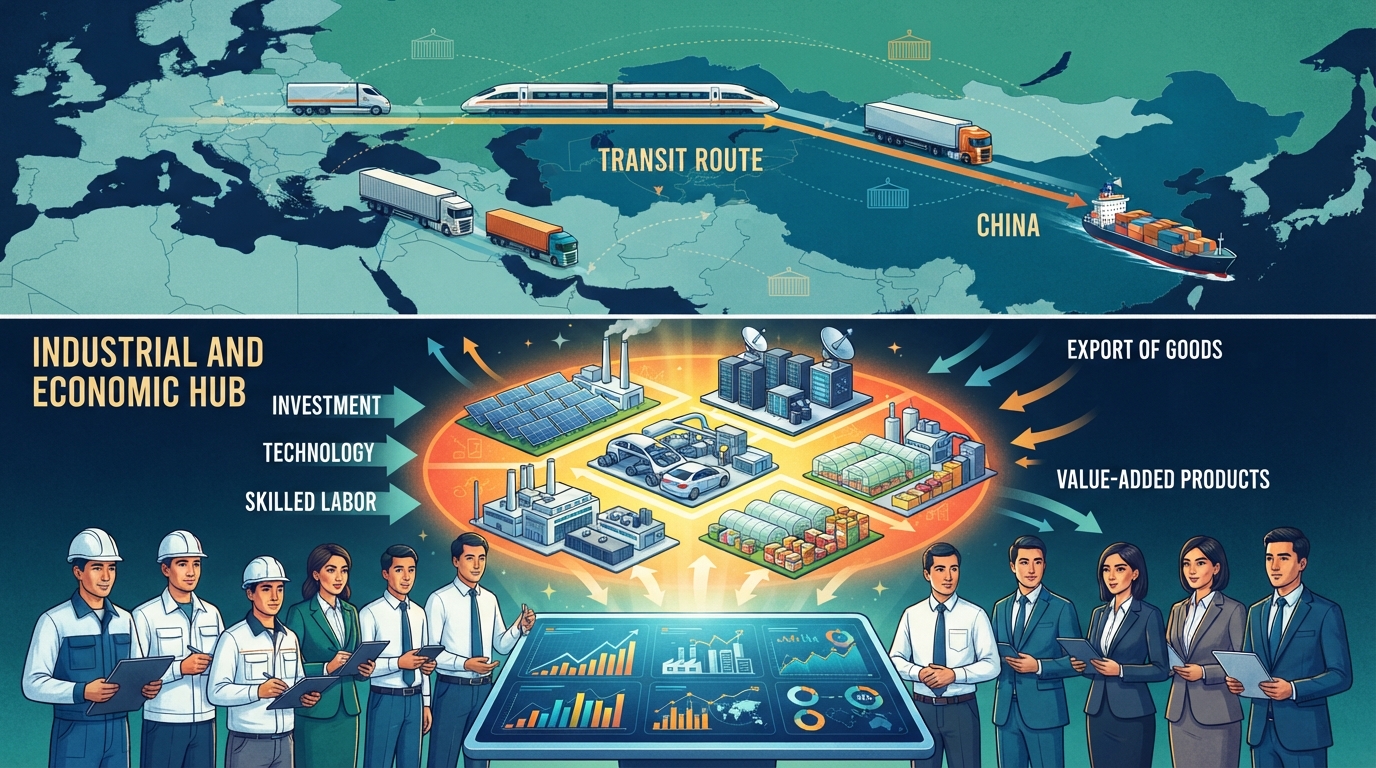
Central Asia is tired of remaining just a road between East and West
Central Asia seeks to turn its advantageous geographical position into a source of industrial growth, investment, and technology. It is no longer enough for the region to be a route between China, Russia, Europe, and South Asia.
This was stated by Akramjon Nematov, First Deputy Director of the Institute for Strategic and Regional Studies, during a September presentation in Italy on the new geo-economic role of Central Asia.
The region's combined economy could exceed $600 billion for the first time in 2026. The population is approaching 85 million people, the median age is about 27 years, and industry is growing at approximately 6% per year.
According to Nematov, the next stage is to transform the region from a transit territory into a space where value is added.
The volume of traffic along the Middle Corridor has increased in recent years from approximately 1.5 million to more than 4 million tons, and container flow has grown from 33,000 to 77,000 TEU. Simultaneously, the China-Kyrgyzstan-Uzbekistan railway is being built, with a potential capacity of up to 15 million tons per year.
However, the growth of cargo traffic in itself does not guarantee a significant economic effect.
"If a container simply crosses the region, the economic effect for our countries is limited to the transport tariff," Nematov noted.
According to him, it is necessary to establish industrial enterprises and logistics centers along transport corridors, and to develop processing, service, financial, and digital services.
In essence, this is about a change of model: not only allowing goods to pass through the region, but also producing them here.
To achieve this, Central Asia requires investment, technology, and engineering expertise. Joint ventures, training of personnel, and the integration of regional producers into global value chains are becoming important directions.
Nematov emphasized that the region's strategic autonomy does not mean isolation. On the contrary, it implies expanding the number of markets, transport routes, sources of capital, and technologies.
Additional support for regional integration is expected to be provided by a UN General Assembly resolution adopted in May 2026. It was co-sponsored by 66 states, including all Central Asian countries. The document provides for the promotion of innovation, job creation, and sustainable growth in the region.
Ultimately, Central Asia is trying to solve one key task: to stop being a geographical bridge between major economies and to become an independent economic hub.