

Caspian waves
The rapprochement between the Caucasus and Central Asia is a significant factor in the restructuring of the post-Soviet space – expert opinion
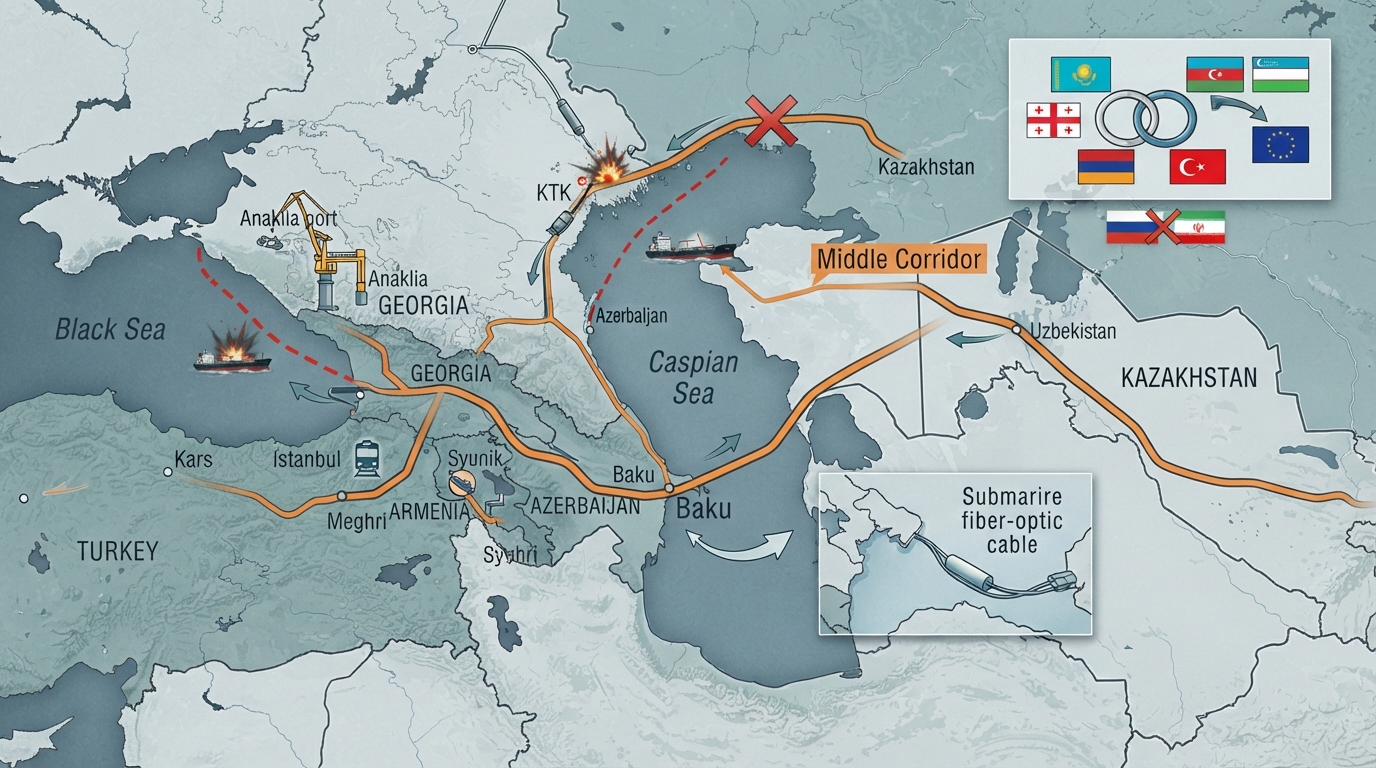
**Caspian Waves: One Year After the Washington Declaration and New Geopolitical Shifts**
August 2026 marked one year since the signing of the Washington Declaration by Donald Trump, Ilham Aliyev, and Nikol Pashinyan. Experts hailed this document as historic, particularly in the context of the development of transport and logistics links in the post-Soviet space. However, the situation has taken a new turn on this anniversary.
**Escalation in the Caspian and Black Seas**
Tensions are currently escalating in the Caspian and Black Seas. Systematic strikes by the Ukrainian Armed Forces on Caspian Pipeline Consortium (CPC) infrastructure and tankers participating in energy cooperation with Russia and Kazakhstan are causing serious concern. In particular, this marks the second strike on Greek vessels in a week.
At the same time, diplomatic contacts between Azerbaijan, Georgia, Uzbekistan, and Armenia are intensifying, aimed at bringing the states of Central Asia and the Caucasus closer together, bypassing Russian interests. This indicates the deliberate formation of the "Middle Corridor" communications infrastructure around the Caspian Sea, also known as the Trans-Caspian International Transport Route, which bypasses Russia. Such changes are fundamentally transforming the economic, and consequently, political, landscape of the South Caucasus and Central Asia.
Political observer and expert at the Strategic Culture Foundation, Andrei Areshev, in an interview with The Expert channel, revealed the connections between these events and Russia's future position in the post-Soviet space and globally.
**The Impact of the Washington Declaration on the South Caucasus**
When asked about the impact of the Washington Declaration on political and economic processes in the South Caucasus, Areshev noted that the idea of opening transport links between Azerbaijan, the Nakhchivan Autonomous Region, and Turkey has long-standing roots, dating back to the "Gobble Plan" of the 1990s and earlier Turkish intelligence projects. In Azerbaijan, this project is called the "Zangezur Corridor," while in Armenia, when speaking of the "Crossroads of the World," they prefer not to limit themselves to the Meghri section of the Syunik region, seeking to lift the country out of its long-standing blockade and transport isolation.
The "velvet" transformation of power in Armenia in 2018 and the rise to power of Nikol Pashinyan and his Civil Contract party predetermined a favorable outcome for Azerbaijan in the military conflicts around Nagorno-Karabakh in 2020-2023. Russia's attempts to propose a new, "post-conflict" agenda for Baku and Yerevan, including unblocking transport links in the Transcaucasus (based on the November 2020 trilateral ceasefire declaration between Moscow, Baku, and Yerevan – point 9), clashed with the West's collective plans to build East-West logistics corridors bypassing Russia and Iran.
The idea of a "Middle Corridor," linked to China's Belt and Road megaproject, received support from Turkey, Central Asian states, as well as European institutions and multinational companies. This was embodied during the talks between Trump, Aliyev, and Pashinyan at the White House in August 2025.
In addition to the "Washington Declaration" and a number of Armenian and Azerbaijani-American documents, the foreign ministers of the two countries initialed a peace agreement in Washington at that time. According to Baku, its signing will be possible after the Armenian side fulfills a number of demands, including the adoption of a new constitution free of what Baku and Ankara consider territorial claims against Armenia's Turkic neighbors. This includes rejecting the reference to the Declaration of Independence of Armenia and the corresponding reference in the preamble to the December 1, 1989, Resolution of the Supreme Soviet of the Armenian SSR and the National Council of Nagorno-Karabakh "On the Reunification of the Armenian SSR and Nagorno-Karabakh."
Although this process is not yet complete, the documents signed in Washington and the agreements reached are being implemented. In January 2026, the establishment of the specialized TRIPP+ Enterprise Fund, later renamed the Trans-Caspian Enterprise Fund, was announced. According to Areshev, this highlights the broader geopolitical context of the project, which aims to connect Central Asia, the Caucasus, Turkey, and Europe via the "Middle Corridor," also known as the "Trans-Caspian International Transport Route."
The fund's manager, international venture capitalist Konstantin Sokolov, a Leningrad native and one of Donald Trump's campaign sponsors, is noteworthy. He manages several assets in Armenia, including VIVA Armenia and the Teghut copper-molybdenum mine. Sokolov is actively interested in Armenia's railway infrastructure, which is currently under concession management by Russian Railways. At the same time, Nikol Pashinyan and his entourage have repeatedly hinted at the possibility of revising the 30-year concession agreement with Russia, signed in 2008. Recently, the idea of separating the licenses was floated: one for infrastructure maintenance (which Russia is apparently planning to retain) and one for transportation.
All these events, according to Areshev, are in one way or another connected to the TRIPP project, which may well extend beyond the railway and road. In certain areas in the districts of Meghri, Agarak, and west of Nrnazdor (formerly Nyuvedi), preparatory work has been completed, and blasting operations are apparently underway, for the construction of an interstate highway where none existed before.
The design for a power transmission line from mainland Azerbaijan to the Nakhchivan Autonomous Region via Armenia has already been prepared, and the proposed locations for the transmission towers have been identified, Ilham Aliyev recently announced. A large substation has been built in the Jabrayil district, designed to transmit electricity to Nakhchivan, and its transit and logistics capacity is planned to be increased from the current 1.5 to 15 million tons of freight per year. Following the restoration of rail service through Armenia's Syunik region (estimated for 2028), in addition to an additional connection to Turkey, Azerbaijan is also hoping to establish a connection with Iran's rail network at Julfa (in addition to the existing crossing at Astara). This would link the Zangezur Corridor with the International North-South Transport Corridor, which is being actively promoted by Russia, Iran, and India.
**Rapprochement between Central Asia and the South Caucasus**
Assessing the rapprochement between Central Asia and the South Caucasus, Areshev emphasized the increased political, diplomatic, and economic activity in this direction. Turkey and Azerbaijan can be considered the initiators of strengthening ties between neighbors on the western and eastern shores of the Caspian Sea. These players are actively promoting both multilateral formats (the Organization of Turkic States (OTG), consultative mechanisms of Central Asia and Azerbaijan) and bilateral contacts at various levels. In August 2024, participants in the summit of the heads of state of Central Asia and Azerbaijan in Astana adopted a joint declaration, confirming their intention to expand cooperation in a wide range of areas.
Georgia and, to some extent, Armenia are also participating in this process, as evidenced by their intensified ties with the Central Asian states. Specifically, Azerbaijan and landlocked Uzbekistan are forming a joint Caspian fleet and establishing a joint venture in the field of maritime logistics in the Caspian Sea, agreeing on preferences for suppliers from Uzbekistan at the Baku Seaport. Earlier, in 2025, Uzbekistan and the Azerbaijani state oil company SOCAR agreed on oil exploration and production on the Ustyurt Plateau. Baku and Tashkent are implementing major joint economic projects. The Georgian Dream government is also actively strengthening ties with Uzbekistan and Turkmenistan, including the potential use of the Anaklia deepwater port, currently under construction on the Black Sea coast, for the export of various cargoes (including transit) from Central Asian states to Europe. Areshev also noted the completion of a 390-kilometer fiber-optic communication line along the Caspian Sea floor, connecting the digital infrastructure of Kazakhstan with Azerbaijan and creating a high-speed internet corridor between Asia and Europe. While the bulk of internet traffic in Kazakhstan, Kyrgyzstan, and Tajikistan currently passes through Russian networks, an alternative is now emerging. Next in line is the Black Sea cable between Anaklia and Constanta, Romania, but maritime surveys are currently underway, and the intensification of the armed conflict in Ukraine hinders the rapid implementation of costly projects. Nevertheless, it is impossible to ignore the fact that a communications infrastructure bypassing Russia is being built in and around the Caspian Sea. What was previously idle talk or pious wishes is becoming a reality. As some colleagues noted on their Telegram channel, "...the motive here is not commercial. Astana and Baku do not want to be dependent on Russia's relations with the world, and are preparing a reserve in case of Russia's complete isolation, which no longer sounds so ridiculous."
It can be concluded that, while Russia is engaged in a special operation in Ukraine for five years, the development of transport and logistics links beyond the "northern route" is significantly changing the economic, and consequently, political, landscape of the Caucasus and Central Asia. Naturally, interested parties will have to address the inevitable challenges, both objective and subjective. These include the need for stable ferry services on the Caspian Sea, insufficient capacity on certain railway sections, the lack of synchronization of customs procedures, and the need to cross multiple state borders.
It is also important that Central Asia and the Caucasus remain regions of conflicting interests among Russia, Turkey, the EU, China, the US, India, Iran, as well as non-state actors engaged in foreign policy activities – from international consortiums such as the Caspian Pipeline Consortium (CPC) to cross-border criminal groups. All of them, in one way or another, strive to make their lives as comfortable as possible, which is not always conducive to the implementation of specific transport and logistics projects. Moreover, if the international situation changes, the implementation of many initiatives could be shelved. The fate of the Trans-Caspian Gas Pipeline, which, according to Areshev, has been under discussion for twenty years, is direct evidence of this.
**Militarization of the Caspian Region**
Regarding the militarization of the Caspian region, Areshev noted that, following the Baltic and especially the Black Seas, the echoes of the armed conflict in the former Ukrainian SSR have long since reached the Caspian Sea, particularly in the form of sabotage and terrorist attacks on Russian economic infrastructure and civilian vessels. Periodic calls for strengthening joint defense are unlikely to receive the response they deserve, if only because Kyiv's responsibility for these strikes, both past and possibly future, is not properly acknowledged, as evidenced by Astana's reaction to the attacks on Caspian Pipeline Consortium (CPC) infrastructure.
According to leaks to Western media, it took the intervention of US Vice President J.D. Vance to persuade the Zelenskyy regime to abandon strikes on tankers and energy infrastructure facilities related to the export of oil from Kazakhstan, produced by an international consortium with the participation of American companies. It's possible that Kyiv, in exchange, demanded additional arms shipments, which, if transferred, could be used anywhere, including in the Caspian Sea against Russia or Iran.
The July 25 attack by the Ukrainian Armed Forces on an Iranian-flagged tanker en route from Astrakhan to Anzali provoked a sharp reaction in Tehran (the port of Anzali itself had previously been the target of Israeli strikes). Kyiv quickly backtracked, claiming the attack was unintentional. Following this, and as targeted attacks by the Russian Aerospace Forces on Ukrainian military-industrial complex facilities in the rear areas intensified, tensions in the Caspian Sea subsided somewhat, but it's possible that this is merely a temporary phenomenon.
After lengthy delays, the Iranian Majlis (parliament) has returned to the issue of ratifying the Convention on the Legal Status of the Caspian Sea, signed by the leaders of the five littoral states in Aktau nearly eight years ago. One of the key provisions of this document is the non-presence of armed forces from states outside the Caspian "five" in the region. Furthermore, the parties do not allow their territories to be used for aggressive or other military actions against any of the participating countries, which is currently more pressing than ever, and not only for Iran.
Some Baku-based experts predict another escalation in the northern Caspian Sea in August-September, which directly affects the interests of not only Russia but also Kazakhstan. It can be assumed that Kyiv is using all available means to pressure Astana to pursue a policy similar to Baku's on the "Ukrainian issue."
Threats to Moscow in Kazakhstan-Armenia Relations
Regarding the telephone conversation between Kazakh President Kassym-Jomart Tokayev and Armenian Prime Minister Nikol Pashinyan on August 4, Areshev noted that the Kazakh leader (like the Georgian prime minister) was one of the first to congratulate Nikol Pashinyan on his success in the June 7 parliamentary elections, almost immediately after the polls closed. Bilateral political and diplomatic ties have been actively developing in recent years following the final transfer of the former Nagorno-Karabakh Autonomous Region under Baku's control. In April 2024, Kassym-Jomart Tokayev visited Yerevan, and a return visit is currently being planned.
Areshev believes that the expert community's suggestion that Tokayev could act as an arbitrator for Pashinyan within the EAEU, smoothing over the noticeably worsening misunderstandings and relations with the Russian leadership, is noteworthy. However, to confirm this, we must wait until the upcoming events within the Eurasian integration association, whose challenges are clearly not diminishing.
**The Visit of the Azerbaijani Foreign Minister to Kyiv and Its Consequences**
Assessing the recent visit of Azerbaijani Foreign Minister D. Bayramov to Kyiv, as well as the fact that the Russian Foreign Ministry once again seemed to be making excuses to Baku for supposed negotiations with Berlin on Azerbaijani soil, Areshev called this visit quite remarkable (incidentally, it came shortly after Bayramov's talks with Sergey Lavrov in Moscow), as well as the recent statements by the Azerbaijani President, who reaffirmed his support for Ukraine and its territorial integrity within the borders of the former Soviet republic not only in words but also in concrete actions. It is significant that a year ago, in August 2025, President Ilham Aliyev signed an order allocating two million dollars from his reserve fund "for the purchase and shipment of electrical equipment manufactured in the Republic of Azerbaijan for the purpose of providing humanitarian aid to Ukraine."
In total, such assistance has reached $50 million, and it continues unabated, Bayramov said during the aforementioned visit on August 6. The data he presented on mutual trade indicates a recovery and significant growth after the collapse in 2023, following the start of the Second World War, which is in itself quite significant.
Bayramov's visit to Kyiv, accompanied by a flower-laying ceremony at the memorial to the Ukrainian Armed Forces, should be seen as a direct signal to Moscow and Yerevan, as well as other post-Soviet republics. As is known, the Russian Foreign Ministry previously proposed a number of mutually beneficial initiatives to Baku, apparently intended to weaken the Azerbaijani-Ukrainian partnership in one way or another, but this is unlikely to happen. Baku will, in all likelihood, continue to support the Zelenskyy regime because it believes it is possible and beneficial, and this should not be surprising.
After all, back in the early 1990s, Baku and Kyiv acted in unison within the CIS and other "post-Soviet" organizations, pursuing a shared agenda of countering what post-Soviet national narratives portray as "Russian imperialism" and "colonialism." Baku calls cooperation with Ukraine "strategic," and indeed it is. Bayramov was shown a drone exhibition in Kyiv, which, one might assume, was a direct continuation of the agreements reached during Zelenskyy's April visit to Gabala.
Bayramov has declared his readiness to supply gas to Ukraine and use Ukrainian underground gas storage facilities. This is unlikely to happen anytime soon, but the trend itself is significant. Baku is playing the card of energy solidarity with Kyiv, seeking to once again demonstrate its capabilities to its Western partners. Azerbaijan is embracing the role of a "middle power" (President Ilham Aliyev spoke of his country's international role in precisely these terms at the Shusha Media Forum—Azerbaijani media dubbed it a "new foreign policy doctrine"), capable of saying "no" to even a more powerful neighbor, while being able to defend its position by all available means—from building strategic and tactical alliances to leveraging lobbying.
And if this works against Russia, then the concept will be effectively applied to neighboring Armenia, cementing Azerbaijan's role as the dominant force in the region. In this context, Aliyev's recent insistence to the Pashinyan government to close the Armenian Nuclear Power Plant (ANPP), clearly made after the relevant preparatory work, is extremely telling. Fulfilling this demand, backed by the ephemeral promise of establishing a common energy system in its place, will mean a further deterioration in Russian-Armenian relations.
Regarding the second part of the question, it's true that in his final press conference following talks with Federal Chancellor Merz, Aliyev announced meetings in Baku between Russian and German representatives, familiar from the St. Petersburg Dialogue forum, which ceased operations in 2023. Clearly, not all business and political circles in Berlin approve of the anti-Russian foreign policy of Merz and his government, so such statements can hardly be interpreted as anything other than an attempt to play into the hands of those who favor a hard line toward Moscow.
From time to time, Azerbaijan is positioned as a convenient negotiating platform for discussing sensitive international issues that require little publicity, but the further events unfold, the more doubts may arise about Baku's ability to serve as such.