

How the strategic partnership between Uzbekistan and Azerbaijan is developing after the signing of the declaration
On the eve of Azerbaijani President Ilham Aliyev's visit to Uzbekistan, Gazeta prepared an overview of the development of relations between the two countries since the signing of the Declaration on Deepening Strategic Partnership in 2022.
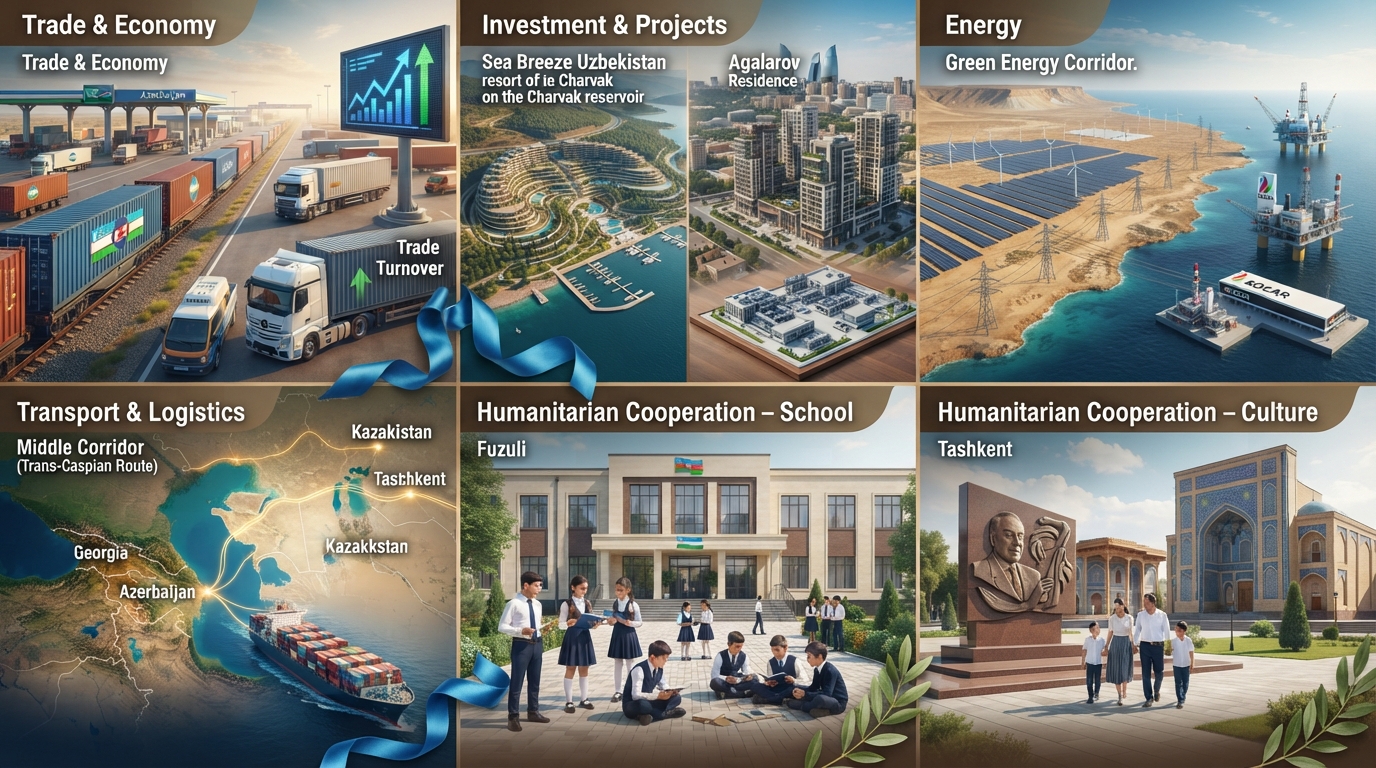
**Development of the Strategic Partnership between Uzbekistan and Azerbaijan since the Signing of the Declaration**
Uzbekistan and Azerbaijan established diplomatic relations on October 2, 1995. In 1996, Azerbaijan opened its embassy in Tashkent, and in May 1998, the Uzbek embassy opened in Baku. Also in 1996, Presidents Islam Karimov and Heydar Aliyev signed the Treaty of Friendship and Cooperation.
Important milestones in the development of relations were the signing of the Declaration on Deepening Strategic Partnership and Expanding Comprehensive Cooperation in June 2022, and the Treaty on Alliance Relations in August 2024. Gazeta previously published an overview of the development of relations between the countries.
In anticipation of Ilham Aliyev's state visit to Uzbekistan, an overview was prepared on the development of cooperation between the countries since the signing of the Declaration on Deepening Strategic Partnership and Expanding Comprehensive Cooperation, as well as the most successful areas of interaction.
**Trade and Economic Cooperation**
Uzbekistan and Azerbaijan enjoy a free trade regime, exempting mutual trade from customs duties. Trade has demonstrated rapid growth in recent years. According to the Center for Economic Research and Reforms (CERR), between 2017 and 2025, mutual trade increased 9.5-fold, from $32.5 million to $307.3 million.
At the time of the signing of the declaration in 2022, trade turnover was estimated at approximately $182 million. By the end of 2024, this figure had risen to $252 million, and in 2025, it exceeded $300 million. Growth accelerated in 2026: in the first quarter, trade turnover reached $80.1 million, a 42.5% increase compared to the same period the previous year.
Uzbekistan's exports of goods are approximately three times higher than its imports: $227.3 million versus $80 million. In 2025, industrial goods ($63.4 million) constituted the bulk of Uzbek exports, followed by machinery and transport equipment ($49.3 million), food products ($36.3 million), and beverages and tobacco ($34.3 million). Services accounted for $22.5 million, finished goods ($11 million), and chemical products ($5.1 million).
Imports from Azerbaijan are less diversified. Of the $80 million, more than half (43.2 million, or 54%) were food products. These were followed by industrial goods ($17.4 million), machinery and equipment ($5.8 million), chemical products ($5.4 million), and services ($4.3 million).
At a meeting of the intergovernmental commission in June 2025, the parties set a goal of increasing trade turnover to $1 billion by 2030. This is planned to be achieved through both increased trade and increased mutual investment and industrial cooperation projects.
**Investment Cooperation**
According to the Center for Economic Research and Development (CERR), in 2017, the volume of Azerbaijani investment in the Uzbek economy amounted to only $100,000, but by the end of 2025, it had reached $173.7 million. The number of enterprises with Azerbaijani capital in Uzbekistan increased from 71 in 2017 to 460. They are primarily engaged in construction, manufacturing, and agriculture.
The Azerbaijan-Uzbekistan Investment Company (AUIC), established in July 2023 with an authorized capital of $500 million, has become a key institution for bilateral investment cooperation. The company's priority areas are processing industry, healthcare, education, logistics, financial technology, and energy.
According to the Ministry of Investment, Industry, and Trade of Uzbekistan, by mid-2025, AUIC had financed 15 projects worth over $360 million. The company's investment portfolio reached $144 million by mid-2026. AUIC's planned projects included the construction of an international school in New Tashkent, support for the American University of Technology in Tashkent, and participation in the creation of an automobile plant in Azerbaijan.
The largest Azerbaijani project in Uzbekistan is expected to be the all-season resort Sea Breeze Uzbekistan, run by Agalarov Development, on the shores of the Charvak Reservoir. In 2024, company CEO Emin Agalarov presented the project to Shavkat Mirziyoyev, at which time its cost was estimated at $10 billion. The project is currently in its initial stages. In June 2025, the parties signed an agreement to implement the project, which is now worth $5 billion, making it the largest private investment in Uzbekistan's tourism industry.
A public debate about the construction's impact on the Charvak ecosystem and water supply was active on social media. Authorities stated that they had set "strict conditions" for the investor: if water was discharged into the reservoir, construction would be halted, the contract would be terminated, and the land would be seized. Public hearings were held in the Bostanlyk district in January, and in April, an environmental assessment approved the first stage of the project, requiring some revisions.
In September 2024, the same company began construction of the Agalarov Residence, a premium residential complex with 750 apartments in central Tashkent worth $133 million.
In August 2024, Uzbekistan and Azerbaijan agreed to launch seven joint projects in the textile industry, the largest of which is Global Textile's cotton and textile cluster in the Yevlakh district, valued at $104 million. The project, implemented jointly with the Azerbaijani company Azersheker, involves cotton cultivation through to the production of finished goods. The project's completion was originally scheduled for mid-2026.
The parties plan to expand the scope of the projects in the future. Receiving the credentials of the new Azerbaijani ambassador in July 2026, Shavkat Mirziyoyev stated that the two countries' joint investment portfolio is expected to reach $10 billion in the near future.
**Energy**
The largest joint project between Uzbekistan and Azerbaijan is oil and gas exploration on the Ustyurt plateau in Karakalpakstan. In July 2025, SOCAR, the state oil company of Azerbaijan, entered Uzbekistan's production sector for the first time when the parties signed a production sharing agreement. Investments in the project are estimated at up to $2 billion, and the Ustyurt plateau's subsoil, according to preliminary estimates, may contain up to 100 million tons of oil and 35 billion cubic meters of gas.
In May 2026, British BP joined the project, acquiring a 40% stake from its partners, but SOCAR remains the project operator. Seismic exploration has already begun at the plateau. Uzbekneftegaz stated that, if successful, Uzbekistan would be able to completely eliminate oil product imports.
The parties are also cooperating in the electric power sector. In November 2024, at the UN Climate Change Conference in Baku, the presidents of Uzbekistan, Kazakhstan, and Azerbaijan signed an agreement on a "green energy corridor." According to the document, the Central Asian countries plan to supply electricity generated by solar and wind power plants to Europe via Azerbaijan.
The project itself is currently in the preparatory stage: the three countries have established a joint venture and are developing a feasibility study, and the construction of power transmission lines is scheduled for the next stages.
**Transport and Logistics**
The Middle Corridor (Trans-Caspian Route) is a key area of transport and logistics cooperation between the countries of Central Asia. It carries cargo from Central Asia to Turkey and Europe via the Caspian Sea, Azerbaijan, and Georgia. Uzbek cargo reaches the Caspian Sea through the ports of Kazakhstan and Turkmenistan. Therefore, Uzbekistan is interested in connectivity projects that integrate the country into the transport corridor through its neighbors. Construction of a new railway connecting Uzbekistan and China via Kyrgyzstan began in late 2024.
In addition, the multimodal route China-Kyrgyzstan-Uzbekistan-Turkmenistan-Azerbaijan-Turkey (CASCA+) is in operation. In 2025, more than 6,720 container shipments were carried along this route, a 47% increase from the previous year. Preferential tariffs have been established for this route for 2026, and a further increase in shipment volumes is expected.
According to the Ministry of Transport of Uzbekistan, bilateral cargo shipments between Uzbekistan and Azerbaijan exceeded 100,000 tons in 2024, a 5% increase compared to 2023. Transit shipments are significantly higher: over 1 million tons of Uzbek cargo passed through the Baku Port as part of the Middle Corridor in 2024, a 26% increase from the previous year. And an increase to 1.5 million tons is projected for 2026.
Cargo clearance itself is also being simplified: customs transit between the two countries has been transferred to the E-TIR electronic system, expediting border clearance, and in road transport, both parties are abandoning paper permits in favor of the E-PERMIT electronic system.
In 2024, following a multilateral meeting of the railway authorities of Kyrgyzstan, Uzbekistan, Turkmenistan, Azerbaijan, Georgia, Turkey, and Tajikistan, the Eurasian Transport Route Association was established – a permanent platform designed to expedite freight transport and promptly eliminate bottlenecks along the route. In February 2026, the railways of Uzbekistan, Azerbaijan, and Georgia signed a cooperation agreement in Tashkent aimed at the joint development of the Trans-Caspian route.
Humanitarian Cooperation
In 2021, Uzbekistan declared its readiness to assist in the restoration of Karabakh. At that time, Shavkat Mirziyoyev stated that the country would contribute to the restoration of monuments, cultural sites, and educational institutions in the region.
In August 2023, Uzbekistan's major humanitarian project in Azerbaijan began: Shavkat Mirziyoyev and Ilham Aliyev jointly opened the Mirzo Ulugbek Secondary School in Fuzuli, a 960-student school built with Uzbek funds. The school began with 100 students; today, it enrolls approximately 650 children.
Azerbaijan's presence is also noticeable in Tashkent, where approximately 40,000 Azerbaijanis live and the Heydar Aliyev Cultural Center operates. In June 2022, on the first day of Ilham Aliyev's state visit, which resulted in the signing of the declaration, the presidents opened a street and square named after Heydar Aliyev in the center of the capital, complete with a commemorative bas-relief.
In the summer of 2025, the presidents of the two countries presented the design for the "Uzbekistan" theme park in Baku. The park, costing approximately $80 million, is conceived as a “mirror of Uzbekistan” and is designed to accommodate 800,000 visitors per year.