

How long will the lull last?
The US stopped Ukraine's attacks on tankers and Caspian Pipeline Consortium (CPC) infrastructure. But at what cost?
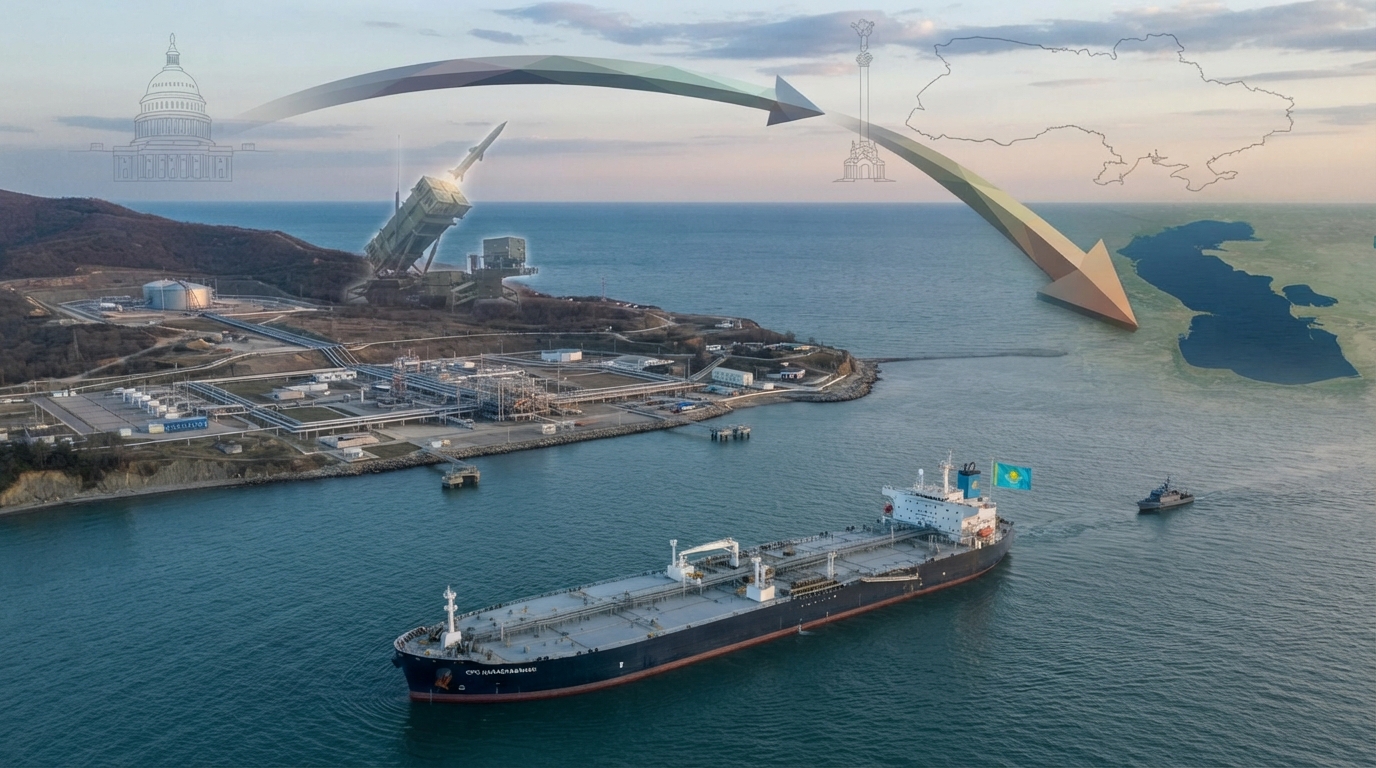
Will the calm last?
Washington persuaded Kyiv to cease attacks on tankers and Caspian Pipeline Consortium (CPC) infrastructure in the Black Sea. This agreement was the result of months of diplomatic pressure, which intensified significantly after a series of strikes in July 2026. Over the course of several days, drones attacked vessels waiting to load Kazakh oil at a terminal near Novorossiysk, leading to repeated interruptions in pipeline operations.
A few days after Bloomberg's publication, the Financial Times confirmed this information, citing Ukrainian and American officials, not just an anonymous source. The specific reason for the agreement was a phone call between US Vice President J.D. Vance and Ukrainian President Volodymyr Zelenskyy on July 31, 2026. Vance personally asked the Ukrainian leader to cease attacks on ships near Novorossiysk. Since that call, the publication notes, not a single tanker has been attacked near the CPC terminal.
That same day, a US official told Reuters that the Trump administration had warned the Ukrainian government to "cease and desist" from attacks on non-Russian vessels in the Black Sea and on CPC infrastructure, adding that Washington views the consortium as an alternative to Russian energy supplies. Thus, by mid-August, at least three major news outlets – Bloomberg, the Financial Times, and Reuters – had independently reported on the agreement.
Official public statements from top officials remain absent. The offices of Zelenskyy and Vance, as well as the Kazakh Foreign Ministry, did not respond to official requests for comment, while Chevron, ExxonMobil, and the CPC themselves declined to comment. However, an anonymous senior Ukrainian official confirmed to the FT that Kyiv had agreed to Washington's request, noting that the Ukrainian side was listening very closely to its American partners and had created the necessary control mechanisms at their request.
There is another curious detail reported by the FT that explains why Kyiv agreed in the first place. According to a source familiar with the Ukrainian side's position, Ukraine made the Trump administration's concession in part because it expects to receive a U.S. license to produce Patriot interceptor missiles and hopes to purchase several hundred of these missiles before winter, when a new wave of Russian strikes on Ukrainian critical infrastructure is expected. If this is true, this is not so much a gesture of goodwill as a direct exchange—refraining from strikes on the CPC in exchange for progress on Ukraine's air defense.
What Kyiv Promised
Judging by publications citing Bloomberg, the wording of the deal is not an unconditional renunciation of strikes on this section of the Black Sea, but rather a conditional exchange. Ukraine pledged to refrain from attacks on tankers and CPC facilities, but it set its own demands on the shipowners—its own conditions for a particular vessel to be considered "safe" for Ukrainian military personnel.
The vessel must not be owned by Russian individuals or legal entities, must not be subject to Ukrainian sanctions, and must not be carrying Russian oil or other cargo from Russia. In other words, Kyiv is not abandoning the idea of putting pressure on Russian exports per se, but is attempting to separate non-Russian cargoes, which are destined for Western shareholders and Kazakhstan, from Russian oil, which uses the same infrastructure. Separate communication channels have been established between the Ukrainian side and commercial carriers for vessel inspection and coordination, requiring them to report voyage details in advance.
This is fundamental – Ukraine did not sign a document granting immunity to the CPC as an object. It agreed not to target specific vessel types or cash flows, reserving room for maneuver regarding anything related to Russia. Given that the CPC is a shared pipeline and terminal for Kazakh and Russian oil, and it is physically difficult to separate tankers into different streams without full certainty of their cargo, the risk of errors or deliberately broad interpretations of the language remains. Will the flow stabilize?
More likely yes than no, but not completely and not immediately. The July attacks had concrete economic consequences. According to Reuters, drone attacks disrupted up to a fifth of CPC's July loadings, and oil production in Kazakhstan fell by 14% in July compared to June. By July 21, the terminal temporarily stopped accepting oil into the pipeline due to the suspension of ship loading. Resuming regular operations following the agreement with the US could return volumes to normal within a few weeks, if the parties actually adhere to the terms. The first two weeks of August, according to available data, passed without further strikes on civilian tankers near Novorossiysk.
However, stabilization in this case is contractual, not structural. Guarantees are based not on an international agreement or the inviolability of infrastructure, but on Kyiv's political will to fulfill its verbal commitments to Washington. However, as the experience of February 2026 demonstrates, this has already proven insufficient. Furthermore, the CPC remains a physically vulnerable asset in the combat zone, and any incident that Ukraine deems a Russian target or that accidentally hits the "wrong" vessel could again disrupt loading.
Back in February 2026, Ukraine's Ambassador to the United States, Olha Stefanishyna, publicly stated that following the strikes on Novorossiysk in late 2025, the US State Department issued a diplomatic demarche to Kyiv demanding it refrain from attacks on American interests in the Black Sea and Kazakhstan. Stefanishyna then frankly noted that the United States does not yet have the same economic interests in Ukraine as it does in Kazakhstan—a statement that explains much of the logic of the entire story.
Despite this demarche, attacks on the CPC infrastructure continued, and in the summer of 2026, they reached a new level of intensity. According to the Wall Street Journal, the new round of pressure from Washington was preceded by a direct appeal from Chevron management to the White House asking for influence on the Ukrainian strikes, as the company owns a stake in both the Caspian Pipeline Consortium (CPC) and a 50% stake in the Tengiz field. This suggests that the American corporation's private business interests acted as a more effective lever than a formal diplomatic note.
According to the FT, not a single tanker at the CPC terminal has been attacked since the July 31 phone call between Vance and Zelenskyy – and that's the second half of July and the entire first ten days of August, a long enough period to suggest a change in tactics rather than a one-time pause. The difference with February is that the warning then remained a formal diplomatic demarche, transmitted through the embassy. In July, the second-in-command in the US administration personally intervened, and Washington's demand was publicly articulated three times by different representatives – the White House, the State Department, and the relevant congressman.
On the other hand, Kyiv retains a strategic interest in inflicting economic damage on Russia, and the line between "Russian" and "non-Russian" cargo on shared infrastructure isn't always clear in real time, especially for a drone launched over a long distance. Furthermore, judging by a leaked Financial Times report about Ukraine's interest in a license to produce and purchase Patriot missiles, the current compliance with the agreement appears more like a pragmatic deal with a clear price than a fundamental rejection of such tactics – meaning it will remain in effect only as long as both sides consider the trade-off beneficial.
The position of American lawmakers is also indicative. Bill Huizenga, Republican Chairman of the House Foreign Affairs Committee's Subcommittee on South and Central Asia, explicitly stated that further strikes on the Caspian Pipeline Consortium (CPC) terminal will not be tolerated, tying this to the nearly $200 billion in American aid to Ukraine. According to him, Washington has publicly articulated this boundary three times already – through the February demarche, the White House's July warning, and his own statement.
Formally, the US and Ukraine are allies. But this story clearly demonstrates the asymmetrical nature of their relationship. The US is not bound by a NATO-style mutual defense treaty with Ukraine, and its support for Kyiv is based on a political decision by the administration and Congress, which can be adjusted if Ukraine's actions begin to harm specific American commercial interests. The situation surrounding the CPC has revealed that for a portion of the American establishment, relations with Kyiv are not an absolute priority, but rather one element of a broader picture that includes the interests of American oil majors in Kazakhstan, relations with Astana, and the stability of global oil prices.
In other words, Washington has made it clear that it is prepared to defend Ukrainian actions against Russia as long as they do not directly affect American money or American partners. As soon as this happens, the rhetoric shifts to warnings and demarches, even to threats that congressmen formulate in terms of revising the scale of aid.
Kazakhstan is watching.
Astana's position is extremely uncomfortable. More than 80% of Kazakhstan's oil exports from its largest fields—Tengiz, Kashagan, and Karachaganak—go through the CPC, and the country simply has no alternative routes of comparable capacity. There is a pipeline to China with a capacity of approximately 400,000 barrels per day, which is filled primarily by smaller fields in central and eastern Kazakhstan. There is also the theoretical possibility of access via Azerbaijan and the Baku-Tbilisi-Ceyhan (BTC) pipeline, but this comes down to the fact that oil can be delivered to Baku either through Russia or by tankers across the Caspian Sea—both options are either politically or technically limited.
A realistic course of action for Kazakhstan is, first, to maintain diplomatic pressure on all parties to the conflict simultaneously, using both bilateral contacts with Kyiv and leverage in dialogue with Washington through the presence of American shareholders in the CPC. Second, to accelerate any route diversification, even partial and clearly incapable of completely replacing the CPC, simply to reduce dependence on a single point of failure. Third, to seek formalization of CPC security guarantees, that is, to transform the current verbal agreement into something more solid, preferably involving not only the US but also the EU as the largest buyer of this oil.
Dulat Tasymov