

Before the ambulance arrives: how airport medical staff practice assisting passengers
When a person feels unwell at an airport, the health post staff are the first to come to the rescue. Assessing the condition, making a decision, and acting without delay — specialists must be prepared for such situations on every shift. How they perfect their skills is covered in the "News of Uzbekistan" report from the practical training stage for medical workers of Uzbekistan Airports. In the simulation center of the Military Hospital, the role […]
Before the ambulance arrives: how airport medical staff practice assisting passengers
When a person suddenly feels unwell at the airport, health center employees are the first to come to the rescue. Assessing the condition, making a decision, and acting without delay — specialists must be ready for such situations on every shift. How they sharpen their skills is covered in the report by "Nosti Uzbekistana" from the practical training stage for Uzbekistan Airports medical workers.
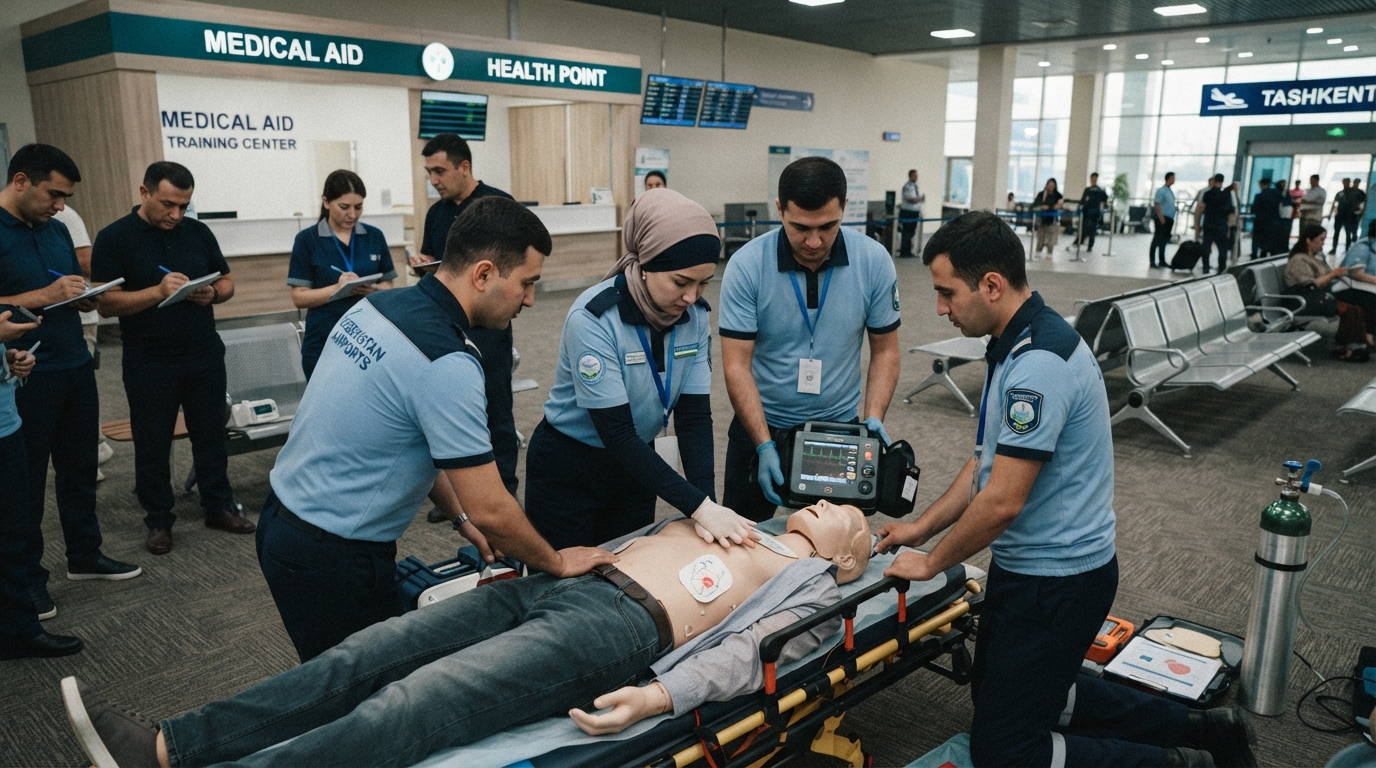
In the simulation center of the Military Hospital, a mannequin plays the role of the patient. Airport medical staff surround it. The participants practice emergency care procedures: assessing the condition of the simulated patient, making decisions, and performing necessary actions. Here, they can analyze a training scenario and repeat the exercise. On shift, these skills will have to be applied under very different circumstances.
Instead of a simulator, there will be a real person who felt unwell before departure. Nearby are anxious relatives and other passengers. Announcements still sound in the terminal, check-in is underway, and someone is rushing to board. The medical staff must quickly focus on the patient and provide care.
It is precisely for such situations that 15 medical workers from Uzbekistan Airports are preparing. A national Advanced Cardiovascular Life Support (ACLS) course in emergency and urgent care was organized for civil aviation employees.
The 18-hour program was developed based on the curriculum of the Military Medical Institute. The first two days are dedicated to online classes. The final stage takes place at the simulation center, where practical training and certification await the participants.
"On shift, a person might say: 'I just don't feel well, but I'm in a hurry to catch my flight.' We need to figure out what stands behind this 'don't feel well' and assess their condition. At the same time, it is important to explain everything calmly: the passenger is worried about both themselves and their trip. You need them to hear you and trust you," shared doctor Shavkat.
For passengers, the health center is rarely a planned stop at the airport. It is usually remembered only when the need arises: sudden weakness, pain, difficulty breathing, or another deterioration in well-being. Medical service staff are the first to evaluate the person's condition and provide the necessary assistance. In emergencies, they act until the patient is transferred to an ambulance crew.
This interval requires special composure. It is necessary to determine how serious the condition is, what actions are required immediately, and not to waste time. Moreover, initially, the medical worker may have very little information — only the passenger's own complaints or the story of people standing nearby.
The training program focuses primarily on such situations. Participants improve their skills in cardiopulmonary resuscitation, the use of a defibrillator, and providing aid for respiratory distress, acute cardiac conditions, and strokes.
It is not just individual techniques that are practiced on mannequins and simulators, but scenarios close to real life. Assessing the patient's condition becomes the starting point for further decisions. Every action must be timely, and the team's work coordinated.
"You know the theory, but here you have to do everything with your hands, go through the entire sequence of actions together with your colleagues. It immediately becomes clear where you hesitated and what still needs to be worked on. It is better to see this during training. When a real person needs help, it is important to do your job with confidence," shared paramedic Nigora.
Teamwork is one of the important components of the training. In an emergency, specialists need to understand each other, distribute tasks, and act consistently. The speed of providing care also depends on how smoothly the team operates.
Airport conditions add their own difficulties. A person is traveling, may be exhausted, anxious about the upcoming flight, or worried about a change of plans. Sometimes there are no relatives nearby to support them or talk about their health. Therefore, it is important for health center staff to quickly establish contact with the patient, ask the necessary questions, and explain further actions.
For a medical worker, this is part of their professional job. For a passenger, it is a situation where everything changes unexpectedly: just moments ago, they were watching the boarding time, and now they need help. The specialist's composure, clear words, and attention to complaints matter greatly at that moment.
The practical stage of the course ends with certification. Beyond it lies a return to routine work at the airports, where it is impossible to know in advance what kind of call they will face on their next shift.
At Uzbekistan Airports, advanced training for medical staff is viewed as part of ensuring passenger safety. Such training helps reinforce skills that are essential during those precise minutes when delay is especially dangerous.
Most passengers will pass through the terminal without ever visiting the health center. But for a person who suddenly falls ill, the readiness of airport medical staff will be more important than anything else. It is for the sake of this readiness that actions capable of saving a life one day are practiced here, in the simulation center.