

Assistants to the hokims are among people ("Bobur" mahalla)
Interview with Muzaffar Kholikov, Assistant Hokim in the "Bobur" Mahalla of Jizzakh city.
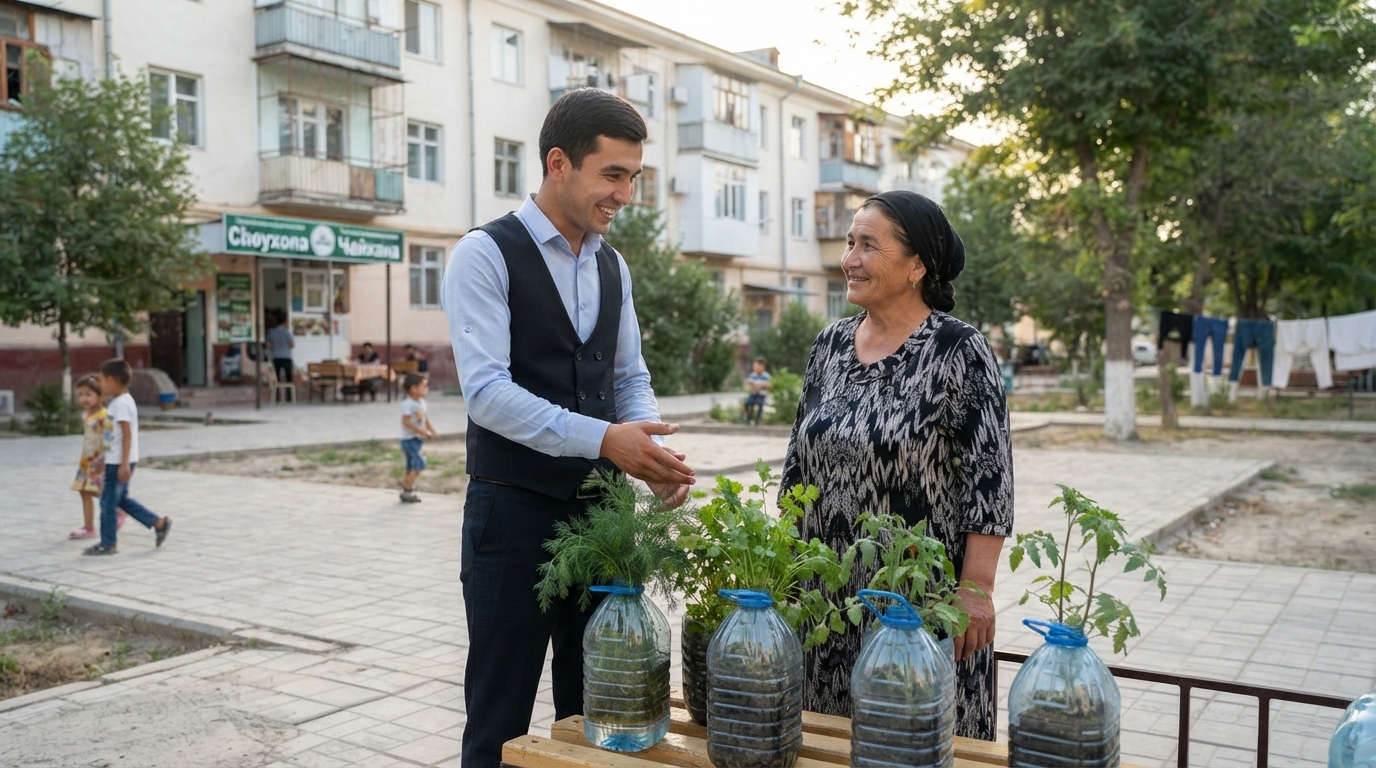
**Assistants to the hokims are among people ("Bobur" mahalla)**
– Tell us a little about yourself. How did your professional career begin, and how did you come to hold your current position?
– I graduated from the Tashkent Financial Institute in 2023. While I was still studying, I worked in the finance department of a private company. After graduating, in January 2024, I was appointed assistant to the hokim in the Zilol mahalla of Jizzakh. I worked there for two years and then, as part of a staff rotation, was transferred to the position of hokim’s assistant in the Bobur mahalla.
– How did the two mahallas you mentioned differ from each other economically and socially?
– The two mahallas are very different. Zilol is the third-largest mahalla in the city. It has 2,300 apartments and a population of about 15,000. Its housing stock mainly includes apartment buildings and individual houses, and most residents are ethnic Uzbeks. Bobur, where I now work, is almost three times smaller than my previous mahalla in both area and population. It has a multiethnic population. To communicate effectively with residents, I also had to improve my Russian-language skills.
There is also a major difference between the two areas in terms of economic potential. Since Zilol is located along a busy road and has well-developed infrastructure, it is home to large industrial enterprises and major retail facilities, including construction materials markets. In Bobur, small businesses and service-sector facilities play the leading role, including food service establishments such as cafés and restaurants, as well as wedding venues.
– How would you describe the mahalla where you currently work?
– The area has well-developed social and economic infrastructure. The mahalla has two public schools, one public and six private preschool institutions, one private clinic, and eight government institutions. More than 80 business entities and three industrial enterprises operate here. The total length of paved internal roads in the mahalla is eight kilometers.
Most residents earn their income by working in government institutions and private companies. There are relatively few large entrepreneurs in the area, while small businesses make up the majority. Self-employment is also widespread. In particular, many residents provide services as seamstresses, hairdressers, and childcare providers. Some residents earn income by preserving agricultural products, preparing hot meals and delivering them to businesses and offices, as well as sewing bedding at home.
– What economic opportunities did you identify in your new mahalla after studying its potential?
– As we know, residents of apartment buildings do not always have enough space or small greenhouses where they can grow agricultural products for everyday consumption. At the same time, demand for fresh herbs and vegetables remains throughout the year. With this in mind, we launched a project to grow fresh produce in ordinary 5–10-liter plastic containers that can be found in almost every household, and we are actively promoting the benefits of this initiative among residents.
Growing herbs and vegetables at home not only contributes to household food security but also helps residents save time and money. We have already begun implementing this project in practice.
– What is the main driver of economic growth in your mahalla? Why were these particular areas chosen?
– The main drivers of economic growth in our mahalla are services and small-scale manufacturing. At the same time, we continue to look for new sources of growth for the local economy.
In particular, the widespread cultivation of crops and berries by households under the project mentioned above could become a new growth driver. To achieve this, we plan to involve qualified specialists and agronomists to teach residents proper soil preparation, irrigation, and fertilization techniques. This will enable people to acquire practical skills in home-based agriculture.
The greatest advantage of this initiative is that it does not require major investment or bank financing.