

9 main tasks of hokim assistants have been defined
The instruction defining the main tasks of assistant hokims (mayors) has been approved. It ranges from ensuring population employment to neighborhood specialization
9 main tasks of hokim assistants have been defined
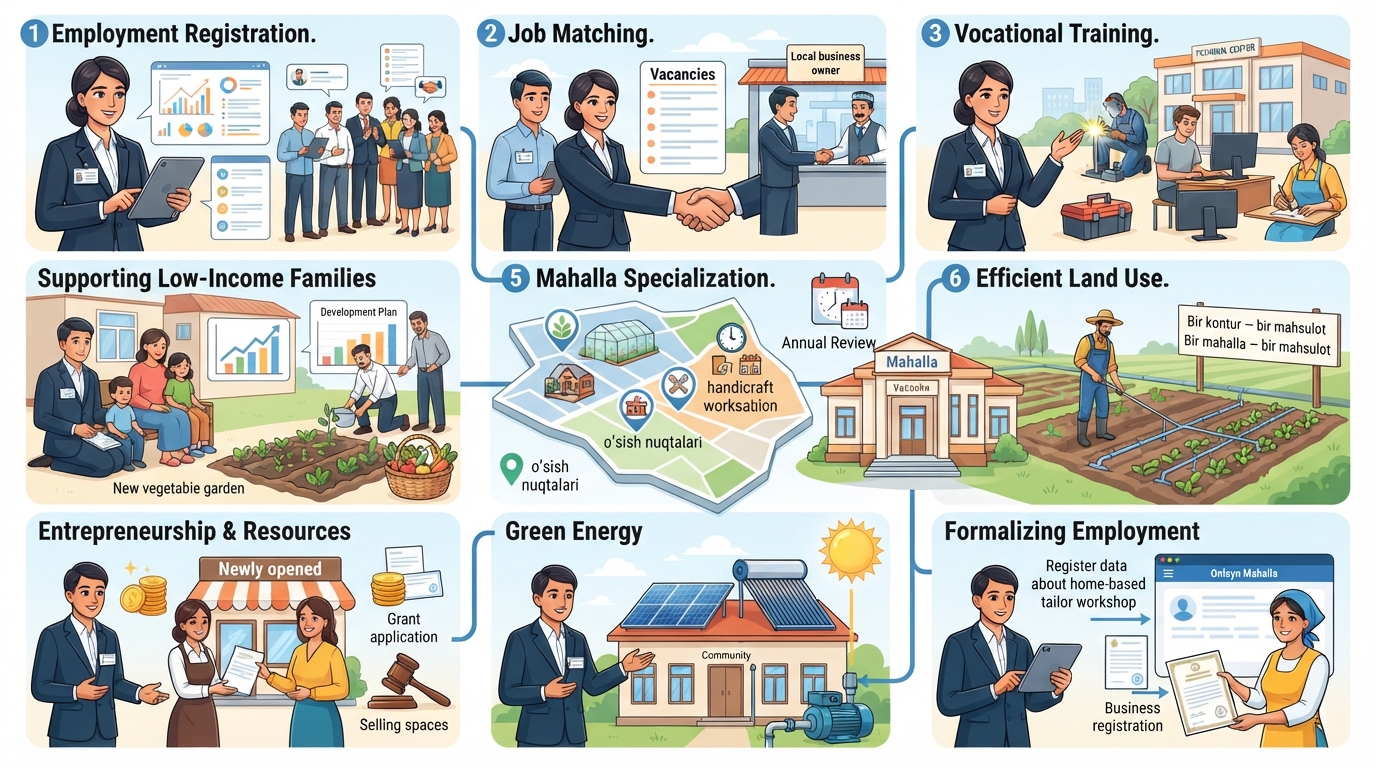
The instruction defining the main tasks of hokim (mayor) assistants has been approved. It covers areas ranging from ensuring population employment to developing neighborhood (mahalla) specialization and reducing informal employment.
According to the instruction, hokim assistants will prepare information on the unemployed and citizens wishing to increase their income on a quarterly basis. They will also compile a list of employers and vacancies in the neighborhood, direct the unemployed to available vacancies, and monitor their subsequent employment status.
Training the population in vocational skills and foreign languages is also one of the tasks of hokim assistants. They will identify citizens wishing to study, direct them to vocational education organizations, and take measures to ensure the employment of those who have completed their studies.
For low-income families, an individual plan will be developed based on the family's capabilities, skills, and interests. On this basis, sustainable employment services will be provided, and the growth of family income will be constantly monitored.
Hokim assistants will also be involved in identifying initiators of micro-projects in neighborhoods, financing and launching them, as well as monitoring the activities of the projects. Based on the economic potential and resources of the neighborhood, "growth points" will be identified, and the direction of neighborhood specialization will be determined twice a year.
Based on the principles of "One contour — one product" and "One neighborhood — one product", production will be organized for the effective use of household plots and leased lands. Training of household plot owners and farmers, establishing cooperative relations, and assisting in the allocation of subsidies and grants are also envisaged. Household plots and leased lands will be inventoried three times a year.
In addition, hokim assistants will identify vacant buildings and land plots in the neighborhood and assist in putting them up for electronic auction. Working with citizens wishing to install energy-efficient devices such as solar panels, solar collectors, and pumps is also part of their duties.
The instruction also pays special attention to reducing informal employment. Hokim assistants will identify informally working citizens and entrepreneurs, enter information about them into the "Online Mahalla" platform, and assist in formalizing their activities.