

Are more boys or girls being born in Uzbekistan? An analysis of the last 16 years
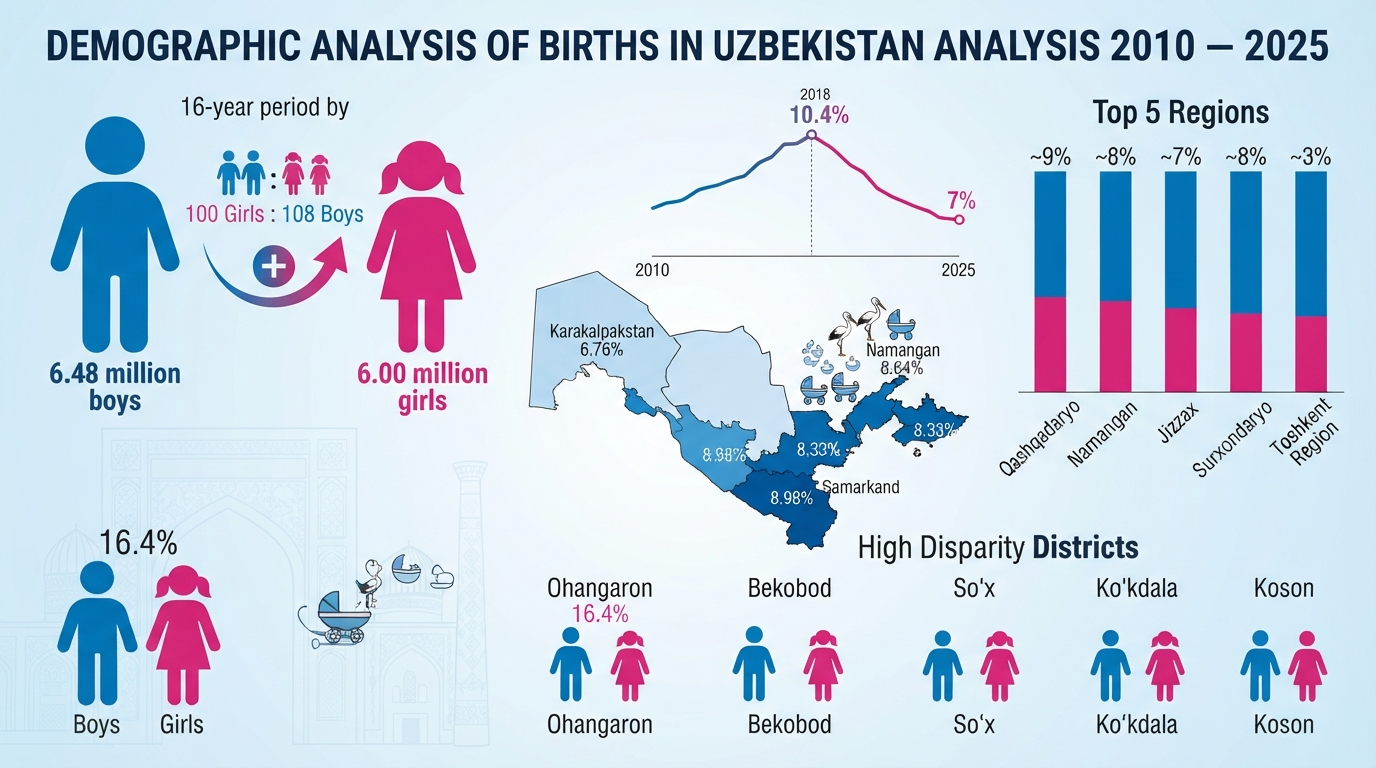
From 2010 to 2025, a total of 12 million 486 thousand 844 babies were born in Uzbekistan. Of these, 6 million 482 thousand 375 are boys, and 6 million 4 thousand 469 are girls. According to the overall 16-year indicator, 477 thousand 906 (7.96 percent) more boys than girls were born across the republic. This means that on average, there are 108 boys for every 100 baby girls.
Are more boys or girls being born in Uzbekistan? Analysis of the last 16 years
Every year, hundreds of thousands of babies are born in Uzbekistan. While their total number provides information about the demographic situation in the country, the ratio of newborn children by gender is also considered one of the important indicators. This is because the difference in the number of boys and girls can significantly affect the demographic structure of society over time. Based on open data, Kun.uz analyzed the number of births by gender and the situation in the regions for the period from 2010 to 2025.
Between 2010 and 2025, more boys than girls were consistently born in Uzbekistan. The highest difference in this regard was recorded in 2018 (10.4 percent), and the lowest difference was in 2025 (7 percent).
During the reporting period, a total of 12,486,844 babies were born in Uzbekistan. Of these, 6,482,375 were boys and 6,004,469 were girls. According to the cumulative 16-year indicator, 477,906 (7.96 percent) more boys than girls were born across the republic. This means that on average, there are 108 boys for every 100 baby girls.
Between 2010 and 2025, Kashkadarya region took absolute first place in terms of the predominance of boys over girls (8.98 percent). Here, there are 109 boys for every 100 girls. Namangan (8.64 percent) and Jizzakh (8.33 percent) regions occupy the second and third places.
A relatively balanced indicator was recorded in the Republic of Karakalpakstan (6.76 percent). Also, in Navoiy (7.27 percent), Fergana regions (7.40 percent), and the city of Tashkent (7.48 percent), the average indicator was lower than the national level. Among the regions, Samarqand region led both in terms of the total number of births and the absolute difference in numbers between boys and girls.
When analyzed by districts and cities, the largest gender gap was observed in the city of Ohangaron — 16.4 percent (the number of newborn boys was higher than girls by this percentage). This indicator is also considered very high in the city of Bekabad (12.1 percent), and in Sokh (11.4 percent), Kukdala (11.3 percent), and Koson districts (10.9 percent).