

Annual payment up to 270 million soums: some universities announce super-contract prices
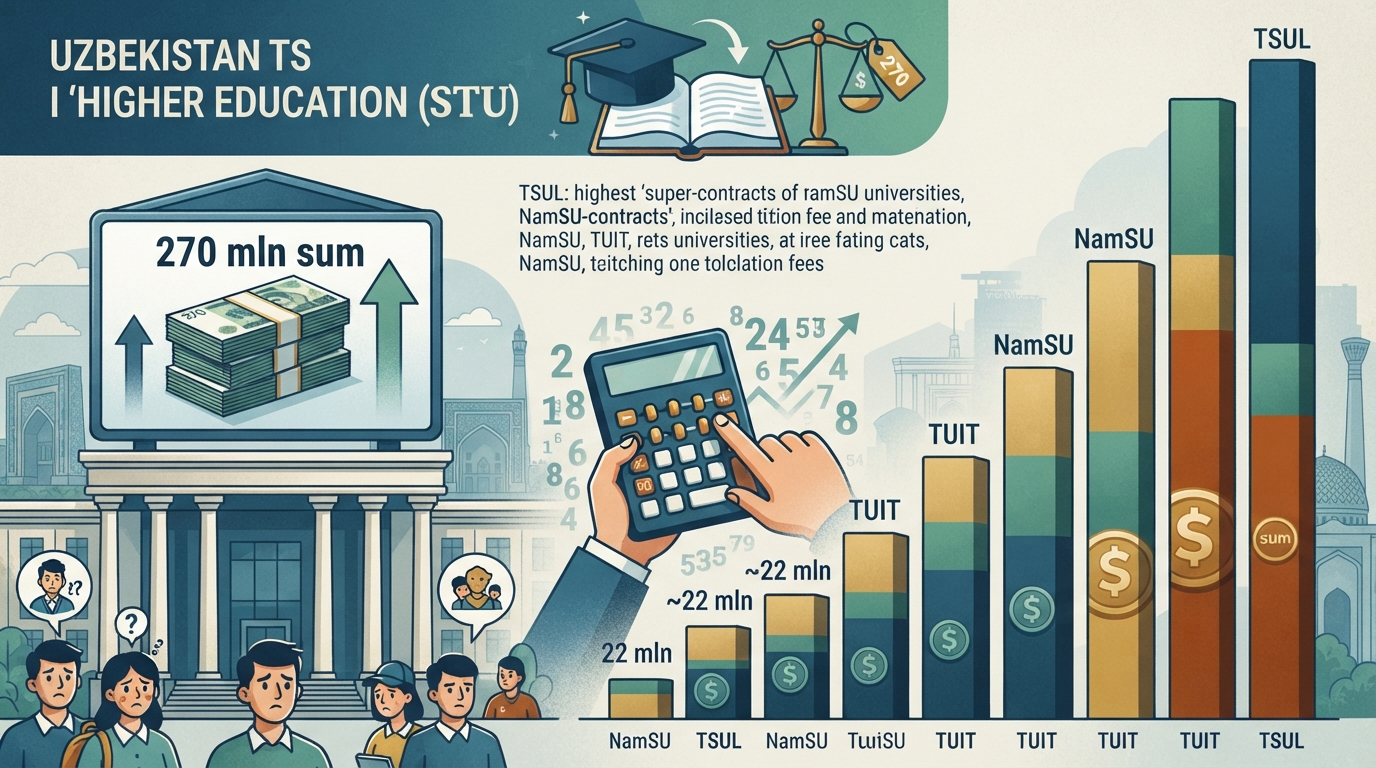
Annual tuition up to 270 million soums: some universities have announced super-contract prices
A number of higher education institutions in Uzbekistan have announced the super-contract amounts set for the new academic year. While the annual fee at some universities is around 22 million soums, at others it has exceeded 200 million soums.
So far, the highest super-contract among universities has been recorded at the Tashkent State University of Law. The prices announced by the university are intended for applicants who scored above the minimum in this year's entrance exams, but whose scores fell short of the payment-contract threshold by at least 4.05 points. In particular, the super-contract for full-time undergraduate education is nearly 269 million 960 thousand soums. The annual super-contract for three-year evening education is set at 132.1 million soums, for full-time master's degree at 122 million soums, and for evening master's degree at 97.6 million soums.
Namangan State University has also announced the updated differentiated payment — super-contract amounts. The lowest price for full-time education is set at 26.9 million soums, and the highest amount is 122.6 million soums. Studying in the fields of general medicine, pediatrics, or higher nursing costs 114.1 million soums. Studying on a super-contract basis in evening or distance learning courses at the university starts from 31.4 million soums and reaches up to 128.5 million soums.
The Tashkent University of Information Technologies has set differentiated prices for the 4-point gap that fell short of the contract score. For example, those whose scores fell short of the contract score by 1.05 points in full-time undergraduate studies will pay 1.5 times the base payment for the super-contract — from 18.1 million soums to 24.7 million soums. If the score fell short by 3.06 to 4.05 points, the payment increases from 36.3 million soums to 49.6 million soums. For the distance learning form, prices are set from 23.1 million soums to 59.4 million soums, depending on the missing points and the chosen field.
At the Namangan State Pedagogical Institute, the minimum super-contract is 22.9 million soums, and the upper limit reaches up to 31.9 million soums. This procedure applies to applicants who wish to study in full-time and evening education fields, whose scores fell short of the payment-contract by more than 4.05 points, and are not less than 56.7 points.
At the Yangiyer branch of the Tashkent Institute of Chemical Technology, super-contracts are set from 22.2 million soums to 48.1 million soums, and at the Namangan State Institute of Foreign Languages from 22.9 million soums to 47.2 million soums.
At Andijan State Pedagogical University, the super-contract amounts for full-time undergraduate education range from 29.6 million soums to 37 million soums, depending on the field. The price for the evening form of education is 34.5 million soums.
At the Andijan State Institute of Foreign Languages, the super-contract amount will range from 29.6 million soums to 47.2 million soums.
In turn, Andijan State University has approved the amount from four to six times the base contract sum. However, university representatives told "Daryo" that the base amount has not yet been fully approved. Nevertheless, it was stated that the super-contract amount is being reduced. For example, previously the base value reached up to 10 times, then the price was reduced to 8 times. Now, the maximum is six times.
The Andijan State Pedagogical Institute has also set the super-contract amount from four to six times the base contract. Other universities have not yet announced their prices.
According to the legislation, an applicant who wishes to study on a super-contract basis must pay at least 50 percent for the first academic year. After that, they will be admitted to study by order of the university rector. If students admitted to the university on a super-contract basis successfully complete the first academic year, they will continue their studies from the next academic year by paying the contract in the generally established manner.
Currently, a total of 215 higher education institutions operate in Uzbekistan. The number of students studying in them is 1.6 million.