

**Studying Difficulties: An Overview of Student Loans in Uzbekistan**
Paying for higher education is a significant financial burden for students and their families. If a one-time payment is not possible, an educational loan is one of the available solutions.
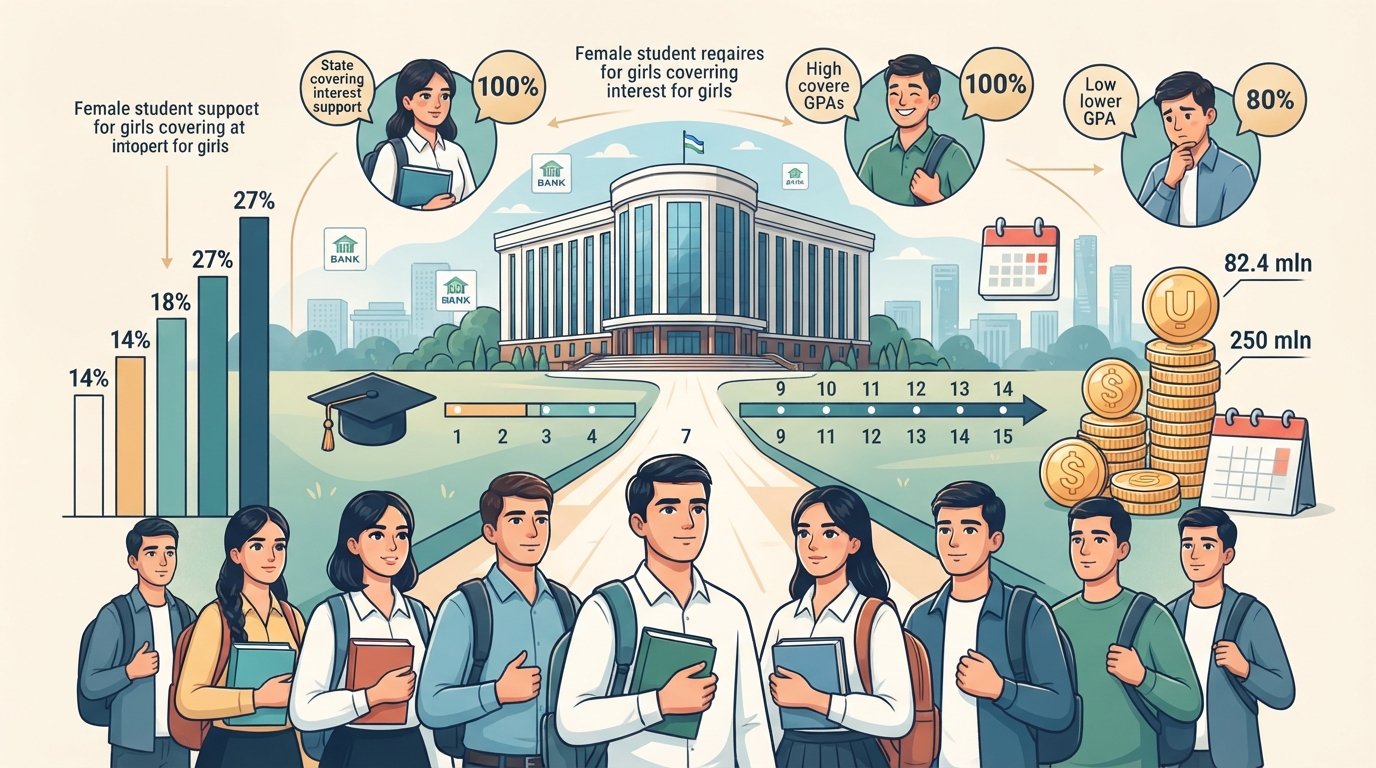
In Uzbekistan, several banks offer so-called "educational loans," with varying terms. Interest rates can range from 14% to almost 27% per annum, and repayment terms range from one to 15 years.
We analyzed student bank offers and highlighted key aspects to consider when applying for a loan.
**Who is eligible for an educational loan?**
Preferential educational loans are intended for full-time Uzbek citizens. Undergraduate and graduate students, as well as students at vocational educational institutions, are eligible.
It is important to note that terms and conditions for the type of study may vary depending on the bank. Some preferential programs are designed exclusively for full-time students, while some commercial loans may also be available for part-time students.
**Loan Amounts Provided by Banks**
For first-year students, an educational loan can cover up to 100% of the contract cost.
For second-year students and above, the loan amount depends on their grade point average (GPA):
* With a GPA of 3 or higher, the loan can cover up to 100% of the contract cost.
* With a GPA below 3, the loan covers up to 80% of the contract cost, with the remaining 20% paid by the student.
For students from families included in the Unified Register of Social Protection, the 80% limitation does not apply. Provided all other conditions are met, the loan can cover up to 100% of the contract cost.
The maximum loan amount depends on the specific bank and the chosen program. For example, Orient Finans Bank offers loans of up to 250 million soums, while Aloqabank and BRB offer loans of up to 100 million soums under certain programs. BRB also offers an educational loan at 14% per annum with a limit of up to 82.4 million soums.
**Preferential Loans for Girls**
Under this program, the interest rate is 14% per annum, with the state covering the accrued interest. Therefore, the student repays the bank only the principal amount of the loan, without having to pay interest.
Similar offers are available at a number of banks, including Turonbank, Xalq Banki, Agrobank, Uzpromstroybank, BRB, Orient Finans Bank, the National Bank of Uzbekistan, Aloqabank, Hamkorbank, and others.
**Loan Terms**
Loan terms vary. For example, Turonbank offers loans for 7.5 years, while Xalq Banki, Agrobank, BRB, and Hamkorbank offer loans for up to 7 years. Uzpromstroibank offers loans for up to 11 years, while the National Bank of Uzbekistan and Aloqabank offer loans for 13.5 years. The maximum term at MKBank is 15 years.
**Loan Repayment Start**
Many preferential programs allow for principal repayment to begin after graduation, rather than immediately. Typically, a grace period is provided for the duration of studies and an additional six months after graduation. The principal loan is then repaid over seven years.
However, a deferment of principal repayment does not always mean no payments during studies. Some banks begin accruing and paying interest after the loan is issued.
**Maximum repayment term: up to 15 years**
For students looking to stretch out their student loan repayments as much as possible and thereby reduce their monthly loan debt, MKBank offers the longest term—up to 15 years.
National Bank of Uzbekistan and Aloqabank rank second, offering loans for up to 13.5 years. Uzpromstroibank offers student loan repayment over 11 years.
It's important to note that banks may calculate the loan term differently. For example, at Uzpromstroibank, it includes the student's studies and an additional seven years after graduation.
The longer the loan term, the lower the monthly payment. However, this doesn't always equate to greater savings, as longer loan terms accrue interest over a longer period, potentially resulting in a higher total loan payment.
**Banks with the Largest Education Loans**
If the loan amount is the priority, Orient Finans Bank stands out among the offers available. Its educational consumer loan offers loans ranging from 2 million to 250 million soums. However, it's worth noting that the interest rate starts at 25% per annum.
Up to 100 million soums can be obtained through separate programs from Aloqabank and BRB. BRB offers the Ta'lim orzusi loan with an interest rate starting from 27% per annum and a term of up to four years. Another BRB option is an educational loan at 14% with a maximum amount of 82.4 million soums and a term of up to seven years.
The National Bank of Uzbekistan offers educational loans of up to 41.2 million soums with an interest rate starting from 22%.
A number of banks do not specify a maximum amount in their terms and conditions. This does not mean the bank is willing to issue any amount; the loan amount may depend on the cost of tuition and other bank requirements.
**Where student loan rates reach 27%**
Not all offers on the market are preferential. There are student loans with interest rates exceeding 20%. The highest rate among the options offered is offered by BRB for its Ta'lim Orzusi loan, starting at 27% per annum.
Infinbank offers student loans starting at 26.99% per annum with terms of up to three years.
Aloqabank offers a separate student loan at 25% per annum with terms of up to five years.
Orient Finans Bank also offers student loans starting at 25% per annum. The terms are up to four years, and the maximum amount is 250 million soums.
At Ipak Yuli Bank, the rate starts at 24.9%. Loans can be issued for terms of one to three years, and the amount ranges from 1 million to 50 million soums.
The National Bank offers another student loan with an interest rate starting from 22%, terms of three to five years, and amounts up to 41.2 million soums.
**What's better: a low interest rate or a long term?**
At first glance, it might seem that the most advantageous loan is the one with the lowest interest rate. In the case of student loans, this is indeed an important factor, but not the only one. For example, a loan with a 14% interest rate for seven years and a loan with a 14% interest rate for 13.5 years have the same interest rate but a completely different financial burden. With a short term, the monthly payment will be higher, but the loan will be repaid faster.
With a long term, the payment will be smaller, which may be more convenient for the student or their family. However, the bank will ultimately have to repay more money. Therefore, before signing the agreement, it's best to request a full payment schedule from the bank and estimate the total payment amount, not just the monthly payment.
**What to consider when applying for a loan**
The interest rate and term aren't the only conditions worth checking. First, find out how much the bank is willing to lend and whether it will be enough to cover the loan.
It's also worth clarifying whether a down payment, guarantor, or collateral is required. Some offers don't include this information in the terms and conditions, so it's best to confirm this directly with the bank.
Another important consideration is the grace period. It's important to find out in advance when the loan repayment period begins and whether you'll have to pay during your studies.
It's also worth checking the possibility of early repayment. If a student finds a well-paying job after graduation and is able to repay the loan early, this can reduce future expenses.
**Most Attractive Options**
Based on the terms presented, those looking for the lowest interest rate should first consider loans with a 14% interest rate.
If the maximum term is important, the most attractive offers are from MKBank (up to 15 years), the National Bank, and Aloqabank (up to 13.5 years). If you need a larger sum, Orient Finans Bank stands out among the offers with the specified limit, offering up to 250 million soums.