

Akramjon Nematov: Central Asia and the Russian Far East can become hubs of a new Eurasian-Pacific connectivity
The 1st All-Russian Scientific and Practical Conference of the Oriental Institute of the Far Eastern Federal University (FEFU) took place in Vladivostok, bringing together Russian and foreign scientists, specialists on China, Japan, and Korea, as well as researchers from Central Asian countries and other states. Within the framework of the conference, a round table titled "Central Asia – Pacific Ocean: A New Level of Connectivity?" was held. Representatives of FEFU, Saint Petersburg […]
Akramjon Nematov: Central Asia and the Russian Far East Can Become Hubs of New Eurasian-Pacific Connectivity
Vladivostok hosted the 1st All-Russian Scientific and Practical Conference of the Oriental Institute of the Far Eastern Federal University (FEFU), which brought together Russian and foreign scientists, experts on China, Japan, and Korea, as well as researchers from Central Asian countries and other states.
As part of the forum, a roundtable titled "Central Asia – Pacific Ocean: Next-Level Connectivity?" took place.
The discussion was attended by representatives of FEFU, Saint Petersburg State University, the Institute of China and Contemporary Asia of the Russian Academy of Sciences, MGIMO University of the Ministry of Foreign Affairs of Russia, Jusup Balasagyn Kyrgyz National University, and the SCO Secretariat. Uzbekistan was represented at the event by Akramjon Nematov, First Deputy Director of the Institute for Strategic and Regional Studies under the President of the Republic of Uzbekistan.
Central Asia: From Regional Consolidation to Economic Cooperation
Speaking at the roundtable, Akramjon Nematov noted that thanks to the consistent and open foreign policy of President of Uzbekistan Shavkat Mirziyoyev and the joint efforts of the leaders of Central Asian states, the region has traversed a path from overcoming former disagreements to aligning strategic priorities and jointly defining development prospects.
According to the ISRS representative, the accumulated political trust has become a solid foundation for deepening economic interaction. The countries of the region are already building a space of good-neighborliness and joint development, transitioning to the practical alignment of infrastructure, industrial, and technological potential. The consistency of this course was confirmed by the eighth Consultative Meeting of the Heads of State of Central Asia, held on October 8, 2026, in Avaza with the participation of Azerbaijan.
The strengthening of regional cooperation is accompanied by a noticeable acceleration in economic growth rates. The combined GDP of the five Central Asian states has doubled since 2016 and, according to forecasts, will exceed 600 billion dollars by the end of 2026. The population of the region is approaching 100 million people, forming a capacious consumer market and significant human resource potential. Concurrently, the industrial base is expanding, mutual economic ties are strengthening, and the participation of the region's states in international economic processes is growing.
Together with rich natural resources and a favorable geographic location, these factors reinforce Central Asia's position as an independent center of economic growth and a promising participant in international production and technological chains.
As Akramjon Nematov emphasized, a pragmatic policy of diversifying foreign economic relations allows the region's states to expand cooperation with various centers of global economic growth. A telling sign of increased international interest has been the development of "Central Asia+" formats. Relations with East Asian countries occupy a special place: in June 2025, the "Central Asia – China" summit was held; in December, the first "Central Asia – Japan" summit took place; and in September 2026, the "Central Asia – Republic of Korea" summit was held.
It was noted that interaction with East Asian partners goes far beyond traditional trade and includes the localization of production, deep processing of raw materials, implementation of advanced technologies, energy development, and training of engineering personnel. This reflects a change in the economic role of Central Asia: the region acts not only as a sales market and a transit link, but also as a partner in creating new manufacturing facilities and generating value added.
Against this background, roundtable participants pointed to the prospects of closer alignment between the economic capabilities of Central Asia and the Russian Far East.
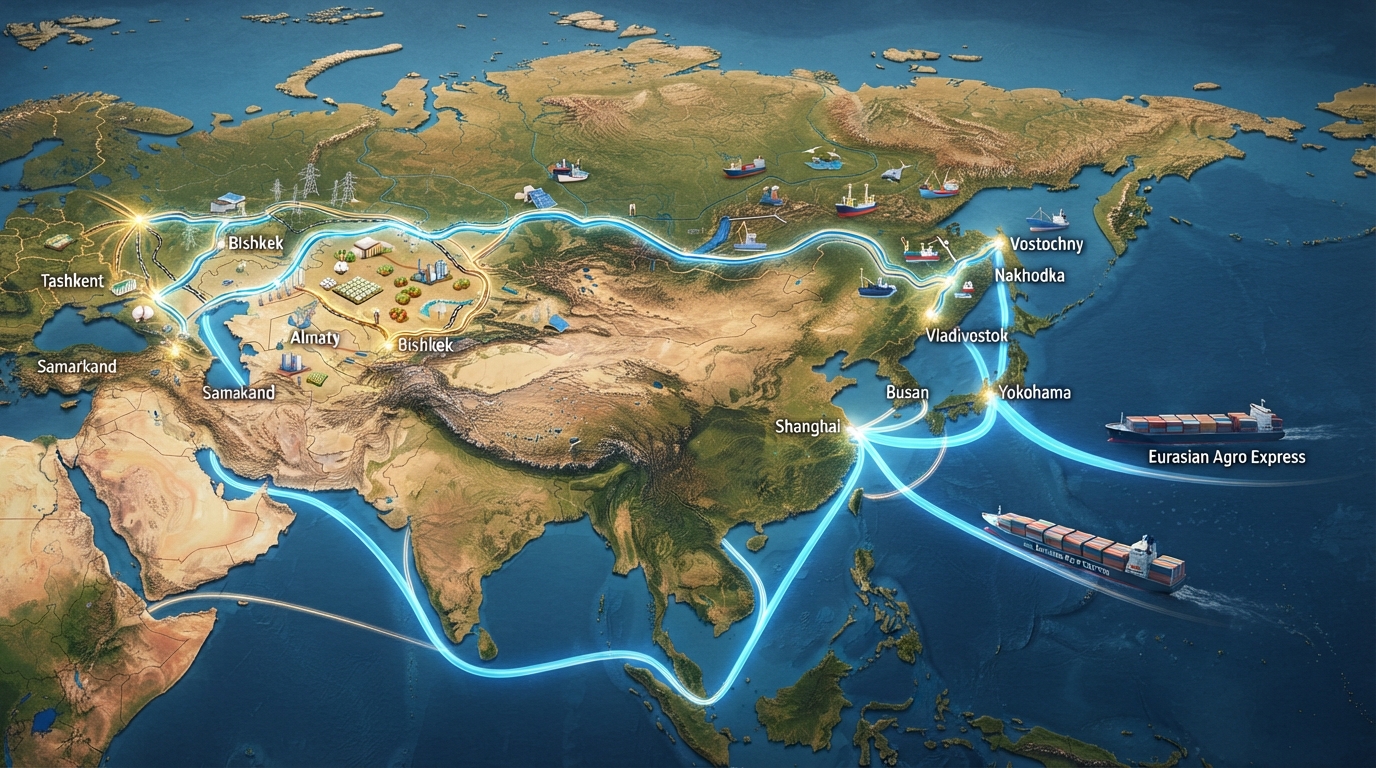
This concerns not only the growth of cargo flows, but also the use of transport connectivity for developing joint ventures, technological cooperation, and expanding presence in third-country markets. Uzbekistan is of particular importance in this interaction. The development of its industrial and transport infrastructure, as well as the strengthening of economic ties with neighboring states, create prerequisites for the formation of production and logistics hubs connecting the Far East with the markets of Central and South Asia and the Middle East.
The practical foundation for the partnership is the Cooperation Plan of the Russian Far East with Uzbekistan for 2025–2030, signed in December 2024. The document covers trade, economic, and investment ties, the agro-industrial complex, education, personnel training, the mining industry, and other areas.
During the roundtable, Akramjon Nematov outlined several interconnected areas that could give practical substance to the cooperation.
The first is the development of interconnected transport and logistics infrastructure. The creation of interconnected logistics and production hubs in the Primorsky Territory and the Tashkent Region, with the participation of Kazakhstan as a transit partner, looks promising. The development of regular container shipping, leveraging the capabilities of FESCO, digitizing transport operations, and integrating information systems—including Uzbekistan's E-logistika platform—will increase the competitiveness of routes, reduce delivery times and costs, and ensure sustainable return loading.
The second is industrial, scientific, and technological cooperation. Prospects are linked to industrial engineering, equipment maintenance services, deep processing of mineral raw materials, and the development of new materials, including critical minerals and rare earth elements. Scientific and educational organizations of the Far East, primarily FEFU, can facilitate joint research, the implementation of engineering solutions, and the development of manufacturing facilities in Central Asia.
This approach aligns with the initiative of President of Uzbekistan Shavkat Mirziyoyev to form the Eurasian Belt of Technological Industrialization, aimed at developing complementary manufacturing, expanding technological cooperation, and creating sustainable value-added chains.
The third is energy and water-ecological sustainability. Central Asia's growing needs for a reliable energy supply and rational use of water resources open up opportunities for joint research, implementation of hybrid generation, digital management of power systems, and water-saving technologies.
The fourth is agro-industrial and food cooperation. Developing the initiative of the President of Uzbekistan to create the Eurasian Agroexpress could ensure regular supplies of fruit and vegetable products, dried fruits, and processed foods from Central Asia to the Russian Far East, and fish and seafood in the opposite direction. This requires modern refrigeration and storage infrastructure, alignment of inspection procedures, and predictable transport organization.
The fifth is personnel training and scientific-educational cooperation. Combining the potential of FEFU and leading universities of Central Asia will allow for the expansion of joint educational programs, applied research, and the training of engineering and technical specialists. Of particular interest is the initiative of the President of Uzbekistan, "Engineers of the Future," aimed at building competencies demanded by joint ventures and new technological directions.
Summing up the results of the discussion, the participants stressed that the development of ties between Central Asia and the Russian Far East should be oriented toward concrete economic results. This means moving from individual trade and transport operations to a comprehensive partnership combining logistics, industry, energy, science, and education.
Aligning the potential of the two regions serves mutual interests. For Central Asia, it opens additional opportunities to access the markets of the Asia-Pacific region, attract technology and engineering competencies, deepen raw material processing, and strengthen production and logistics potential. For the Russian Far East, it means expanding economic ties with Central Asia, building an additional cargo base, developing joint ventures, and entering the markets of South Asia and the Middle East through the region.
A practical step could be the formation of a portfolio of pilot projects within the framework of the existing Cooperation Plan of the Russian Far East with Uzbekistan for 2025–2030, with the participation of relevant departments, research centers, transport operators, and business circles. This would allow moving from identified prospects to the implementation of initiatives based on the competitive advantages and complementarity of the economies.
Overall, according to the opinion expressed by the roundtable participants, Central Asia and the Russian Far East possess significant potential for forming a new space of Eurasian-Pacific cooperation. At the same time, Central Asia is no longer perceived solely as a peripheral market or a transit space, but is gaining importance as an independent hub of economic connectivity and a promising link in international value-added chains.
Realizing this potential requires further development of transport routes, alignment of production capabilities, expansion of technological exchange, and the establishment of sustainable partnerships. Such a model is capable of bringing mutual benefits to both regions, strengthening their positions in the international division of labor, and creating additional opportunities for entering new markets.
On the sidelines of the conference, meetings were also held with participants from Russia, China, Vietnam, and other countries. Prospects for expanding interregional cooperation, developing expert dialogue, and implementing joint research initiatives were discussed. Agreements were reached on expanding professional contacts and strengthening interaction with relevant research and educational organizations.