

Aggression on the roads and "auto-terror": why is a driving culture not developing on a mass scale?
Aggressive driving, speeding, intimidating pedestrians, and fatal accidents on the streets of Tashkent are increasingly bringing the issue of road safety to the forefront. In particular, safety around schools and the behavior of drivers on the road are raising many questions. Kun.uz spoke with a psychologist, a lawyer, a road safety officer, and a driver regarding these issues.
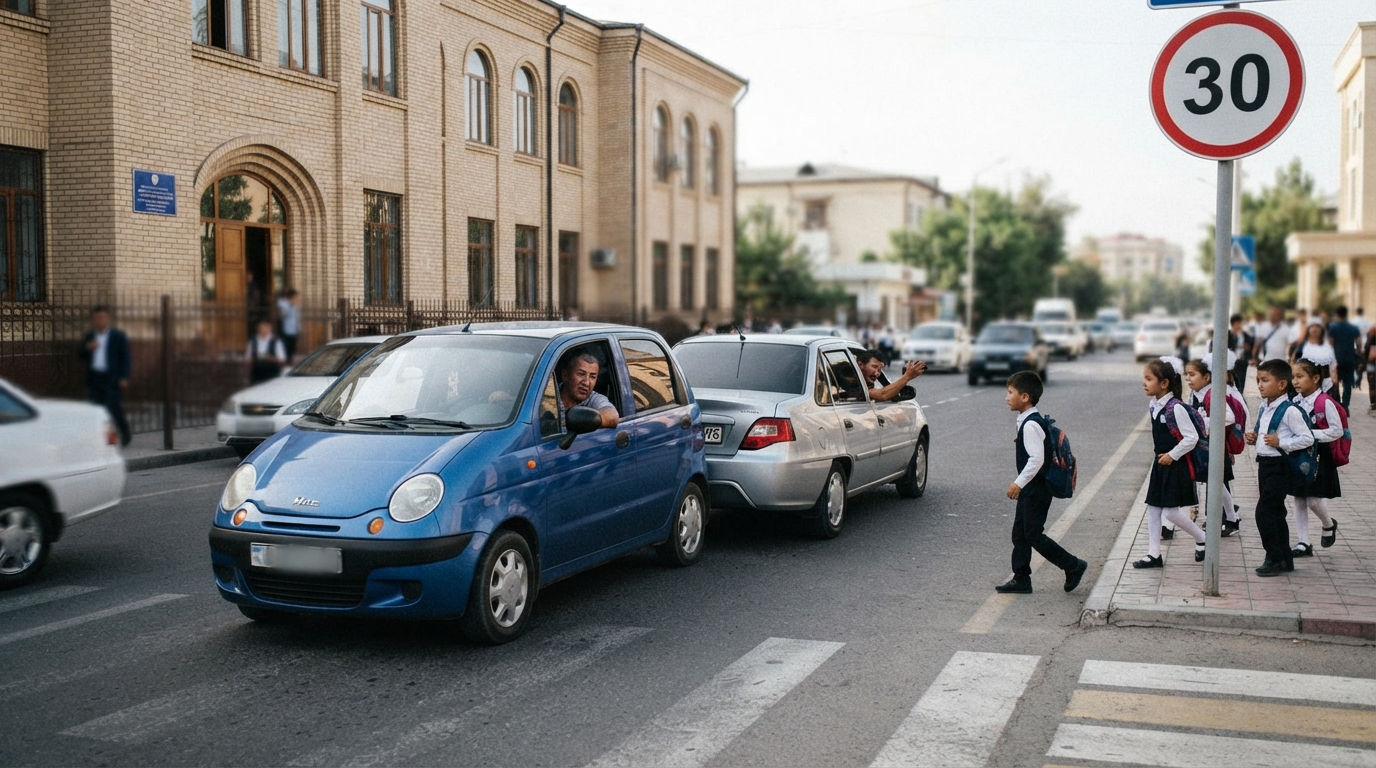
Road aggression and "auto-terror": why is driving culture not being formed on a mass scale?
Aggressive behavior on the road does not only mean speeding or violating traffic rules. Honking from behind to rush another driver, intimidating a pedestrian, making sharp maneuvers, and getting nervous in traffic jams also affect road safety. Such situations pose a serious danger, especially around schools.
Answers were also sought to the questions of whether punishment alone is sufficient, or if it is necessary to improve driving culture and strengthen public influence.
### Why is 30 km/h in front of schools important?
There are about 400 schools in Tashkent, 91 of which are located along main streets and roads. Because children can suddenly run out onto the road, stricter caution than ordinary traffic rules is required around schools. Does limiting the speed to 30 km/h in front of schools alone ensure children's safety?
"If we look at the statistics, traffic accidents involving pedestrians make up a significant portion of total traffic accidents. Meanwhile, 82 percent of traffic accidents involving children are related to pedestrians. In this, cases such as children crossing in undesignated or regulated areas make up the main part. Therefore, we must strengthen measures aimed specifically at preventing traffic accidents involving pedestrians," says Zokir Fayziyev, representative of the Tashkent City Road Safety Department.
### "There is no point in speeding for the sake of two or three minutes"
According to driver Abduqodir Otkirov, one of the reasons for speeding is related to the lack of mutual respect and road culture among drivers. He says that some drivers speed or rush other vehicles to save a few minutes in traffic.
"Some drivers speed to arrive two or three minutes earlier on the road. In fact, there is no point in risking one's own life and the lives of others for those two or three minutes. Especially in front of schools, you do not know where a child might come out from. No matter how experienced a driver is, they need time to react in an unexpected situation.
I have faced such a situation myself. I was driving past a school. We also work mainly with a navigator. Even if we do not see the sign, the navigator warns us that we need to drive at a speed of 30. I am driving at 30. a foreign car came up behind me, started honking, and gesturing to drive faster. Still, one must follow the rules. I ignored it and kept driving at 30. It started honking behind me again, as if to say, 'won't you go faster?' I was forced to drive faster. At that moment, I almost hit a child. Then I pulled the car over and explained it to that driver. What would have happened if I had hit him? I would have been guilty, and you would have driven away," says Abduqodir Otkirov.
### Why does human behavior change at the wheel?
Medical psychologist Asqar Ergashev attributes this situation to how a person manages stress and emotions. When sitting at the wheel, one must constantly focus attention on the road and react to factors such as traffic jams, honking, and sharp movements of other cars. This can increase fatigue and nervousness.
"Traffic jams, being cut off, and unexpected situations can make a person angry. At that moment, their character, which they usually hide, is likely to manifest. Some drivers start swearing, shouting at others, or acting aggressively towards them. In such a situation, a person's constant belief that they are right can further intensify aggressive behavior. If a driver takes into account that other participants can also make mistakes, sharp reactions are likely to decrease," says the psychologist.
### Stress cannot be an excuse for lawbreaking
Lawyer Azizxon Saidxojayev emphasizes the need to separate a driver's mental state from legal liability.
"A person has an ego, and they can get stressed in some situations. But this stress cannot be any excuse for a person who has committed a traffic accident. Clear legal norms work here: which legal requirement was violated, which norm was violated – it is assessed on this basis. The psycho-emotional state, in my opinion, is the last thing to be asked about here. Another important aspect is that it cannot always be concluded that the person who violated the traffic rule caused the traffic accident. For example, one driver violated the U-turn rule, and the oncoming driver might have been drunk. But if that U-turn rule had not been violated, the accident might not have happened at all. Therefore, in each case, the causal relationship is determined," says the lawyer.
### "The lower the speed, the fewer the injuries"
Another important issue regarding road safety is the effectiveness of speed limits and the penalty points system. According to the specialist, road safety must come first when setting speed limits.
"There are scientific analyses of how much harm is caused to a person if speeding is reduced, for example, from 60 km/h to 50 km/h, or if it is 40 or 30 km/h. The lower the speed, the fewer bodily injuries a person receives. From this point of view, the issue of reviewing speed limits for road safety should always be discussed. Penalty points are one of the mechanisms to deter drivers. Some drivers violate rules several times, pay the fine, and keep violating rules. The points system should be such a mechanism of punishment and incentive that the driver must be able to restrain themselves from repeated violations. After the speed was reduced, a decrease in speed-related traffic accidents was observed," says Zokir Fayziyev.
The lawyer, however, emphasizes that along with the fine and points system, driving culture and public influence are also important.
"It is not correct to apply the same speed limit to every road. There should be differentiation depending on the infrastructure and conditions of the road. As for the points issue, there could be an assessment system based on a certain percentage exceeded from the set speed. For example, if a 10 percent margin is applied where 30 km/h is set, it would be up to 33 km/h, where it is 60 it would be 66, and where it is 80 it would be 88 km/h. This issue can also be a clear and understandable system for both sides – drivers and law enforcement agencies. But the situation can never be fully corrected with punishment alone. The threat of punishment can prevent violations to some extent, but even points or deprivation of rights may not have enough effect on some people.
Therefore, public reprimand and drivers educating each other are also important. As for children, along with teaching them traffic rules from an early age, it is necessary to instill road etiquette and culture in them," says the lawyer.