

"A wolf in sheep's clothing." Why is Ulrich Siegmund called "the most dangerous man in Germany"?
Many attribute the decisive victory of the 'Alternative for Germany' party in the Saxony-Anhalt elections to the personality and charisma of its regional leader, Ulrich Siegmund. Despite his popularity among the public and on the internet, critics and the media call him 'the most dangerous man in Germany'.
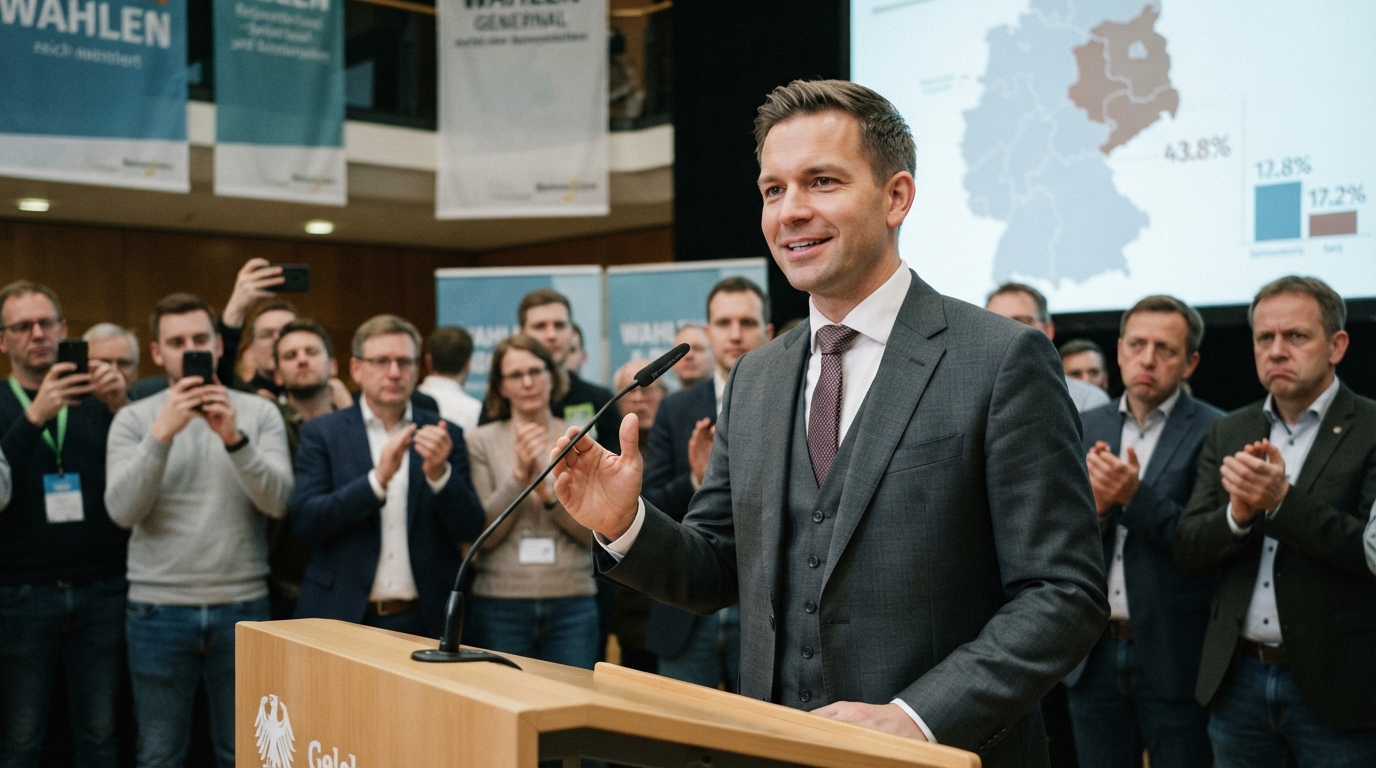
“A wolf in sheep's clothing”. Why is Ulrich Siegmund called “the most dangerous man in Germany”?
On September 6, the results of the elections to the federal parliament of Saxony-Anhalt — the Landtag — caused a great resonance among the general public. The right-wing radical Alternative for Germany (AfD) party won a confident victory with 43.8 percent of the vote and will now have the opportunity to form a regional government. The Christian Democratic Union (CDU), which held power in this region, received only 17.2 percent of the vote. Chancellor Friedrich Merz said after the elections that a “tectonic shift” had occurred in the German party system, suggesting that this could signal the AfD coming to power at the national level soon.
The party's astonishing success in the election is also linked by the media and analysts to the personality and charisma of the regional leader, Ulrich Siegmund. Gazeta presents a translation of the article published by the Meduza edition about his popularity on the Internet, his entry into politics, and his views.
Ulrich Siegmund was born in October 1990 — just three weeks after the GDR rejoined the FRG and the reunification of Germany was completed. Not much is known about his parents: only that his father works in an administrative position under AfD parliament member Thomas Korella, and his mother died in an accident in 2019.
There is one issue related to his father's position. At the beginning of 2026, the younger Siegmund was accused of nepotism for “placing” his father with his party colleague. In response, he said that it is difficult to find good employees for his party because all its members are subjected to attacks and stigmatization by opponents and the media.
Ulrich's childhood was spent in Tangermünde, a picturesque medieval town with a population of about 10,000, located approximately 100 kilometers west of Berlin.
Siegmund did not plan to become a politician in his youth. He graduated from a commercial college specializing in wholesale trade and export. In 2011, Ulrich moved to Berlin and began working in the marketing department of an ophthalmology clinic. After working at the clinic for three years, he founded his own company, Reima AirConcept, which specializes in selling room scenting products.
At the same time, Siegmund graduated from the European Distance University of Applied Sciences in Hamburg, becoming a specialist in business psychology. His thesis was dedicated to how enterprises can unconsciously influence customers' desires using scents.
In the mid-2010s, Siegmund moved away from business and became interested in politics. As a teenager, he had already become a member of the Christian Democratic Union (CDU) — the conservative center-right party led by then German Chancellor Angela Merkel. Siegmund spent six years in the CDU, but in 2014 he moved to the Alternative for Germany party, which had been founded shortly before. Two years later, at the age of 26, he took a seat in the parliament of Saxony-Anhalt from the AfD. The basis of Siegmund's election program, like many of his party colleagues, was criticism of the Merkel government's migration policy.
Why did Siegmund switch from the CDU to the AfD? According to one version, he realized that he could not enter the CDU elite due to the extremely intense competition in the country's largest party, and therefore decided to leave. Siegmund himself explained this decision by his dissatisfaction with the “euro rescue” policy pursued by Merkel's party, which involved allocating large amounts of funds to support eurozone countries in crisis, particularly Greece.
Siegmund achieved popularity outside his party activities in the early 2020s — during the COVID-19 pandemic. It was then that he began releasing videos against quarantine restrictions on social networks. In particular, he called mandatory vaccination and the requirement to wear masks in public places “madness.” The videos were viewed millions of times in a short period and provided the young politician with a loyal electorate.
Even after the restrictions were lifted, Siegmund continued to actively use social networks — for example, posting “trailers” of his campaign. In these videos, Siegmund travels around the country on a motorcycle, meets with supporters, or spends time with his wife and daughter. Without exception, all of Siegmund's appearances are broadcast live on his social networks or on YouTube.
With his focus on his online image, he stands out even among his party colleagues: all his videos are spectacularly edited, and popular songs are attached to all his posts. Due to his openness and activity on social networks, the media called Siegmund the “smiling face” of the AfD. Currently, he has 750,000 followers on Instagram and almost one million on TikTok.
Ulrich Siegmund with his wife Julia on election day. September 6, 2026.
Journalists note that voters treat Siegmund like a pop star — asking him to sign T-shirts, jackets, phone cases, banknotes, magazine issues, and copies of newspapers with his photo on the cover. Later, these newspapers and magazines are even sold on the Internet — sometimes for more than 1,000 euros. One AfD supporter, 66-year-old Frank Wille, who predicted the post of chancellor for Siegmund, even called him the new Kennedy.
“That is Uli's magic,” says his party colleague and member of the Saxony-Anhalt parliament Hans-Thomas Tillschneider about Siegmund. “As soon as he appears somewhere, people start to feel better. People feel good around him, it cannot be explained.”
The core of the young politician's program still remains calls for tightening migration rules and faster deportation of illegal refugees. However, this is not the only aspect for which critics accuse Siegmund and the AfD of radicalism.
According to Elsa Conesa, Germany correspondent and investigative journalist for Le Monde, the “Alternative” program in Saxony-Anhalt is considered one of the most brutal among all regional branches of the party. In particular, it states that if the party comes to power, it is necessary to accelerate the deportation of immigrants and refugees without official status, force asylum seekers to perform public works, and establish special classes for refugee children in schools. Also, schools will be forced to “form an image of a normal family consisting of a man and a woman” in students, “educate children in the spirit of love for the people and the fatherland,” and raise the national flag, “not the rainbow flag.”
According to the AfD plan, the regional government will have to promote the history of Saxony-Anhalt and tell about its role in the German Empire. Funding for local television, educational programs, and climate change mitigation programs from budget funds will be stopped. In addition, the regional branch of the AfD led by Siegmund plans to establish a special commission to investigate those who introduced “disproportionately strict measures” against the covid pandemic in order to “identify and hold them accountable.”
“Siegmund is a wolf in sheep's clothing,” notes the politician's CDU rival Sven Csekalla. “Behind a young and handsome man with a charming smile lies the radical views of the far-right party to which he belongs. Many do not realize this because very few people familiarize themselves closely with the candidates' program. His campaign consisted of 30-second videos on TikTok. And for many, that was enough to get an idea.”
Critics accuse Siegmund of sympathizing with Hitler's Germany. For example, he refused to condemn his supporters who chanted his name to the tune of the Nazi slogan Sieg Heil. Journalists of Die Welt managed to find out that four of Siegmund's advisors were previously members of the “Patriotic German Youth,” an extremist and neo-Nazi organization banned by the German federal government in 2009 and partially based on Hitler Youth principles.
Another associate of Siegmund, Sebastian Schmidtke, previously led the National Democratic Party of Germany (which changed its name to “The Homeland” in 2023). This party is described by a number of political scientists as the ideological successor of the NSDAP and the largest Nazi party after the fall of the Reich. Schmidtke himself has been found guilty of inciting hatred several times and has been a member of other neo-Nazi organizations.
In 2023, Siegmund, along with several party colleagues, attended a secret neo-Nazi meeting at the Adlon villa in Potsdam, which was also attended by representatives of the CDU right wing and several right-wing radical groups. At the meeting, Martin Sellner, an Austrian radical and one of the leaders of the Identitarian movement, presented a plan for the mass deportation of immigrants.
When investigative journalists exposed the details of this meeting in January 2024, mass protests began against its participants. Under pressure from protesters, Siegmund was removed from his post as head of the committee on labor, social affairs, health, and equality in the Landtag of Saxony-Anhalt. However, he did not apologize himself and stressed that his participation in the meeting did not mean he agreed with the ideas expressed there.
All these events and connections with extremists did not affect Siegmund's reputation among voters. Some political scientists attribute this to the fact that the AfD has long made distrust of mainstream media a part of its ideology. Therefore, when one of the “Alternative” leaders is accused of links with neo-Nazis or right-wing radical views, it is easy for Siegmund and his party colleagues to blame it on opponents' propaganda.
The politician's skill in turning even critical materials to his advantage also plays an important role. For example, after Der Spiegel published an article about him in August 2026 under the headline “The most dangerous man in Germany,” Siegmund jokingly stated that if his party gained 46 percent of the vote in the regional elections, he would reveal how much he paid the publication for such PR.
Despite Siegmund's connections with right-wing radical politicians and his party affiliation, some experts believe that it is difficult to consider him a radical by conviction. According to German political scientist Johannes Hillje, Siegmund is more of an opportunist, using the rise of right-wing ideas in Germany to boost his career.
“His strength is that he is different from other AfD leaders,” explains Hillje. “He doesn't just oppose migration and spread negative thoughts. He knows how to speak positively, and he has what can be called a strategic vision. He embodies what the AfD lacks on a national scale: charismatic leadership that inspires people. He is a right-wing populist in a conservative mask.”
August 25, 2026.
However, despite the image of a positive and peace-loving politician who is primarily interested in Germany's prosperity, Siegmund has already demonstrated his uncompromising nature. After winning the election, although the AfD failed to win an absolute majority in parliament, he announced that he does not plan to form a coalition with other parties. Siegmund spoke particularly sharply about possible cooperation with the CDU.
“The CDU supports open borders, naturalization, and gender policy,” Siegmund said of the party where he began his career. “All of this has brought Germany to its current state. I cannot save Germany together with such people.”