

Europe wrestles with impact of historic regional gains for Germany's AfD
The BBC's Europe editor Katya Adler sees the far-right win in Saxony-Anhalt state ringing alarm bells for the EU and traditional parties.
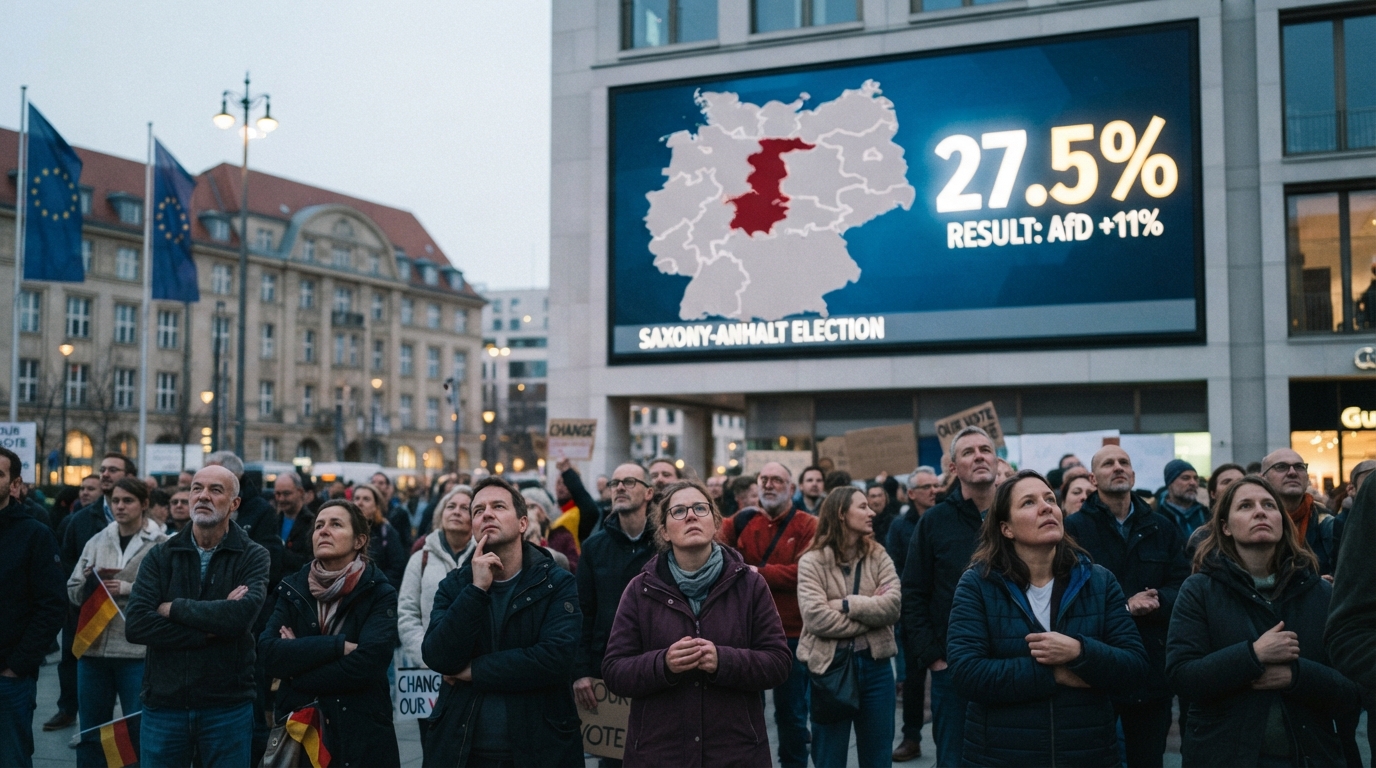
Europe grapples with the consequences of historic regional gains for Germany’s AfD
AfD lead candidate Ulrich Siegmund says the party has secured a clear mandate to govern
“Seismic”, “a socio-political earthquake”, “a watershed moment for Germany.”
That is how political analysts and many media outlets described the striking victory of the anti-immigration Alternative for Germany (AfD) in local elections in Germany on Sunday. But is that overstating it?
Saxony-Anhalt is one of the smallest of Germany’s 16 regions. It has just 1.7m of the country’s 59m eligible voters. How much political weight can it really carry, especially as the AfD fell just short of an outright majority?
The answer: very significant.
Above all, at home in Germany.
Although the vote was regional, its effects are national. The AfD landslide adds still more pressure on the already embattled centrist coalition government in Berlin. It could even become the final blow to the political career of Germany’s deeply unpopular conservative Chancellor, Friedrich Merz. He had pledged to reduce the AfD’s support.
These troubles will further weaken and distract Germany, the EU’s most powerful member, at a moment of continental crisis, as Europe tries to manage Russian aggression, Donald Trump’s tariff outbursts and the economic challenge from China.
The Saxony-Anhalt outcome also prompts reflection across Germany, where the Nazi past still casts a long shadow. This is the first major electoral landslide for a hard-right nationalist party since the fall of the Third Reich in 1945.
German authorities have described the AfD as partly anti-democratic, and several regional branches of the party, including Saxony-Anhalt, as far-right extremist.
The AfD is already known to be especially popular in east Germany, but it is now also polling as the largest political party nationwide.
It appears Germany’s political mainstream has failed voters. What should Europe’s biggest single economy, and its most populous nation after Russia, do now?
Small Saxony-Anhalt is also making waves beyond Germany.
The President of the United States himself quickly posted the Saxony-Anhalt exit poll on his Truth Social platform on Sunday.
The AfD’s anti-immigration, anti-woke, “Germany for Germans” message closely echoes Donald Trump’s MAGA line. Like several other nationalist parties in Europe, the AfD draws heavily on the Trump playbook — undermining mainstream media, questioning the neutrality of judges and promising to “make Germany great again”.
Still, it is worth noting that the US president is rarely mentioned by name on the campaign trail in Europe. Politicians know very well how unpopular he is with voters.
Close behind Donald Trump on social media on Sunday night was the influential Russian businessman Kirill Dmitriev, CEO of the Russian Direct Investment Fund. He called the AfD result “historic”, Germany’s national government “discredited” and the German Chancellor “humiliated”, comparing Friedrich Merz with the UK’s recently departed prime minister, Keir Starmer, who felt compelled to resign this summer.
You may ask what interest Russia has in German regional elections, and what Dmitriev’s swipe at the UK was meant to imply.
The German government is the largest single donor to Ukraine, and the UK is known to have supplied Kyiv with missiles used to strike inside Russian territory. That has deeply angered Moscow.
By contrast, the AfD is broadly pro-Russia. It wants to stop military aid to Ukraine, end sanctions on Moscow and resume buying much cheaper Russian energy. German industry, which is heavily dependent on energy, suffered a major economic blow after the country stopped importing Russian energy following the full-scale invasion of Ukraine in 2022.
The AfD’s softer stance toward Russia also has appeal in Germany’s east, which remains much poorer than the west. This is despite Germany spending between 2.3 and 3 trillion euros, depending on reports and whether inflation is included, to help integrate the former communist part of the country after the fall of the Berlin Wall in 1989.
Saxony-Anhalt is Germany’s poorest region and, as in much of east Germany, voters there often display what is known as “Ostalgie” — essentially “nostalgia in the east” for the comparatively more stable years under communism.
The European Union was also watching the Saxony-Anhalt election closely. The next 12 months are packed with elections across the EU. Votes are expected in major countries including France, Italy, Spain and Poland. Brussels fears that more “extreme” parties, especially on the right but also on the left, could gain ground across the board.
The leader of Spain’s nationalist Vox party, Santiago Abascal, wrote on X on Sunday that the AfD victory in Saxony-Anhalt was “a great hope for Germany and for Europe”.
By contrast, France’s Europe Minister, Benjamin Haddad, an ally of centrist President Emmanuel Macron, warned: “this is a serious moment in Europe, seeing the far right win in a regional election in Germany”.
Neither the AfD nor other European parties described as “extreme right” or “hard right” accept those labels. They also differ from one another in tone and policy. France’s National Rally under Marine Le Pen expelled the AfD from its European Parliament grouping two years ago for being too “radical”. What these parties do generally share, however, is an anti-immigration platform and strong nationalist rhetoric. And that deeply concerns the EU.
Whether the slogan is “Germany First”, “Italy First” or “France for the French!”, Brussels worries that the rise of nationalist parties is weakening European unity at a time when outside pressures make it more necessary than ever.
Nationalist parties such as the AfD or Italy’s League Party are often strongly Eurosceptic, but Brussels says Europe must remain united to resist Donald Trump’s bullying, for example, or to defend European business effectively against China’s dumping of goods.
Europe’s defence establishment also warns that cracks in European sanctions against Russia, or countries becoming lukewarm on Nato membership — as seen in Marine Le Pen’s National Rally, for example, or Germany’s AfD — only encourage Moscow.
Security officials say countries must stand together to stop Russia in Ukraine, otherwise the Kremlin may be tempted to strike inside Nato, including in the Baltic states.
The reality is that Europe’s voters are well aware of these external threats and how they affect life at home. They worry about the wars in Ukraine and the Middle East, about deteriorating health services and shrinking economic security for themselves and their families. Uncontrolled immigration and street safety are also major concerns.
That is where the importance of the Saxony-Anhalt vote becomes especially clear. It is a flashing red warning to traditional political parties, but also to institutions across Europe such as the judiciary and security services — those the AfD dismisses as the self-serving “Establishment”.
Voters across the continent feel abandoned and disappointed by parties they have backed repeatedly for decades. Turning to the right or left at election time does not mean they have all suddenly become extremist.
The AfD campaign slogan in Saxony-Anhalt was an upbeat “Anything is Possible!” along with a promise to make Germans proud of their country again. Still untested in government, people now seem increasingly prepared to give them a chance.