

“AfD’s success is not unexpected, the main issue is how the party will use it.” Expert on the election results in Germany
The victory of the radical "Alternative for Germany" (AfD) party in the elections in Saxony-Anhalt has the potential to bring this political force to power at the federal level for the first time. How could the AfD form a government? What does the result mean for the political system? "Dekoder" editor Dmitry Kartsev explains.
“The success of the AfD is not unexpected, the main issue is how the party will use it.” Expert on the election results in Germany
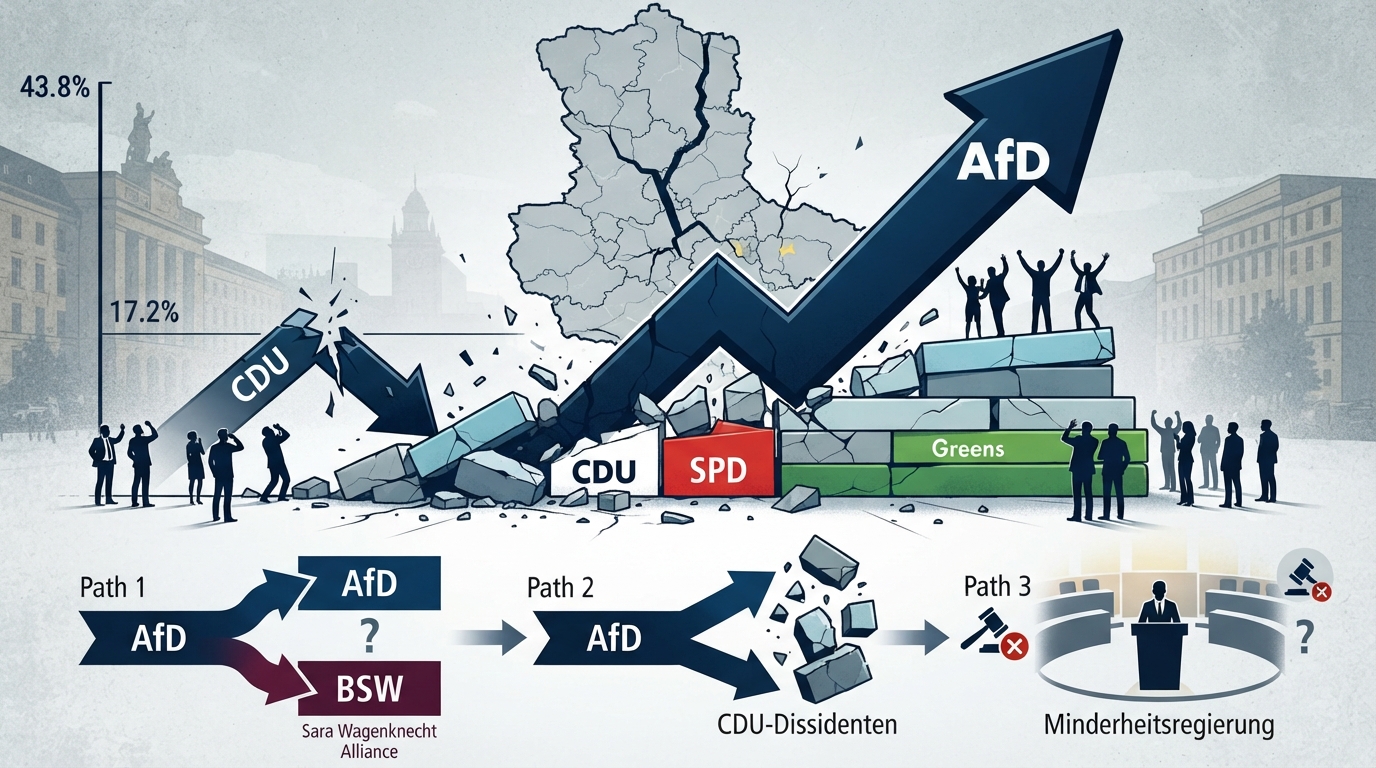
The results of the elections to the federal parliament (Landtag) of Saxony-Anhalt in Germany on September 6 caused a great resonance among the general public. The right-wing radical “Alternative for Germany” (AfD) party achieved a confident victory, gaining 43.8% of the vote. The Christian Democratic Union (CDU), which held power in this region, gathered only 17.2% of the vote. Chancellor Friedrich Merz said after the elections that a “tectonic shift” had occurred in the German party system.
Since the AfD did not secure an absolute majority of seats, the party is forced to form a coalition government. Germany's leading parties, including the CDU, adhere to the “brandmauer” (firewall) policy — this is what the refusal to cooperate with far-right parties in Germany is called. However, earlier the “Sahra Wagenknecht Alliance” expressed readiness for cooperation.
We discussed the election results, possible scenarios for forming a government, and the consequences of the AfD's growing influence on the German party system with Dmitry Kartsev, editor of the online publication “Dekoder”.
— This interest was related to the possibility of the ultra-right “Alternative for Germany” (AfD) party, classified by German special services as right-wing extremist, winning the elections. At the same time, it was not just about victory (such a situation was observed in the party's history two years ago in Thuringia — also in the east of the country), but about the possibility of winning an absolute majority of votes and forming a government independently. Until now, there has been no such case in any region.
It should also be noted that all other German parties have strictly refused to cooperate with the AfD — both in forming a coalition and in voting together.
— Specifically for Saxony-Anhalt, this result shows that at the moment the AfD is the most popular party in all areas of this federal state. Moreover, it leads in almost all socio-demographic groups. Previously in Germany, such forces were called “Volksparteien”, that is, “people's parties” capable of uniting almost all segments of the population.
I would also point out that the AfD won under conditions of a record turnout — almost 78% participation. The party managed to attract people who had not gone to elections before. These people did not go to vote not with the thought that “the Christian Democrats or Social Democrats will win anyway, everything will be fine,” but because they did not favor anyone before. And they liked “Alternative for Germany”.
Accordingly, now for the first time, the AfD has serious opportunities to form a government in this state. Several possible paths open up from here:
The first path:
Forming a majority government together with the “Sahra Wagenknecht Alliance”. This is a pro-Russian party with left-wing views on economic and social issues, while at the same time strongly opposing migration.
The second path:
Forming a majority government at the expense of “defectors” from other parties who would vote for the “Alternative for Germany” candidate Ulrich Siegmund for the post of prime minister in a secret ballot. Such “defectors” would be immediately exposed in subsequent voting processes on one bill or another.
The third path:
A minority government. There are formal procedures for this, and theoretically, it could happen. But whether the “Alternative for Germany” itself will agree to this is still unknown, because passing bills for a minority government is very difficult. Some things will work out, some will not. Therefore, it is not clear whether this model will work either.
— I cannot call the exact result obtained by the AfD unexpected — opinion polls showed that their probability of winning was very high. Two other factors were unexpected.
First, the success of Sahra Wagenknecht. Before the election, her party had already been “buried”, but she crossed the necessary 5 percent barrier. This is unexpected because her contradictory statements, including words about cooperation with the “Alternative”, seemed likely to alienate voters from her. In practice, on the contrary, she attracted various categories of the population, and Wagenknecht was able to gather supporters here and there.
Second, this was the extent to which the Christian Democrats collapsed. Polls showed them getting about 5 percent more votes than they actually received. It was about a possible result of 20–22 percent. However, in the end, they received only 17.2 percent of the vote, which is lower than even the most pessimistic forecasts.
Here, the context must also be understood correctly. Across Germany, the ratings of the ruling federal parties have dropped sharply. When elections to the Bundestag (German federal parliament) were held in 2025, the results for Saxony-Anhalt were approximately the same. But if we take another step back, the picture becomes even more interesting: in the elections to the Landtag of Saxony-Anhalt in 2021, the CDU gathered 37.1% of the vote. That is, the local Christian Democrats were much more popular than the federal party itself. And the elections on September 6 showed that this time they could not soften the mood of dissatisfaction with the federal party.
— Yes, it can claim. Precisely because the situation has taken an extremely unfavorable turn for the “traditional parties”. The problem is not only in Saxony-Anhalt. The main problem is that across Germany, the Christian Democrats and Social Democrats have become highly discredited.
During the Merz administration, the drop in the rating of the CDU/CSU (Christian Social Union) was about 10%. Although the decline in the rating of the Social Democrats was not as large (4% in total), considering their initial indicators, this represents a loss equal to that of the Christian Democrats. This is also their main headache.
For the AfD, this is an opportunity to present themselves as a force seriously claiming not only legislative but also executive power. They may try to put pressure on the CDU in order to cause an internal split over the issue of cooperation with the AfD. Or they will try to break up the government coalition and achieve early elections. They have been setting exactly this goal for themselves since the current coalition began working.
Currently, the media environment formed around the falling ratings of traditional parties provides them with such an opportunity. For the first time in the last five years, the result of a poll showing the CDU rating at less than 20% was published. This is approximately equal to the result at the time Merz took over the party leadership. That is, he is returning the party to what was considered a rather deplorable state at that time.
If we focus more specifically on what might happen if the AfD forms a government, the situation is as follows: if the party forms its own government, it can act in two different ways.
The first path: Quietly governing and passing laws that do not contradict the German Constitution.
These measures may not please some, they may be sensational, but they will formally remain within the law. For example, banning rainbow flags in schools (this is one of their favorite program promises), expanding the teaching of the Russian language in schools, cutting funding from the regional budget for research that the party does not like — for example, on gender or post-colonialism. All of this falls under the competence of the federal state government and in itself does not contradict the Basic Law. These are sensational, but not radical steps.
The second path: Taking the path of confrontation.
For example, trying to practically stop accepting refugees, slowing down the development of wind energy in some way, or expanding police powers, including to fight refugees. In such a case, the federal government will face the question: “Is it necessary to interfere in local state affairs or not?”
However, this will cause a full-blown constitutional crisis. First, the possibility of such intervention is indeed provided for in the Basic Law, but its implementation is very complex. Second, this in itself will be a major political move. Under conditions where the federal government's ratings are low, this could lead to unexpected and unpredictable consequences.
— There is such a possibility, but as I noted above, for now, the answer “no” is more appropriate.
An AfD representative could be elected thanks to the votes of some people within the CDU — for example, “dissenters”, dissidents, or opponents within the Christian Democrats. But after that, the question arises: what will they do after such a vote? If they leave the CDU and join the AfD or remain partyless, this does not yet mean that the “brandmauer” has been broken. But if they remain in the CDU and at the same time regularly continue to vote together with the AfD, this will be a completely different situation.
At the same time, I think that any initiatives of the AfD against open institutional structures will not arouse sympathy or a desire to join it in anyone. But if the party tries to do something within the framework of the Basic Law, perhaps someone might join it. It is not out of the question that this could turn into a form of “soft cooperation”.
However, in this case, the AfD itself faces the risk of losing a part of its radical voters — they may conclude that the party has become opportunist, that it only wants power. That is, the AfD also remains in a rather difficult situation. It could not win an absolute majority and now must rack its brains over how to manage its success.
There are different views on this within the party. The federal leadership in Berlin believes that they should try to run the government anyway. The local leader in Saxony-Anhalt, Ulrich Siegmund, as I understand it, does not really want to lead a minority government. Without support, he also does not want to go for coalition governance. That is, it is clear that he does not want to rule as a minority.
Therefore, the situation is quite complicated.
— It is difficult to say, because the situation is developing very rapidly, and I would avoid making firm predictions.
Merz now has several possible scenarios for the future. One of them is that his own party might rebel against him and suggest that he resign while maintaining the current coalition. He, naturally, wants to prevent such a scenario.
The scenario of the Christian Democrats cooperating with the AfD, I say again, has very big problems. This does not guarantee the return of voters to the CDU/CSU. In my opinion, the probability of this is not very high. Moreover, it will no longer be Merz's CDU. He will not lead a party that cooperates with the AfD. He has stated many times that he would never go for such cooperation, and it is difficult for me to imagine what could make him change his mind.
I think his current main political message consists of a call to “let's be patient a little longer.” Because the German economy, despite extremely unfavorable conditions, is seemingly showing some signs of recovery. The first growth figures have appeared, signs of increasing exports have emerged. In general, the economy has begun to give some positive signals despite the situation around the Strait of Hormuz, the hot summer, and other factors.
That is, this is talk about the need to wait for the results of reforms, because reforms are going on anyway. Another issue is whether there will be enough patience? Especially considering that Merz himself, as a communicator, does not calm the situation, but on the contrary, provokes anger. He always gives the impression of making society nervous and creating an additional anxious atmosphere instead of peace. Therefore, I am not sure whether there will be enough patience. We will see.
Now Merz does not have many choices. They must try to reach an agreement within the current coalition and with the current coalition partners. Another option is the dissolution of the coalition and re-elections. But this is also a difficult path and does not promise anything good to the Christian Democrats.
— The result of Saxony-Anhalt can by no means be directly transferred to the whole of Germany. The small cannot be equated to the large. Saxony-Anhalt, like any other German state, does not fully reflect the entire country. Germany is a very federalized state in this sense, and each state is a separate world. Although, of course, there are also general trends: for example, the growth of the “Alternative”, the decline of the old parties, and so on.
I think changes are possible. Now one can approximately imagine in which direction they will move.
Apparently, not only the “Alternative” but also the left — the Die Linke party — will radicalize. Because being in the radical opposition seems to bring political points now. It is clear that a three-way center will be formed: the Social Democrats, the “Greens”, and the Christian Democrats, because now two parties alone are no longer enough to make up a majority.
The “Greens” will probably try to present themselves now as the most reliable force combining centrism and the desire for change. But whether they can do this is a big question, because their anti-rating is still very high. In particular, I think one of the reasons why the “Alternative” achieved such a strong victory is that many voters, seeing the growing indicators of the “Greens” before the election, deliberately voted for the “Alternative” because they disliked them.
The main question is — what will happen to the CDU? How will it develop? Will there not be a major internal split there?
The second important question is — if the “Alternative” comes to power, what will happen to it itself? Because we have not seen it in power yet. I am referring for now to power at the state level, that is, in Saxony-Anhalt. This is also not out of the question to lead to problems and divisions within the party itself, because power is always a difficult test. In the absence of experience, things can go in a completely unexpected way.
Therefore, we will watch the situation. Changes, in all probability, will happen. But for me, the coming of the “Alternative” to power at the federal level is not inevitable. More precisely, I would say this: for me, the coming of the “Alternative” to stable and strong power is not an obvious fact.
They may come to power in some limited form — for example, through a minority government or in some other role. But so far, I do not see them becoming an absolute dominant force in German politics. Now many are thinking about this and expecting this, and many things seem to point to this. But if one looks deeper, it is not so yet.