

A vested interest
The Golden Fleece of Central Asia: How Wool and Leather Could Become the Region's New Industry
**The Hide and Skin Aspect**
Central Asia is commonly regarded as a major livestock breeding region, but the economic return from this specialization is most often evaluated solely by meat and milk production. This approach is too limited. Almost every farm animal simultaneously yields several types of industrial raw materials: wool, leather, hides, down, hair, fat, bones, collagen-containing raw materials, and other materials.
In a developed processing economy, livestock farming does not end at the slaughterhouse or the dairy plant. It continues at the tannery, the spinning mill, the shoe factory, the technical textile enterprise, the furniture factory, and the pharmaceutical or cosmetic production facility. It is there that a significant portion of the added value is created. Central Asia has the raw material base to build such a production chain.
In Kazakhstan, the sheep and goat population is numbered in the tens of millions, in Uzbekistan it also exceeds 20 million, and millions of animals are kept in Kyrgyzstan and Tajikistan. If we add cattle, horses, and camels, we are talking about a huge, annually renewable raw material base.
But the presence of animals in itself does not yet mean the presence of an industry. A significant portion of wool remains low-grade raw material, is sold cheaply, is used within households, or does not enter organized industrial circulation at all. A similar problem is observed with hides. An animal may be raised for several years, but after slaughter, its skin, potentially suitable for shoes, bags, furniture, or car interiors, becomes a secondary product with minimal value. As a result, the region generates income from primary agricultural products but loses the subsequent links of the production chain.
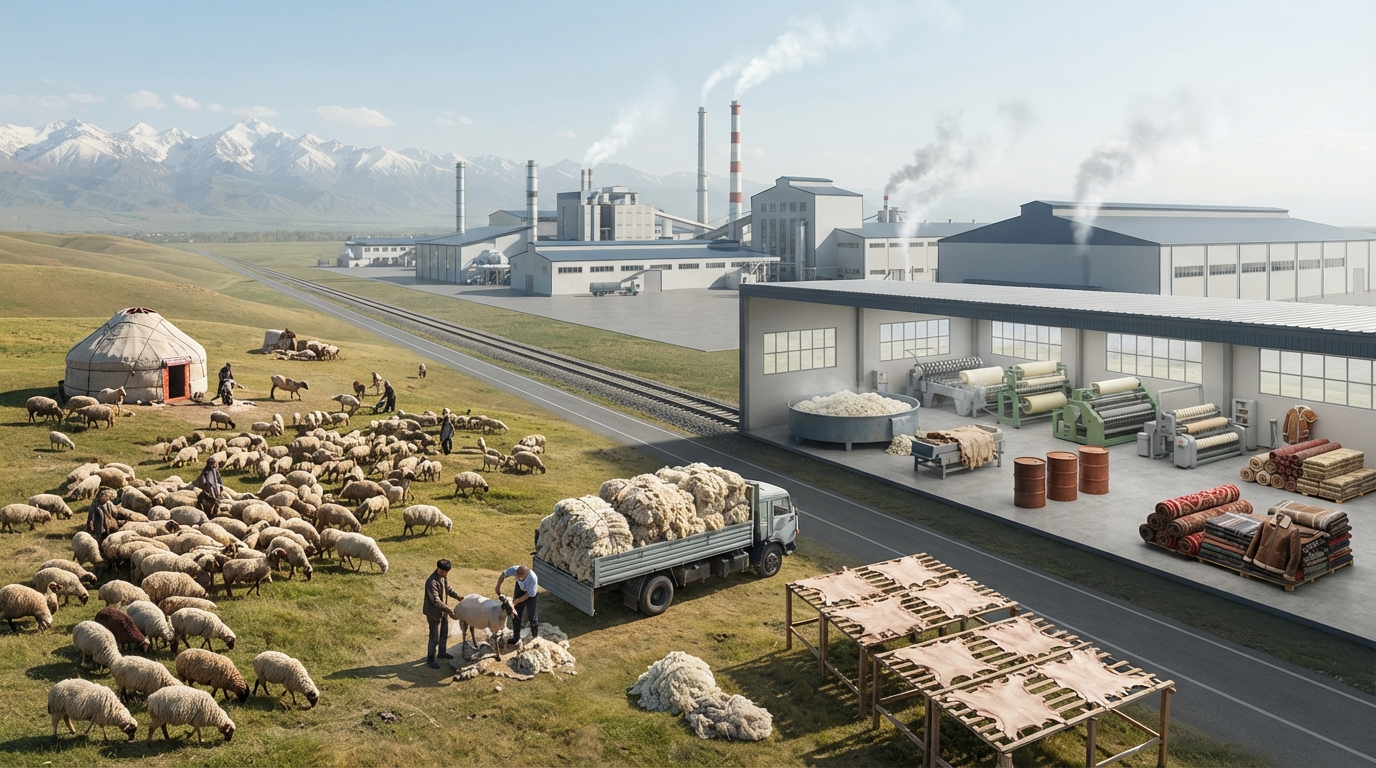
The example of wool is particularly illustrative. Between freshly sheared wool and a finished wool coat lies a long technological chain. The raw material must be collected, sorted by fiber length and thickness, cleaned, washed, degreased, dried, carded, spun into yarn, dyed, woven or knitted into fabric, and then made into the final product. At each stage, the value grows. At the same time, raw wool is often the cheapest part of the final product. Therefore, a situation where a state has millions of sheep but imports a significant portion of high-quality woolen clothing, fabrics, yarn, or home textiles is a classic example of a raw material gap.
For Central Asia, the problem is compounded by the structure of livestock farming. Wool is produced by thousands of farms, often small and distant from one another. The quality of the raw material is inconsistent, unified sorting is poorly developed, and it is often economically simpler for a farmer to sell the entire batch to a single intermediary than to separate the fiber into classes. The situation is even more difficult with coarse wool. It is noticeably cheaper than fine wool and is not always needed by the traditional textile industry. But low suitability for suit fabric does not mean a lack of industrial value. Coarse wool can be used for felt, carpets, technical fabrics, fillers, acoustic panels, thermal insulation materials, and interior elements. This means the issue is not only about improving the quality of existing raw materials, but also about finding an industrial application for each of its classes. Even material that is almost considered waste today can become a commodity if the technology is available.
With leather, the economic logic is even harsher. Hide is a perishable raw material. If it is flayed incorrectly, preserved late, or stored in unsuitable conditions, its future value drops sharply. Cuts during slaughter, contamination, parasites, improper salting, and long transportation can turn potentially valuable leather raw material into low-grade material. Therefore, the leather industry begins not at the factory, but effectively on the farm and at the slaughterhouse.
For the region, this is fundamental. It is impossible to create a modern production of high-quality leather simply by buying Italian or Turkish equipment. A unified quality control chain is needed—from animal husbandry to flaying, primary preservation, sorting, and delivery to the processor. Then the industrial stage proper begins: soaking, liming, tanning, dyeing, drying, finishing, and producing finished leather with specified characteristics. After that, another level of added value arises—shoes, belts, bags, gloves, furniture, automotive components, and other products. Depending on the depth of processing, the same starting material can go from a cheap raw material sold by weight to a finished product whose price is already determined by design, workmanship, and brand. It is this transition from a kilogram of raw material to a unit of finished goods that constitutes the main economic sense of deep processing.
Central Asia has several objective advantages for forming such an industrial complex. The first is the scale of livestock farming. Kazakhstan possesses vast pasture territories, Kyrgyzstan and Tajikistan have a centuries-old tradition of mountain livestock farming, and Uzbekistan combines a large livestock population with a developed light industry and a large domestic market.
The second advantage is the geographical proximity of the countries to one another. An individual state does not necessarily have to create absolutely all links of the chain on its own. Regional specialization can be economically more rational: primary sorting can be concentrated in one place, wool washing and yarn production in another, leather production in a third, and the manufacture of shoes, clothing, or furniture in a fourth.
The third advantage is the already existing competencies in textiles. Central Asia has long been developing cotton processing, especially Uzbekistan, which in recent years has significantly increased the production of yarn, fabrics, and finished garments. Wool is technologically a different raw material, but a developed textile environment means the availability of personnel, sewing enterprises, logistics, equipment, export channels, and experience working with international clients. The fourth factor is labor resources. The production of finished goods is much more labor-intensive than the export of raw wool or semi-finished products, which means that processing can create jobs not only in large cities but also in small district centers near livestock farming areas.
The region's potential is not limited to traditional clothing. This is particularly important because competing solely in the mass wool fabric market would force Central Asia to compete with major producers that have decades of technological experience. Broad diversification is much more interesting. Wool can be used for carpets, rugs, blankets, felt, insulation, designer interior panels, and technical textiles. Camel wool and down have their own market niche. Goat down, with appropriate breeding, sorting, and processing, can become the basis for higher-end products.
There is a historical culture of felt product manufacturing in the region, which today can be viewed as more than just a craft or souvenir industry. Modern technologies make it possible to produce acoustic materials, interior coverings, and furniture elements from natural felt. For leather, the market is even wider: footwear, leather goods, upholstery materials, work gloves, protective gear, furniture, and transport components. Even tannery waste, with the right technological organization, can be used to obtain collagen, gelatin, and other products. In this case, the livestock economy ceases to be a linear "raise-slaughter-sell" scheme and turns into a multi-stage industrial system.
The main obstacle is not the lack of raw materials, but their fragmentation. A processing enterprise needs a predictable flow of standardized material. A factory cannot operate efficiently if it receives 20 tons of one quality today, 5 tons of another in a week, and then stands idle for a month. Therefore, a large livestock population in itself guarantees nothing. Collection infrastructure is needed. The region requires wool and hide collection points, quality determination laboratories, standardized sorting, refrigeration and warehouse capacities, and batch traceability systems. For wool, fiber thickness, length, strength, contamination, and uniformity are particularly important. For leather, size, the presence of mechanical damage, surface condition, and preservation quality are key. As long as the buyer takes raw materials almost "by eye," the farmer has little motivation to improve their quality: additional labor may not yield additional income. When the price begins to depend on measurable characteristics, an economic incentive appears to change breeding, feeding, shearing, housing conditions, and primary processing. In essence, industrial modernization must begin with a clear quality system at the very bottom level of the chain.
There is also a separate environmental problem. Classic leather production is associated with high consumption of water, chemical reagents, and the generation of polluted wastewater. Therefore, simply increasing the number of small tanneries could create more problems than economic benefits. A modern industry requires treatment facilities, water recycling, chemical control, and centralized industrial sites. A similar logic applies to wool washing: fat, organic impurities, and other contaminants are removed from the raw material, which means a full-fledged water treatment system is needed. But environmental requirements simultaneously open up an opportunity for technological renewal. New production can be initially designed to more modern standards, rather than trying to modernize old factories decades later. In addition, wool itself aligns with the growing global interest in natural, renewable, and biodegradable materials. Natural wool insulation, for example, competes not only with other textiles but also with synthetic building materials. This fundamentally expands the potential market.
Ultimately, the issue of wool and leather for Central Asia is much broader than agriculture. It is about the region's ability to turn its own raw materials into an industrial product. An economy loses not when it sells raw materials as such, but when raw materials are exported or fall out of economic circulation due to the lack of next-stage processing technologies within the country. One sheep yields a relatively limited financial result if the economy sees only meat in it. But the same livestock base becomes part of a much more complex system if the meat goes to the food industry, the wool to textiles and technical materials, the leather to shoe and furniture production, and the by-products to chemical, cosmetic, or pharmaceutical processing. With tens of millions of animals, the scale of this difference ceases to be minor. Central Asia already possesses the main starting resource—large-scale livestock farming. What is missing above all is the connecting industrial layer between the pasture and the final market. If this gap is narrowed, wool and leather can turn from a by-product of agriculture into an independent direction of industrialization. And then the value of the region's livestock farming will be measured not only by the amount of meat and milk produced, but also by the amount of finished goods obtained from each animal within its own economy.