

Why does a ready-made factory not make a country rich? EDB names the industrial path for Uzbekistan
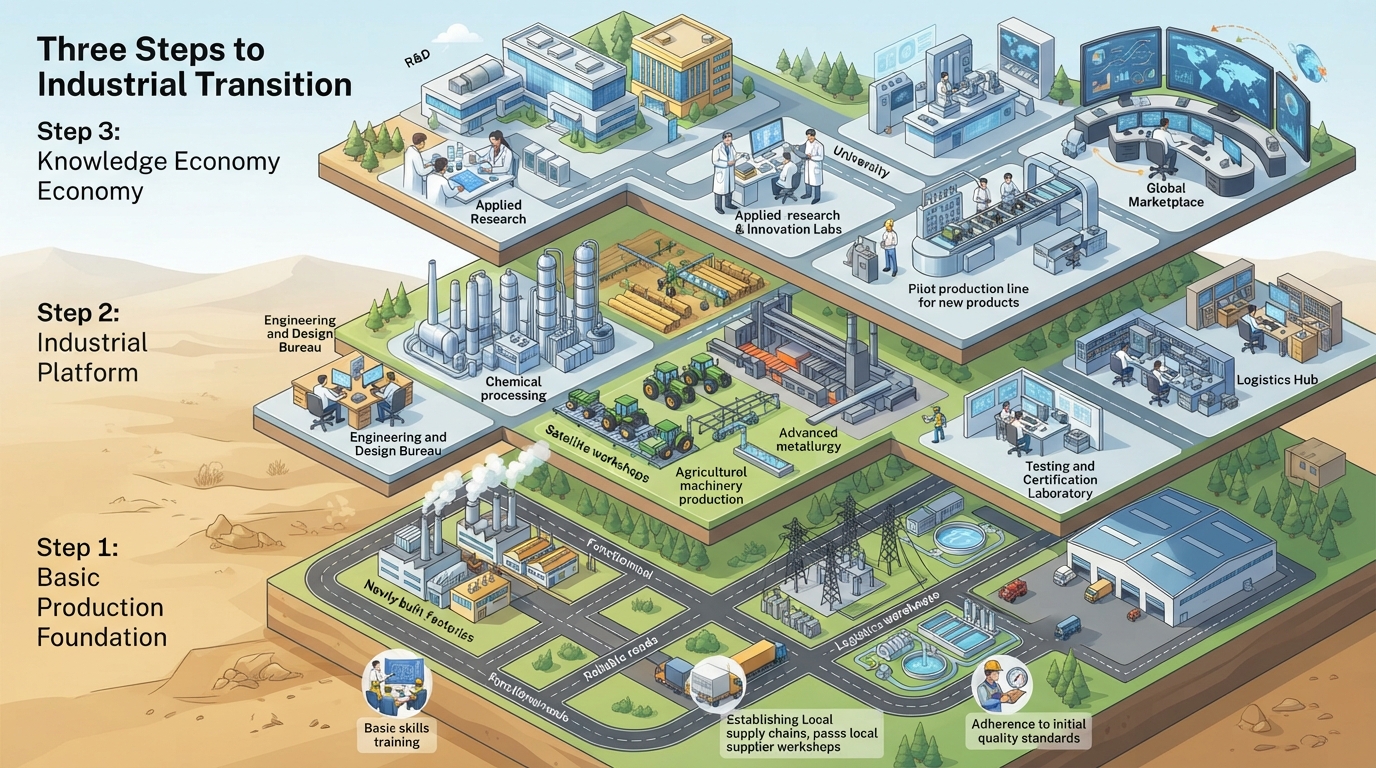
Why a ready-made factory does not make a country rich: EDB outlines industrial course for Uzbekistan
For Uzbekistan, simply attracting investment, purchasing modern equipment, and opening new factories is not enough to join the ranks of high-income countries. To advance further, it is necessary that, along with domestic production, technologies remain in the country, and local suppliers, engineers, standards, services, proprietary developments, and competencies emerge. This is pointed out by analysts of the Eurasian Development Bank (EDB), who proposed a new model of industrial transformation for developing economies.
### Competence cannot be bought
Today, the middle-income group includes 108 economies, home to about 6 billion people. Since 1990, only 34 of them have managed to transition to the high-income category. At the same time, in 2021–2023, 95 out of 143 developing economies remained commodity-dependent: raw materials accounted for more than 60% of their merchandise exports. High resource prices can provide rapid growth, but they do not guarantee a sustainable transition to a wealthier economy.
The EDB explicitly emphasizes: it is not enough for a developing economy to increase investment and acquire modern equipment. External technology must become an internal productive capability — that is, engineers and technologists, a network of suppliers, standards, service, repair, design, and the ability to improve processes.
This does not mean a call to close off from imports or reject foreign investors. On the contrary, openness is still necessary. But its result is proposed to be evaluated not by the number of imported machines or even the number of launched enterprises, but by how much equipment imports, foreign direct investment, and participation in international chains increase local value added and transfer knowledge within the country.
Why is industry so important here? According to estimates presented in the new report, the manufacturing sector was associated with 64% of economic growth episodes over the past 50 years. One job in industry on average supports another 2.2 jobs in logistics, construction, services, education, and other related fields.
### Is Uzbekistan transforming?
In the EDB's regional model, Uzbekistan, along with Kazakhstan, is classified in the group of "resource-scale transformers." By this, analysts mean countries that simultaneously possess a resource and energy base, agricultural potential, and a sufficiently large domestic demand. Their task is not to stop at raw materials and primary processing, but to move up the value chain: to turn resources into chemical products, more complex metals and products, electrical engineering, machinery, and components.
For Uzbekistan, the highest scores in the sector map were received by chemistry and polymers, as well as industrial machinery — 4.71 points each. These are followed by the food industry and deep agricultural processing — 4.62, transport components — 4.61, agricultural and irrigation equipment — 4.58, fertilizers and agrochemistry, as well as light industry and technical textiles — 4.55 each. Electrical engineering and pharmaceuticals received 4.50 points each.
Importantly, these scores do not mean a single "stage of development" for the entire country. Chemistry and industrial machinery are assigned to the second stage — when suppliers, engineering competencies, standards, and project financing are already particularly important. The food industry, agricultural machinery, fertilizers, and textiles are between the first and second stages. Pharmaceuticals is between the second and third, where proprietary research and commercialization of solutions are added to the production platform. In other words, basic production, mature industrial platforms, and individual innovative niches can coexist simultaneously in the same economy.
The EDB suggests choosing directions not by prestige, but by a combination of demand, resources, already available competencies, technological proximity, infrastructure, and the ability to finance the project. Therefore, a conditionally complex factory, for which there are no engineers, suppliers, and testing facilities in the country, can produce beautiful investment statistics, but a weak effect for the entire economy.
### Neighbors have other tasks
The report does not compare Uzbekistan with its neighbors on a "who is better" basis. Countries are assigned different roles within a single regional industrial system. Russia and Belarus are designated as the industrial core: they have higher starting competencies in complex machinery, components, engineering, and a number of technological niches. Kazakhstan, like Uzbekistan, must process its own resource base more deeply. Armenia, Kyrgyzstan, and Tajikistan are viewed rather as niche and cooperation hubs capable of specializing in individual components, services, and segments.
The figures clearly show the differences. In Russia, industrial machinery receives 4.97 points, transport components — 4.94, chemistry and polymers — 4.91. In Belarus, machinery leads with 4.93 points, followed by agricultural and irrigation equipment — 4.84 and transport components — 4.83. For Kazakhstan, chemistry and polymers are in first place — 4.87, followed by high-value metallurgy — 4.84 and critical materials — 4.83.
Small economies have a different profile. In Armenia, pharmaceuticals and medical devices are rated highest — 4.49, electronics and components — 4.47. In Kyrgyzstan, light industry and technical textiles lead — 4.40, followed by food and agricultural processing — 4.29. In Tajikistan, metallurgy and metalworking received the highest score — 4.27, followed by light industry — 4.21 and critical materials — 4.15.
### Three steps instead of one big leap
The model proposed by the EDB is built on three consecutive stages. The first is the basic production foundation. Here, a country needs reliable energy, transport, water, industrial sites, warehouse infrastructure, basic standards, and mass vocational skills. The main goal is to ensure stable output and create the first networks of suppliers.
The second stage is the industrial platform. At this level, simply producing is no longer enough: deeper processing, machinery, chemistry and metallurgy, certified suppliers, engineering centers, long-term financing, and the ability to adapt imported technologies to local conditions emerge. For many of Uzbekistan's priority sectors, this stage currently looks key.
The third stage is the knowledge economy. Here we are talking about applied research, pilot lines, intellectual property, new products, and their commercialization. But analysts separately warn: jumping here without building a production platform is difficult. Individual technology companies may appear earlier, but the mass sophistication of the economy requires personnel, suppliers, standards, and financing.
### What this means for Uzbekistan in practice
A new factory should not be launched in isolation. Around it, training programs, local suppliers, engineering support, testing laboratories, certification, service, long-term financing, and market access channels must emerge simultaneously. The EDB proposes to consider as a full-fledged industrial transition project only one that has four mandatory packages: personnel, technological mastery, quality infrastructure, and financing of piloting with subsequent scaling.
This also changes the meaning of localization. Assembling a finished product from imported components is only the first step. A more valuable stage begins when local companies start producing components, repairing and upgrading equipment, redesigning processes, meeting international standards, and selling products outside the domestic market.
The same logic applies to foreign investment. For 2016 – the first half of 2025, the volume of mutual accumulated direct investment in the Eurasian region reached $48.4 billion. But manufacturing accounted for $9 billion, or 18.4%. The EDB suggests attracting an investor not just with a tax incentive, but with a ready-made offer: a site, infrastructure, local partners, personnel, future suppliers, financing, and an export market.
Another principle is market testing. Broad subsidies and large programs should not be launched just because an industry looks promising. First — a pilot, private co-financing, demand, and proven competitiveness. If a project does not pass the market test, its scaling creates the risk of expensive capacities that exist through constant support.
### Why it is important for our country to develop foreign markets
For some complex industries, the market of Uzbekistan may be insufficient. The combined market of the EAEU and Central Asia is estimated at approximately 180–220 million people. Already, the region on average accounts for about 59% of sales of second-stage processing products.
This is precisely where the sense of division of specializations arises. Uzbekistan and Kazakhstan can deepen chemistry, metallurgy, electrical engineering, and equipment production; Russia and Belarus can supply more complex components, technologies, engineering, and standards; small economies can occupy specialized niches. The EDB formula actually boils down to "different competencies — a single industrial system," where national enterprises get a market larger than their own.
The bank rates the potential of such a model highly. In a previous EDB study, the scenario development of four interconnected complexes — chemistry, machinery, high-value metallurgy, and the food industry — yielded over $510 billion in annual additional output in 2019 prices.
### Main conclusion
The republic's industrial base is viewed as the foundation of growth. But the commissioning of capacity itself is the beginning, not the result. If, after launch, an enterprise remains a technological island dependent on imported parts, foreign service, and external engineers, its contribution to long-term development is limited.
More complex and much less visible work begins after the workshop opens: it is necessary to teach local specialists to maintain and improve technology, grow dozens of suppliers around a large enterprise, bring their products up to standards, create engineering and testing competencies, and bring the chain to export. It is this transition — from purchased equipment to proprietary production knowledge — that analysts consider the boundary between a simply growing economy and an economy capable of sustainably transitioning to a higher income level.
For Uzbekistan, this is particularly relevant right now: the most promising directions in the EDB's assessment are already at the stage of sophistication. Chemistry, machinery, transport components, agricultural machinery, electrical engineering, and pharmaceuticals require not only capital, but also engineering depth.