

A proposal has been developed to increase the fine for fare-evading bus passengers by 5 times
In one year, fines amounting to 2.7 billion UZS were collected from more than 113 thousand ticketless passengers on Tashkent buses. The Ministry of Transport is proposing to increase the fine for fare evasion by 5 times. "This is aimed at improving the culture of using public transport," officials said.
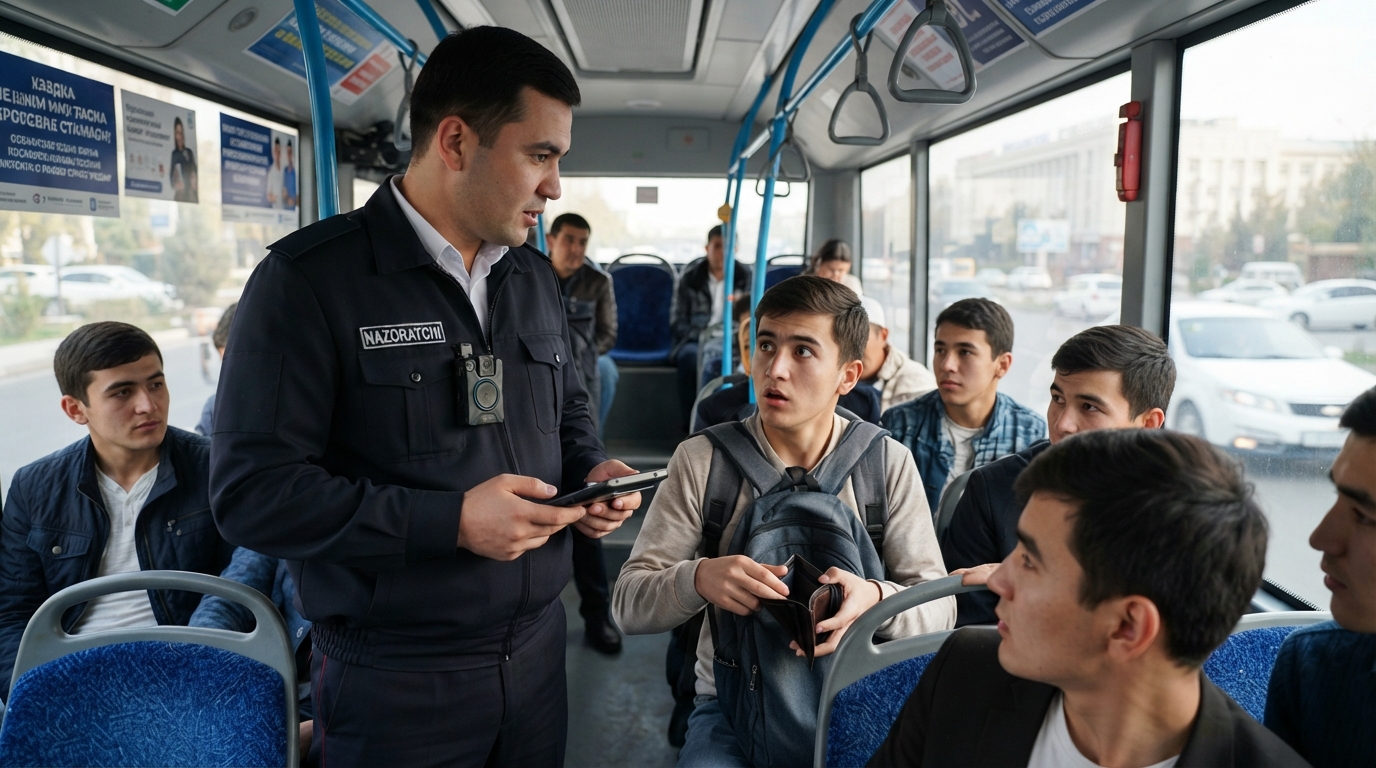
Proposal Prepared to Increase Fine for Fare-Evading Bus Passengers 5-Fold
Over the course of one year, administrative protocols were drawn up for more than 113 thousand fare-evading passengers on Tashkent buses, and 2.7 billion UZS in fines was collected.
According to Mamanbiy Omarov, buses in Tashkent make 24 thousand trips per day. Based solely on cases identified by officials, every day more than one thousand passengers disembark without paying the fare. He noted that these figures reflect only detected cases, and in practice, the actual number could be higher.
According to Mirakbar Ikromov, fare-evading passengers make up 8–10 percent of the total passenger volume. On certain routes, this figure exceeds 10 percent.
He emphasized that starting from September 1, 2026, passengers are required to pay the fare upon boarding the bus. Resolution No. 276 of the Cabinet of Ministers dated June 3 of this year granted inspectors the authority to check inside the bus cabin whether passengers have made the payment. While they previously conducted raids mainly at intermediate and terminal stops, under the new procedure they can also carry out monitoring inside the bus.
Ikromov stated that the new procedure has expanded opportunities to identify fare-evaders. Inspectors are engaged in identifying passengers who systematically fail to pay on specific routes and taking measures against them.
“Our inspectors are human too. During peak hours, it is not easy to walk from the front door to the rear door of the bus and check everyone. Therefore, we instructed them not to move inside the bus during such times and to conduct checks when it is less crowded,” he says.
Mirakbar Ikromov reported that 98 percent of non-paying passengers are under 30 years of age. He stated that the activities of ticket inspectors are also monitored: all inspectors are provided with body cameras and tablets. These devices allow monitoring which route's bus they have boarded, their actions, and their conduct culture with passengers.
“Inspectors are not given a mandatory quota to catch a specific number of violators per day. We also monitor the quality of their work,” says Ikromov.
Navruz Ashurmatov stressed that fare payment discipline is directly linked to improving the quality of public transport. Fully collecting funds received from passengers is important in covering part of transport operational costs.
“Passengers must feel the obligation to pay their fare on time. We see that fare evasion cases are high among those under 30. However, preferential transport cards have been introduced for pupils and students. They provide a 50 percent discount on fares,” says Ashurmatov.
In his opinion, public control regarding non-paying passengers must also be strengthened. If a payment culture is formed in society and the vast majority of passengers pay the fare in full, the need for inspectors will decrease.
According to Mirakbar Ikromov, after the public transport fare increase on October 1, no increase in the number of fare-evading passengers was observed. On the contrary, a record was set for the number of passengers transported in a single day compared to last year — buses served 1 million 520 thousand passengers.
He reported that over a one-year period, specifically from October 2025 to October 2026, administrative protocols were issued for more than 113 thousand fare-evading passengers, and 2.7 billion UZS in fines was collected.
Ikromov mentioned that the Ministry of Transport has developed a proposal to increase the fine amount for non-payment of fares. Currently, the issue of raising the current 44 thousand UZS fine fivefold is being coordinated with ministries and agencies.
“This is proposed not to increase revenue to the budget, but rather to influence the culture of public transport usage,” he says.
Navruz Ashurmatov emphasized that the fine amount should act as a deterrent to violations. If a passenger does not feel the fine financially, they may repeat the violation and make a habit of it.
“If a passenger feels the impact of the fine in their own pocket, next time they will try not to commit a violation. If they do not feel the financial damage, they will keep repeating the violation and eventually get used to it. In international practice as well, strict control measures are applied against fare-evading passengers, and in developed countries, fine amounts are significantly higher,” says the ministry spokesperson.
According to Mamanbiy Omarov, public transport operators are paid for every kilometer driven. Revenue collected from passengers is directed to a fund, and if the money is insufficient to cover expenses, the remaining portion is subsidized from the state budget. Therefore, raising the fare does not mean a reduction in state expenditures.
He emphasized that state funds are spent not only on covering bus expenses, but also on purchasing new buses and increasing the number of routes.
Omarov stated that public transport fares in Uzbekistan rank among the five cheapest in international comparisons. In his view, per capita income and gross domestic product indicators must also be taken into account here.
“The basis for this lies in our president's social policy 'For Human Dignity'. We are, after all, a social state. Fares have not been increased over the past three years. If prices had been raised by 200–300 UZS every year, it would not have been as noticeable. But to be frank, the state budget is also limited. Therefore, along with transport expenses, funds must also be allocated for schools, hospitals, and other social facilities,” says the deputy minister.
Mirakbar Ikromov reported that in 2025, 1.8 trillion UZS was allocated from the budget for public transport in Tashkent. Payments made by passengers amounted to 600 billion UZS. Thus, last year one-third of transport expenses was covered by passenger payments.
According to him, the prime cost of carrying one passenger by bus in Tashkent currently stands at 5,580 UZS. Next year, plans include bringing in another 500 buses, increasing the number of routes, and shortening interval times. This will impact the increase in public transport expenses.
“According to current forecasts, public transport expenses next year are expected to reach 2.7 trillion UZS. With the fare set at 2,500 UZS, revenue from passengers may reach approximately 1 trillion UZS. The remaining 1.7 trillion UZS will be covered from the state budget. This means that over 60 percent of the total costs will fall on the state,” he says.
Navruz Ashurmatov noted that even though the tariff has been raised, more than half of public transport expenses are covered by the state. Passengers, meanwhile, when using multiple modes of transport, can take advantage of transfer tariffs and tariff packages that offer savings depending on the number of trips.
According to him, ATTO preferential cards have been introduced for pensioners, pupils, and students, providing a 50 percent discount on fares. Certain banks are also participating in transport payments, offering cashback for every trip.