

A modern chronicle, or the world held in the palm of a hand
In ancient times, a person traveled for years to see a foreign land. Dust rose from behind the caravan, the sun
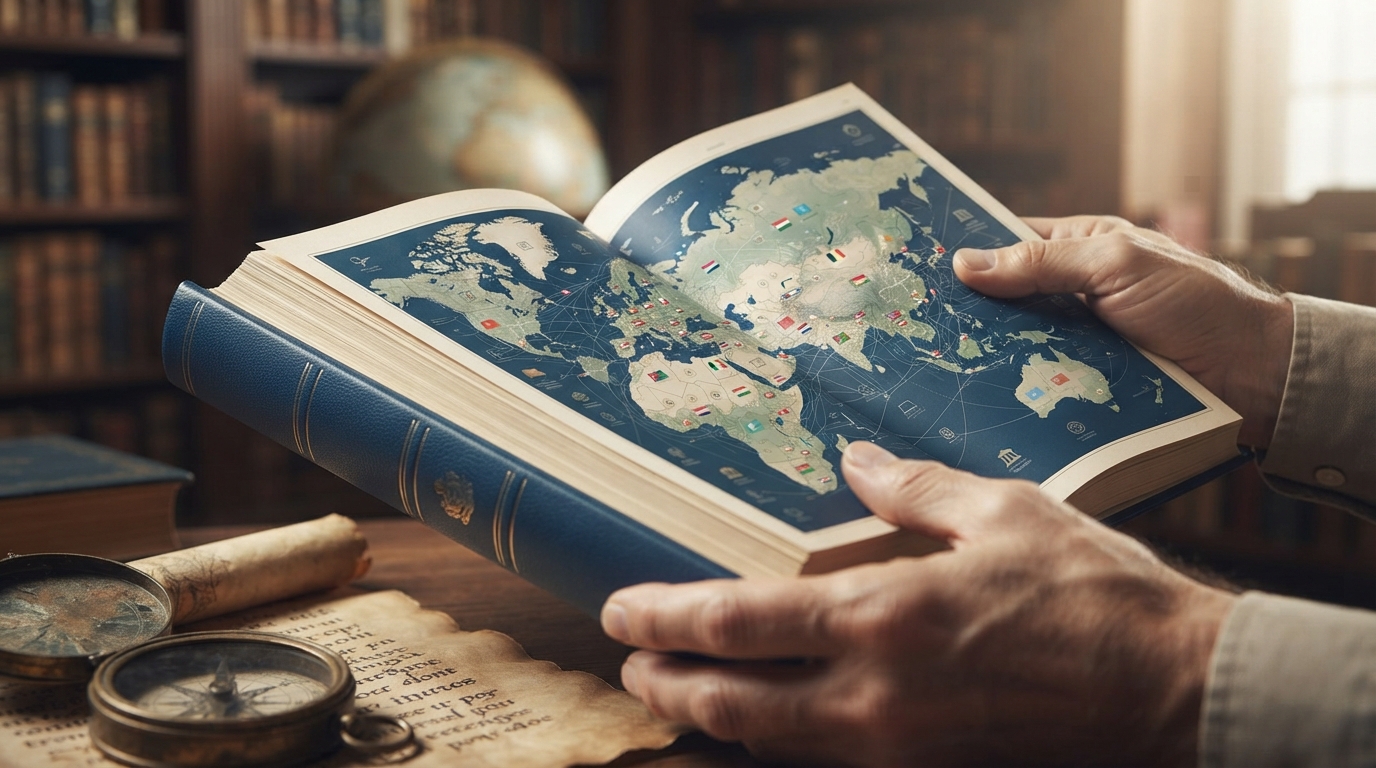
**A Modern World Almanac or the World Held in One's Palm**
In ancient times, a person traveled for years just to see a foreign land. Dust rose behind the caravan, the sun scorched, and snow covered the mountain passes. By the time the traveler reached their destination, they had either grown old, changed, or were unable to return.
Today, however, one second is enough to hear the name of a country on the other side of the world. Yet there is a vast distance between a name and knowledge. Hearing is not knowing; seeing is not comprehending. Modern humans do not suffer from a lack of information. They need knowledge organized into an orderly system that can navigate the sea of information, distinguishing the true from the false, and the essential from the fleeting.
It is precisely this need that makes encyclopedic books more valuable than ever. An encyclopedia is a "quiet teacher" that imparts knowledge unhurriedly, reliably, and systematically. No one feels embarrassed before it, and no one lags behind. Both a young child and a doctor of science take their share from it.
The book "Countries of the World" by Laziz Rahmatov, Doctor of Philosophy (PhD) in Political Sciences and member of the Writers' and Journalists' Unions of Uzbekistan, takes its place among such unique teachers. The accomplished academician Akmal Saidov describes this work as a substantial encyclopedic source that allows one to "virtually discover" the countries of the world. Meanwhile, the renowned writer Khurshid Dostmukhammad called it a "unique world almanac."
This description itself carries deep meaning. A world almanac is a book about the world, and at the same time, it is a guidebook for the reader facing the world.
As authors, we view this book through the lens of a pedagogue and researcher. Our many years of research have been dedicated to pedagogical skills, speech culture, the art of public speaking, the hermeneutic ability of a teacher—which serve as criteria for quality education—as well as the old Uzbek script and Uzbek folk books. From this perspective, "Countries of the World" is not just a simple reference book, but arouses great interest as an effective tool in the process of education, upbringing, and enlightenment.
**What is an Encyclopedia: Not Volume, but Criteria**
Akmal Saidov, a prominent scholar who compiled the encyclopedia of the world's constitutions, poses an apt question in the preface: can any large-volume book with many pages be called an encyclopedic source? The answer is no. The word "encyclopedic" (qomusiy) is derived from Arabic, meaning "comprehensive" or "all-encompassing." An encyclopedic source is a fundamental work that systematically, scientifically, and thoroughly covers all branches or a specific field of knowledge accumulated by humanity.
Its first criterion is comprehensiveness: facts, historical events, personalities, and concepts are presented not superficially, but with deep analysis. Its second criterion is reliability: such a source relies on precise evidence.
Three main characteristics of an encyclopedic book are also highlighted:
Striving to systematically understand the world is not new to Uzbek thought. Mahmud al-Kashgari attempted to show the location of Turkic peoples on a world map in his "Dawan Lughat at-Turk." Beruni left an immortal example of objectively studying a foreign culture in his work "India." Babur described the lands he saw with precise observation and refined artistic taste in the "Baburnama." Thus, knowing the world is a thirst that has existed in our spiritual heritage since ancient times. "Countries of the World" can be evaluated as one of the 21st-century modern responses to this thirst for knowledge.
**Structure and Content of the Book**
This publication of nearly 1,200 pages provides detailed, selected, and accurate information on 236 countries, territories, and territorial units. Because the information is arranged alphabetically, the reader does not waste extra time finding any country. To keep the text concise, international organizations—such as the UN, NATO, UNESCO, CIS, EU, OSCE, SCO, CSTO, and others—are presented with acronyms.
The chapter dedicated to each country follows a specific consistency. Starting with a brief general description, it reveals the following layers:
One of the most noteworthy aspects of the work is that our country's bilateral and multilateral relations are presented in chronological order. Today, Uzbekistan has established diplomatic relations with nearly 170 countries worldwide; the number of our diplomatic and consular missions abroad has reached 65, and the number of strategic partner states has reached 22. The book dwells more extensively on these states. In this way, in addition to answering the question "what is the world like?", it also answers a question crucial for every compatriot: "what is our place in the world?"
The book also contains rare information. Nearly 4,000 names of individuals are recorded in various places across the encyclopedia, and interesting facts about that state are provided at the end of each country's chapter. This enhances the popular-science character of the book.
The publication is also visual: it contains approximately 1,000 color photographs, flags, and maps that visualize the geographical and political landscape of our planet. In the language of educational theory, the harmony of text and image significantly facilitates the retention and understanding of information.
**Advantages: Why This Specific Book?**
The advantages of the book can be seen in several directions:
**Scope and Systematization.**
Each of the 236 countries and territories is covered based on a single framework. This provides an opportunity for comparison and contrast. The reader can compare the forms of governance, economic potential, or foreign relations of two states with each other and draw an independent conclusion. Comparison, after all, is one of the most effective tools for developing thinking.
**Novelty and Relevance.**
The earlier, more concise edition of the book was published in 2019 by the Gafur Gulyam Publishing and Printing Creative House. Over the past seven years, many events have occurred on our planet. The fact that this edition, being published in October 2026, includes news up to that very month transforms the work from a merely "readable" source into a "living" one. If an encyclopedia becomes outdated, it turns into a monument of the past rather than a source of knowledge; the author demonstrates the ability to update the progression of events and figures in subsequent editions of the book as well.
**Author's Personality and Experience.**
Laziz Rahmatov worked as an editor at the "State Scientific Publishing House of the National Encyclopedia of Uzbekistan"; he is a diplomat and political scientist with rich practical experience in foreign policy. The combination in one person of an editor's textual discipline, a diplomat's practical eye, and a scholar's analytical capacity directly impacts the quality of the book.
**An Approach in the Spirit of National Interests and Values.**
It is noticeable that when writing about each state, the author approaches the processes through the lens of our national interests, our values, and age-old traditions. An encyclopedia must be objective, yet this book was written through the eyes and warm heart of an Uzbek reader, making it close to the Uzbek audience.
**Scale of Creative Labor.**
Usually, scientific institutes or editorial teams are mobilized for such work. However, the author conducted this work starting in 2016, and an editorial board was established during the research, involving more than 50 scholars. It is truly an educational achievement for a single creator to persistently bring such a complex process to completion over so many years.
**Visual Presentation.**
Nearly one thousand photographs, flags, and maps transform the book from a "dry reference" into a "living mirror of the world." Relief maps clearly show where the gardens, mountains, deserts, and water bodies of a country are located. In educational theory, "visual learning" has always been considered one of the most powerful methods.
**Pedagogical Significance**
From the perspective of pedagogical skill, the criterion for quality education is the teacher's skill. A skilled teacher is not one who delivers knowledge ready-made, but one who leads the student toward knowledge. Such a guide needs a reliable and large-scale source.
"Countries of the World" can serve as ready material to enrich the content of lessons in geography, history, social sciences, foreign languages, international relations, and even literature and art. For example, a teacher can assign students the task of preparing a "country passport": a brief factsheet covering location, form of governance, economic potential, and relations with Uzbekistan.
This assignment matches the book's own structure perfectly and teaches the student to work with sources, select facts, and express ideas concisely and precisely.
**From the Perspective of Speech Culture and Public Speaking**
There is an ancient rule of public speaking: the beauty of a speech relies on its substance. A speech without substance is mere noise. For a speaker, reliable and precise evidence serves as the supporting pillar of the speech. An encyclopedic book is precisely such a source of evidence. When a diplomat, journalist, teacher, or student speaks on an international topic, they must accurately state country names, leadership, participation in international organizations, and dates. An incorrect figure or wrong name destroys credibility.
Furthermore, the language of the book is concise and clear. This conciseness serves as a practical exercise in developing speech culture: a reader can read a one-page chapter and turn it into a one-minute oral presentation. There are few better ways to form a brief, orderly, and fact-rich speech.
**From the Perspective of a Hermeneutic Approach**
Hermeneutics is the art of understanding and interpreting text. A teacher's hermeneutic ability manifests in being able to see the meaning behind the text, the cause behind the event, and the process behind the figure. An encyclopedic text, due to its conciseness, requires interpretation. Behind phrases like "strategic partner," "center of international dialogue," or "reform program" lies a vast historical and political context. By revealing this context, the teacher transforms a short sentence into a broad concept. In this way, reading turns into dialogue with the text, and dialogue turns into independent thinking.
Another aspect: an encyclopedia must be free of personal emotions. This provides an additional opportunity for the teacher—to analyze an objective text together with the student, teaching them to separate fact from interpretation. In today's era of information overload, one of the most essential skills is this: reading a fact, independently understanding the meaning behind it, not blindly following, but possessing the capacity to deeply comprehend one's own interests.
**Educational and Upbringing Significance**
A person who knows another nation understands their own people more deeply. The fact that Uzbekistan has become an active and proactive subject in world politics, along with the chronological presentation of its relations with other countries of the world, instills a sense of pride in the motherland among the youth.
As you read about the relations of states with New Uzbekistan, you witness that our country is becoming a center for international dialogue, peace, and diplomacy today. The reader sees the steadily growing role of our country in the world with their own eyes.
**Categories of Readers**
**Conclusion**
"Countries of the World" is a truly encyclopedic book not because of its large volume, but because it meets the criteria. The principles of systematicity, objectivity, conciseness, and comprehensiveness are demonstrated in practice within it; it is enriched with novelty, visual presentation, and an approach aligned with national interests. From a pedagogical standpoint, it can serve as a reliable pillar for the teacher, a window opened to the world for the student, a treasure trove of evidence for the speaker, and a rich text for hermeneutic reading.
In a fast-paced world, a person may not be able to travel across the entire globe. However, exploring the world through thought by means of this magnificent work is open to everyone. This book is a reliable guide on that journey. Putting it into the hands of young people means granting a broad horizon to their thinking, a love for their homeland in their hearts, and a sense of responsibility before the world.