

The future of the Uzbek language begins with a book dedicated to the child — Saida Rashidova
Preserving a language is not limited to merely praising it from the rostrum. A language lives, enriches, and becomes a natural need of the new generation only when it reaches a child in the form of joy, games, books, conversations, and discoveries. "A child should be offered life, not just a language," says Saida Rashidova, a promoter of the Uzbek language. Column.
**The future of the Uzbek language begins with a book dedicated to the child — Saida Rashidova**
October 21 — Uzbek Language Day is not merely a historical date for us to recall. This day calls us to responsibly reflect on the present breath of our native language, its place in the life of the future generation, and its global future. Preserving a language is not limited to merely glorifying it from rostrums.
A language lives, grows richer, and becomes a natural need for a new generation only when it reaches a child in the form of joy, games, books, conversations, and discoveries, says Saida Rashidova, a promoter of the Uzbek language and children's book author, in her column written for Gazeta.
Strengthening the position of the Uzbek language in the development of Uzbekistan means, first of all, expanding its capabilities as a language of education, science, modern technology, and international communication. In particular, creating scientifically grounded, attractive, and age-appropriate materials for children learning Uzbek not as a native language, but as a second or foreign language, is an urgent task today. Because the first impressions associated with a language in childhood define the subsequent relationship: a child can either be intimidated by the language or fall in love with it.
For a child aged three to ten, language is not a set of rules. Language is a character in a picture, a cheerful repeating phrase, a song, a movement, a question-and-answer, a small task performed with the family, and communication in a game.
For this reason, a modern product designed to teach the Uzbek language to children should combine a short plot, a visual support, repeating linguistic units, games and movements, a national character, family involvement, and an observable result.
For example, after finishing a book, it is important that the child does not just recite a few words by heart, but can greet others, introduce themselves, ask for a color or an object, answer a simple question, and participate in Uzbek during play with peers. Only then does the language not remain stranded on the pages of a textbook, but becomes a daily habit. The result of education should also stem not from a mark saying "covered the topic," but from a clear criterion of "what the child understood and was able to perform independently."
This approach takes into account the specifics of the ISCED 0 and ISCED 1 levels of international educational classification — preschool and primary education. At the same time, it requires adapting the Pre-A1 and A1 levels of the CEFR criteria, which determine language proficiency, to the age of children, the characteristics of the Uzbek language, and the local cultural environment. Rather than copying international criteria as a ready-made template, it is necessary to scientifically adapt their content to national educational needs.
When learning Uzbek, a child in a multilingual environment should not have their home language and cultural experience rejected. On the contrary, respect for a child's native language is not an obstacle to learning Uzbek, but a safe bridge. A child who feels valued is not afraid to make mistakes in a new language, enters into conversation more actively, and looks at another culture with interest.
Thus, national characters in children's books should fulfill a communicative function rather than a decorative one. Plots related to the neighborhood (mahalla), family, hospitality, nature, national dishes, craftsmanship, holidays, and daily etiquette help a foreign child understand Uzbekistan. However, such images should not be artificial and preachy; they should be conveyed naturally through age-appropriate events and interesting characters.
Love for a language often begins precisely with love for a character.
Today, creating a beautiful book for children is not enough on its own. Whether its text is age-appropriate, whether the illustrations help understand the content, whether repetitions reinforce the child's memory, whether games encourage them to speak independently — all of these must be verified through pilot testing. Only then can a creative author transform into a researcher-author, and later into an expert whose views are recognized nationally and internationally.
To achieve this, existing books must first undergo a scientific-methodological audit, followed by the development of simple "can do" micro-criteria for children, organizing testing in small groups, and refining the material based on the results. When observations, audio or video samples of children's speech, teacher diaries, parental feedback, and pre- and post-testing tasks are analyzed together, the true impact of the book becomes visible.
Academic integrity is also crucial in this process. It is essential not to exaggerate any positive results, to draw conclusions even from unsuccessful attempts, to maintain the confidentiality of information about the child, and to obtain parental consent for image and voice recordings. Only a scientific approach that puts the child's best interests first will win the trust of society.
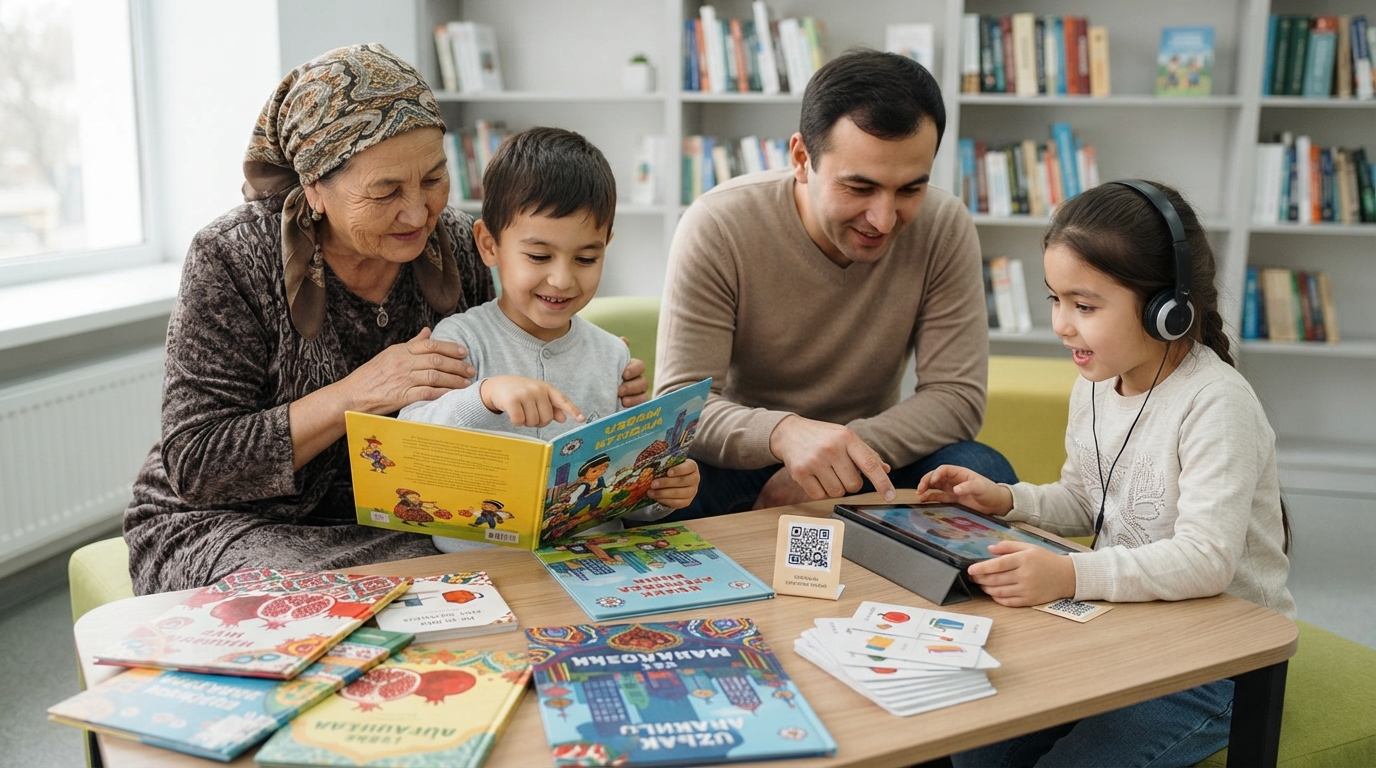
Today's child is not limited to the printed page alone. Audio attached to the book, QR resources, simple animation, and interactive games provide the opportunity to hear pronunciation, rewatch the story, and practice together with the family. However, technology should not crowd out the content of the book.
Its role is not to tie the child to a screen, but to lead them to listen, speak, and engage in real communication in Uzbek.
Inclusivity must also be an integral criterion of such a system. If fonts, colors, illustrations, task volumes, audio speeds, and types of activities are adapted for children with various educational needs, language learning opportunities will expand.
Uzbekistan's educational policy must see and hear every child; children's literature is one of the most sincere tools that brings this principle into daily practice.
A child's interest in language does not depend solely on the author or the teacher. A ten-minute daily family activity — looking at pictures together, playing the roles of characters, applying a new phrase in a daily situation — increases the stability of the acquired knowledge. Therefore, it is advisable to provide concise, clear instructions for parents and educators alongside every children's book.
To create a quality product, the author should not be left alone. A scientific supervisor, preschool and primary education specialist, CEFR expert, psychologist, illustrator, editor, digital designer, educational organization, publisher, and sponsor must collaborate around a single goal. Only then can individual books turn into a systematic series, and the series into an evidence-based national model for teaching the Uzbek language.
We have a clear prospect ahead:
In the long term, a comprehensive system uniting dozens of books, over sixty tested games, methodological guides, and an open scientific portfolio can emerge.
This work is not merely a linguistic or publishing initiative. It connects preschool education, primary education, culture, science, digital technology, and public diplomacy.
A foreign child learning Uzbek discovers through books not only words, but also the communicative culture and worldview of our people. In this sense, every quality children's book is a small yet influential cultural ambassador of our country.
On the eve of Uzbek Language Day, we need to ask ourselves one important question: in what state are we handing over our language to children?
Is it merely in the form of rules and requirements, or as a living communication enriched with love, creativity, play, and modern opportunities? The future standing of the language is also determined by the quality of the book placed in a child's hands today.
Every scientifically grounded book created for children is a living bridge of the Motherland's language to future generations. The stronger, more beautiful, and more open this bridge is, the more confident the steps of the Uzbek language will be both in Uzbekistan and on the world stage.