

The State Language: Why Its Development Is Important for Uzbekistan's Future
The Uzbek language is evolving alongside society today, gradually expanding its presence in education, public administration, science, culture, and the digital environment. For independent Uzbekistan, it is not only a means of communication but also a part of national identity and statehood. At the same time, modern life presents new challenges for the language: it is necessary to create scientific terminology, develop digital resources, and make the Uzbek language […]
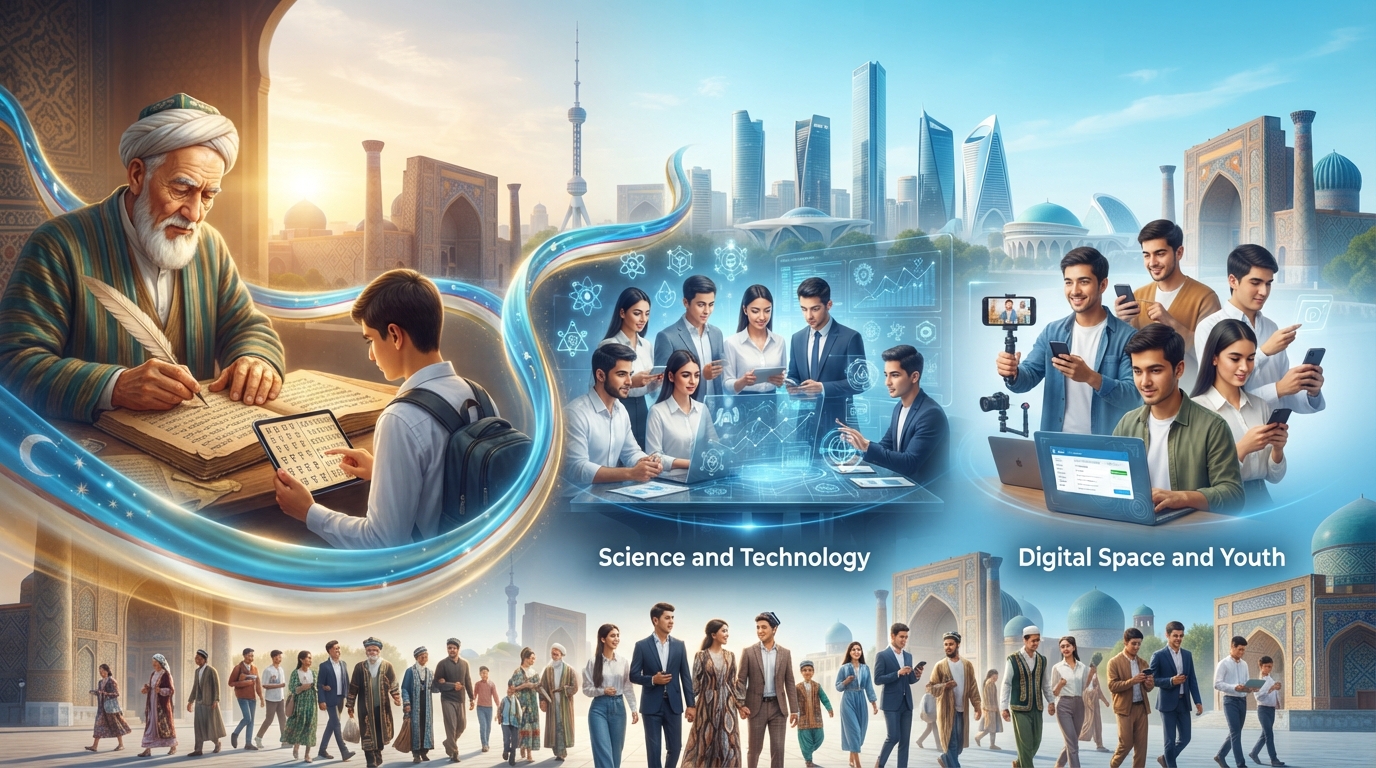
The State Language: The Importance of Its Development for the Future of Uzbekistan
The Uzbek language is actively developing alongside society today, gradually expanding its presence in education, public administration, science, culture, and the digital environment. For independent Uzbekistan, it is not only a means of communication but also an integral part of national identity and statehood.
At the same time, modern life presents new challenges for the language: it is necessary to develop scientific terminology, develop digital resources, and ensure the relevance of the Uzbek language among young people.
Language as a Symbol of National Identity
The history of language is inextricably linked with the history of the people. Cultural heritage, traditions, literature, and historical memory are transmitted through language. Therefore, the issue of its preservation and development has significance that extends far beyond philology.
On October 21, 1989, the Law of the Republic of Uzbekistan "On the State Language" was adopted. This event became an important historical milestone and one of the significant stages on the path to the country's independence. In his speech marking the 30th anniversary of Uzbek becoming the state language, Shavkat Mirziyoyev emphasized that the Uzbek language is "a symbol of national identity and state independence, a tremendous spiritual treasure."
These words are particularly vividly illustrated by historical examples. Works by Alisher Navoi, Abdullah Qadiri, Chulpan, and other prominent literary figures were written in Uzbek. Their works not only enriched the language but also became part of the people's cultural heritage.
The President also noted that the native language was the most important factor in national self-identification for their ancestors, and outstanding cultural works, scientific works, and artistic masterpieces were created in this language.
**From Historical Heritage to Contemporary Development**
Today, the state language faces a different challenge: preserving this accumulated heritage while simultaneously making it a fully-fledged tool in modern life.
For example, the language must be actively used in public administration. Official documents, government services, information materials, and communications must be understandable and literate. This is especially important in the context of the development of e-government, when citizens increasingly access government services online.
In 2019, the President signed a decree on measures to dramatically enhance the role and authority of the Uzbek language as the state language. In accordance with this document, October 21 was declared Uzbek Language Day, and a special department for the development of the state language was established under the Cabinet of Ministers.
Thus, language development began to be viewed not only as a cultural but also a state task.
**Science requires new words**
One of the most noticeable challenges of modern language is the need to quickly respond to developments in science and technology.
New professions, programs, technologies, and scientific concepts emerge annually. For example, terms such as "artificial intelligence," "digitalization," "cybersecurity," "blockchain," and "machine learning" have entered everyday speech. For the full development of the Uzbek language, it is important not only to translate such terms, but also to create understandable and consistent ways of using them.
This is precisely the problem Shavkat Mirziyoyev addressed. In his speech, he noted the need to "create Uzbek versions of modern terms and ensure their consistent application." The President also acknowledged that there are shortcomings in this area.
This demonstrates that language development is a living process. If a language does not keep pace with advances in science and technology, its use in professional fields becomes more difficult.
**Uzbek Language in the Digital Space**
Another important example is the internet.
Today, young people spend a significant amount of time on social media, instant messaging apps, educational platforms, and video sharing sites. Therefore, a language that is actively used in the digital space has greater potential for development.
Let's imagine a student who wants to study artificial intelligence in the Uzbek language. If they have access to high-quality textbooks, video lectures, electronic dictionaries, and specialized websites in the state language, they can gain professional knowledge without encountering a language barrier.
The same applies to digital government services. If a government agency's website has a clear and user-friendly Uzbek interface, citizens can more easily find the information they need and use the service.
In his speech, the President specifically emphasized the need for the full use of the state language in fundamental science, modern information and communication technologies, industry, the banking and financial system, law, diplomacy, and other areas, and called for more active use of the internet to promote the Uzbek language.
**Language and Youth**
The younger generation plays a particularly important role in the development of the state language. It is the youth who determine what the language will be like in ten, twenty, or thirty years.
Therefore, it is important that the Uzbek language be present not only in textbooks but also in modern culture. For example, the creation of high-quality films, podcasts, blogs, popular science videos, mobile apps, and educational content in the Uzbek language makes it more attractive to the younger generation.
The principle of personal involvement is crucial here. President Shavkat Mirziyoyev emphasized: "And each of us must begin this noble work with ourselves, our families, and our communities."
This means that language development depends not only on government agencies. It begins with everyday use: literate speech, reading books, creating high-quality content, and respecting the native language.
**State Language and Other Languages**
Developing the Uzbek language does not mean abandoning linguistic diversity. On the contrary, respect for other languages is an important part of Uzbekistan's public culture.
People of various nationalities live in the country, and for them, their native language is part of their cultural identity. The President noted that respect for the native language must be combined with respect for the languages of other peoples. Uzbekistan is creating conditions for the development of their languages, cultures, customs, and traditions.
For example, educational institutions and media outlets operate not only in Uzbek, but also in Karakalpak, Russian, Kazakh, Kyrgyz, Tajik, and Turkmen.
This approach demonstrates that the state language can serve a unifying function without limiting the cultural diversity of society.
**Language on the International Stage**
Today, the Uzbek language is also gaining international recognition. The President noted that it is heard from international platforms, and it is studied in universities and schools across the world.
This can be seen in specific examples: the Uzbek language is studied in educational institutions in the United States, Great Britain, Germany, France, Russia, China, Japan, South Korea, India, Turkey, and other countries.
The dissemination of the language beyond the country's borders is important not only for cultural reasons. It allows foreign researchers to study the history and literature of Uzbekistan, and allows foreign audiences to better understand the country.
**What needs to be done next?**
The development of the state language requires ongoing work. It is essential to improve the education system, create modern dictionaries and terminology databases, develop scientific publications, expand digital content, and support the use of the Uzbek language in new technologies.
Particular attention should be paid to the quality of the language. For example, signs, advertising texts, and information signs must be written correctly and clearly. In his speech, the President drew attention to instances where public signs and advertising texts are written predominantly in foreign languages or violate linguistic norms. He called this problem an indicator of the general literacy and cultural level of society.
Therefore, language development begins not only with government programs but also with the daily actions of each person.
**Language of the Future**
The state language is the link between the past, present, and future. Its preservation is impossible without development, and development is impossible without societal participation.
Today, the Uzbek language must be the language of literature and culture, but also the language of science, technology, journalism, business, and digital communication. Only then will it be able to meet the demands of modern society.
President Shavkat Mirziyoyev's statement that the attitude toward the state language should be viewed as an attitude toward independence allows us to see the issue more broadly. "Loyalty and respect for it are the same as loyalty and respect for the Motherland. This must become the rule of our lives," the head of state noted.
The development of the Uzbek language is a task that will take generations. Its place in the future of Uzbekistan depends on how carefully society preserves its heritage and how actively it is used in modern spheres.