

A method to reduce energy losses in solar cells has been developed in China
Researchers from China's Nanjing University and other scientific institutions have achieved an efficiency of 30.1 percent in a triple-junction solar cell made entirely of perovskite. An efficiency of 29.3 percent was confirmed in independent certification. The new processing method has enabled the reduction of defects and energy losses in the material.
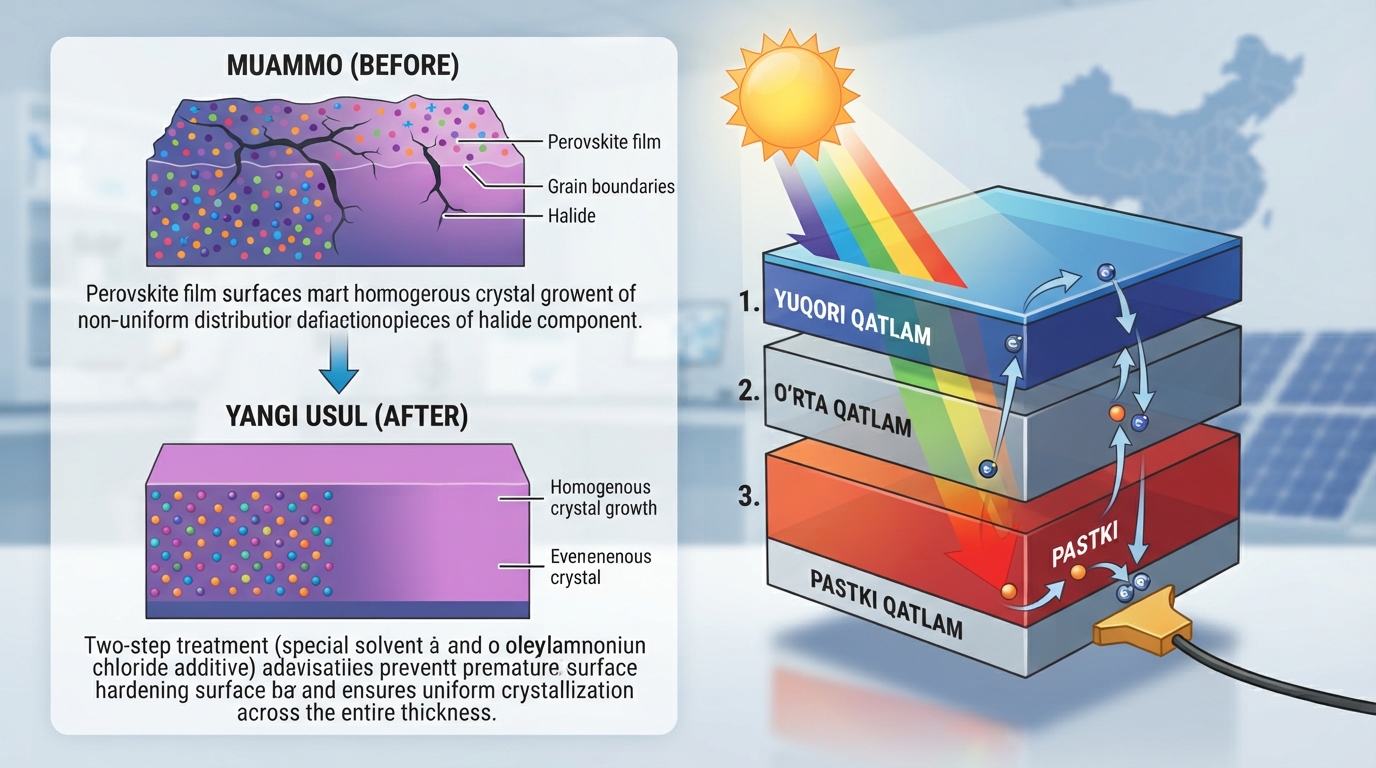
A method that reduces energy losses in solar cells has been developed in China
Scientists have developed a technology aimed at smoothing the surface of perovskite films and ensuring an even distribution of halides in their composition.
Perovskites are considered promising materials for converting sunlight into electricity. By combining them into multiple layers, different parts of the solar radiation spectrum can be used more efficiently.
How was the main problem in the material solved?
Perovskite films designed to absorb high-energy radiation contain a high proportion of bromine. However, during the preparation of such a material, its upper part can dry and crystallize before the lower part.
This forms a hard crust over the still-wet inner layer. This leads to the appearance of wrinkles and cracks in the film, and an uneven distribution of chemical components. Such defects increase energy and voltage losses.
The researchers solved the problem through a two-step treatment. Treatment with a special solvent smoothed the top layer of the material, while a small amount of added oleylammonium chloride helped the simultaneous crystallization of the bromine and iodine components.
As a result, premature hardening of the surface was limited, and a smooth film with a uniform structure throughout its thickness was obtained.
Three layers absorb different parts of sunlight
The developed solar cell consists of three interconnected light-absorbing layers. Each layer is designed to absorb a specific part of the solar spectrum.
The top layer absorbs high-energy radiation, the middle layer absorbs another part of the spectrum, and the bottom layer absorbs near-infrared radiation. Their combined operation increases the efficiency of converting solar energy into electricity.
In the study, a record result of 30.1 percent was recorded for this all-perovskite triple-junction structure. The figure confirmed in independent testing was 29.3 percent.
Stability was maintained during a 569-hour test