

China has created a "laser bridge" between Earth and the Moon
Chinese researchers have successfully tested two-way high-speed laser communication between the Earth and the Moon over a distance of more than 400,000 kilometers. During the experiment, the data transmission rate from Earth to space was 1.25 megabits per second, while the transmission rate from the Moon to Earth was 100 megabits per second.
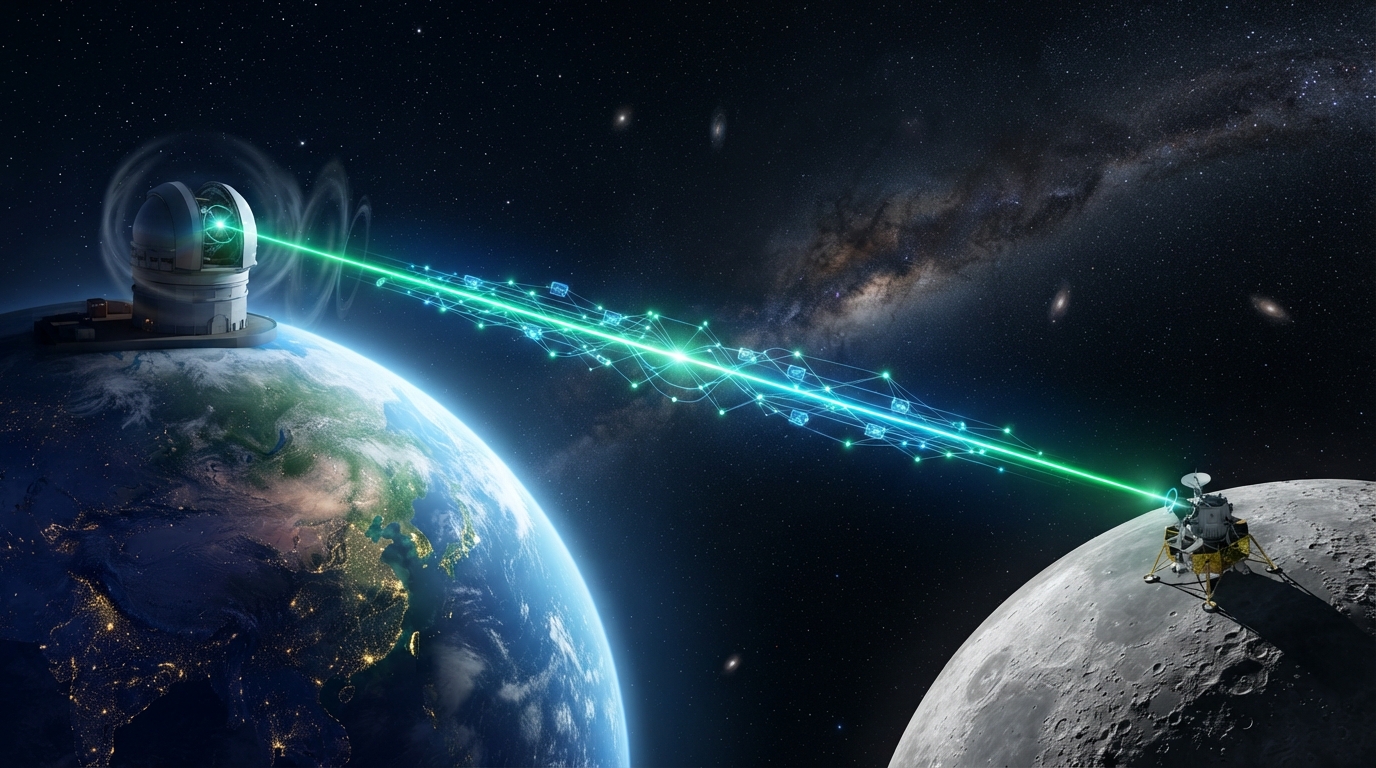
China has established a "laser bridge" between Earth and the Moon
Chinese engineers and scientists have completed tests on creating a two-way laser communication channel between Earth and the Moon. As a result, the possibility of high-speed data exchange over a distance of more than 400,000 kilometers was confirmed.
Experts have tested the system in orbit for more than a year. This experiment showed that China's laser space communication technologies can be used not only in near-Earth orbits, but also in deep space.
Laser communication has a number of advantages over traditional microwave radio communication systems. In particular, it allows for high-speed data transmission, provides high bandwidth, increases communication security, and enables the use of relatively compact equipment.
However, to establish a stable laser channel between Earth and the Moon, scientists had to solve three main problems: ultra-precise pointing of the laser beam, receiving an extremely weak signal, and transmitting large amounts of data at high speed.
Over the vast distance to the Moon, even a very small vibration of the satellite or atmospheric turbulence above the ground station can change the direction of the laser beam.
Under such conditions, even a very small angular error causes the beam to deviate from the target by several kilometers.
To overcome this problem, experts have developed a new target acquisition and tracking system. The system takes into account orbital motion, signal passage through the atmosphere, and delays occurring in the propagation of optical radiation.
As a result, equipment on Earth and in space can maintain a highly precise orientation toward each other even during movement.
The second serious problem is the sharp drop in signal strength.
After the laser beam travels more than 400,000 kilometers, the signal returning to Earth weakens so much that ground telescopes can detect only a few photons at a time.
In addition, the light from the Moon and stars, as well as artificial lighting from cities, creates "noise" that interferes with the reception of the laser signal.
For this reason, researchers have developed a superconducting technology that detects individual photons at high speed. Highly sensitive algorithms were also used to extract the useful communication signal from external noise.