

Chinese scientists have tested solar panels at a depth of 10 meters for the first time
Chinese scientists have tested solar cells in the open sea at a depth of 10 meters for the first time. The experiment showed that the system can generate electricity even underwater. The study was conducted by specialists from Yunnan University. Its results were published in the scientific journal Joule. The scientists used perovskite solar cells. They are designed for blue-green light, which penetrates water best. In the laboratory, the conversion efficiency […]
Chinese scientists have tested solar panels at a depth of 10 meters for the first time
Chinese scientists have tested solar cells in the open sea at a depth of 10 meters for the first time. The experiment showed that the system is capable of generating electricity even underwater.
The study was conducted by specialists from Yunnan University. Its results were published in the scientific journal Joule.
In their work, the scientists used perovskite solar cells. They are designed for blue-green light, which penetrates water best. In laboratory conditions, the energy conversion efficiency reached nearly 35%.
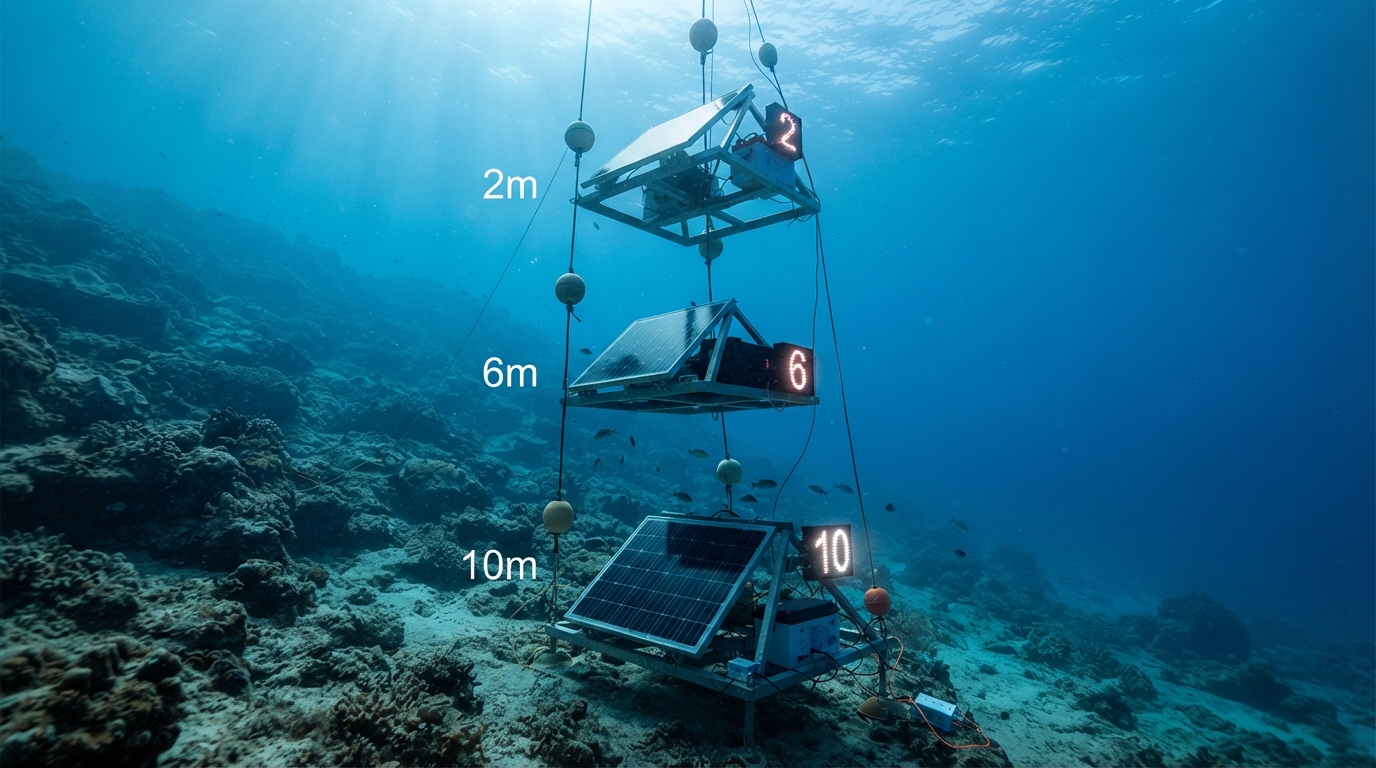
After that, the system was tested in the South China Sea near Weizhou Island. The solar cells were installed at depths of 2, 6, and 10 meters.
The system generated the largest amount of energy at a depth of 2 meters — 1416 milliwatt-hours. At 6 meters, the figure was 752 milliwatt-hours, and at 10 meters — 324 milliwatt-hours.
In all cases, the energy obtained was sufficient to charge batteries and power an LED sign.
According to the scientists, in the future, this technology could be used to power underwater communication systems, cameras, sensors, and other autonomous devices.