

45 thousand tons of stones will be laid on the seabed - why is this necessary?
The vessel Windpiper has commenced its first commercial operation in the Baltic Sea. According to Boskalis, this is the first time such a large volume of cargo has been recorded for a single installation campaign among vessels designed for subsea rock installation. The rocks will be used to protect the subsea cables of two offshore wind farms under construction off the coast of Poland.
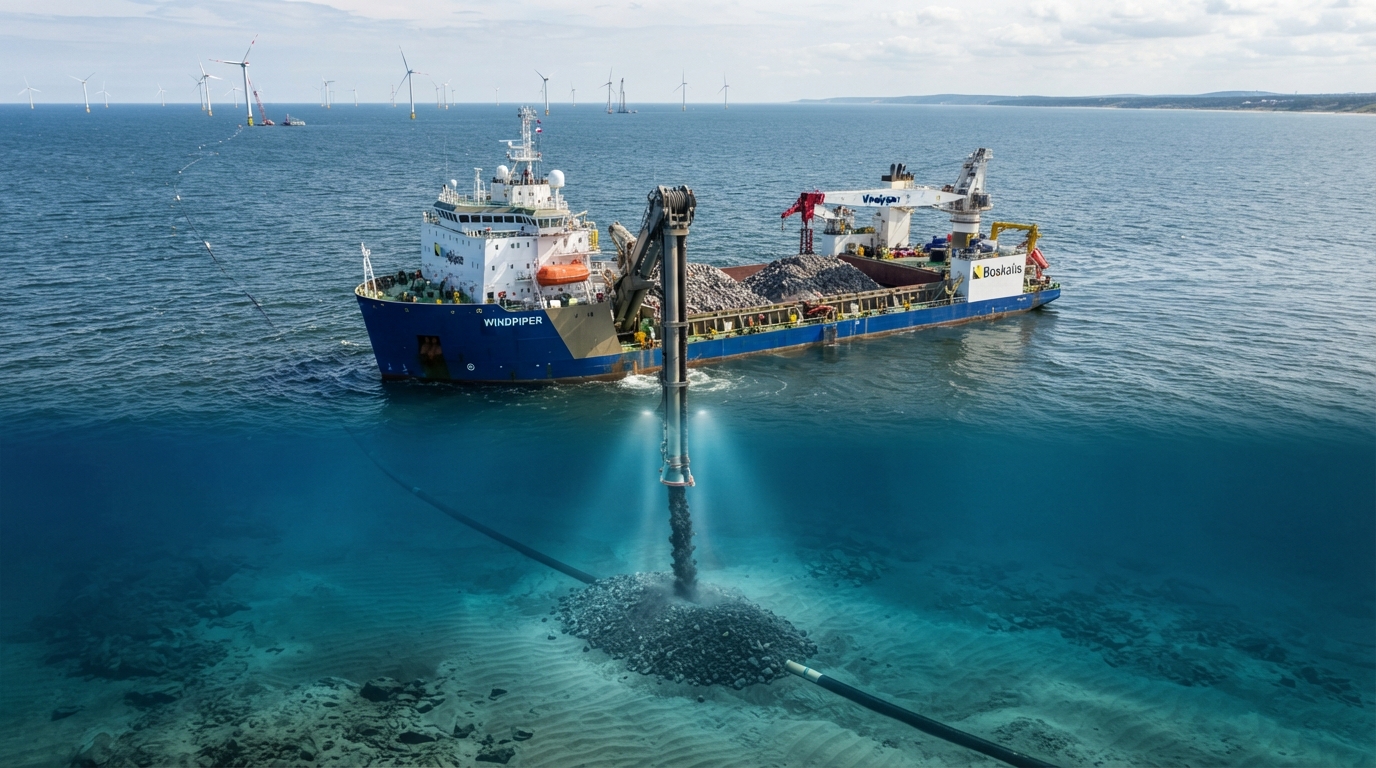
45 thousand tons of stones will be laid on the seabed — what is the reason for this?
The Boskalis company has started using its new vessel, Windpiper, in the Bałtyk 2 and Bałtyk 3 offshore wind farm projects being built near the coast of Poland. The first batches of rock have already been laid on the bottom of the Baltic Sea.
Before starting work, the Windpiper entered a Norwegian port and loaded nearly 45 thousand tons of stones on board. According to Boskalis, this is a record figure for vessels of this type, as no such vessel had previously loaded so much stone at one time within a single installation campaign.
The maximum carrying capacity of the Windpiper is 45.5 thousand tons. This means that in its very first operation, the vessel's cargo capacity was almost fully utilized.
However, this huge amount of stone is not intended for building an artificial island or a dam in the sea.
To transmit the electricity generated at the Bałtyk 2 and Bałtyk 3 wind farms to the Polish power grid, power cables will be laid along the bottom of the Baltic Sea. After the cables are laid, a special layer of stones will be formed over some of their sections.
This layer protects the underwater cables from damage caused by external influences and from displacement.
The Windpiper does not simply dump the stones from the sea surface. The vessel is equipped with a special system that allows the rocks to be delivered to a precisely designated location.
The stones are delivered through an inclined pipe lowered to the seabed. In this way, the rocks can be placed directly at the required point and a precise protective layer can be formed along the underwater infrastructure. This method provides much higher accuracy than simply dumping stones from the water surface.
This project in the Baltic Sea is the first commercial contract for the Windpiper since its commissioning.
Boskalis specially retrofitted the vessel specifically for underwater rock installation work. In the future, the company plans to use it primarily in the construction of offshore wind farms, as well as in other large-scale infrastructure projects on the seabed.
The Bałtyk 2 and Bałtyk 3 wind farms, where the Windpiper is operating, are being built by Equinor and the Polish company Polenergia.