

21 new stations, 33 kilometers of track, and a 2-minute interval: How has the Tashkent Metro changed over the last 10 years?
In 2016, the metro, which consisted of 29 stations and a 38-kilometer line, today has 50 stations and a 71-kilometer network. With the purchase of new trains, peak-hour headways on some routes have been reduced to 1.5–2 minutes. It is reported that by 2030, plans are in place to extend the network to 103 kilometers and increase the daily passenger traffic to up to 1.8 million people.
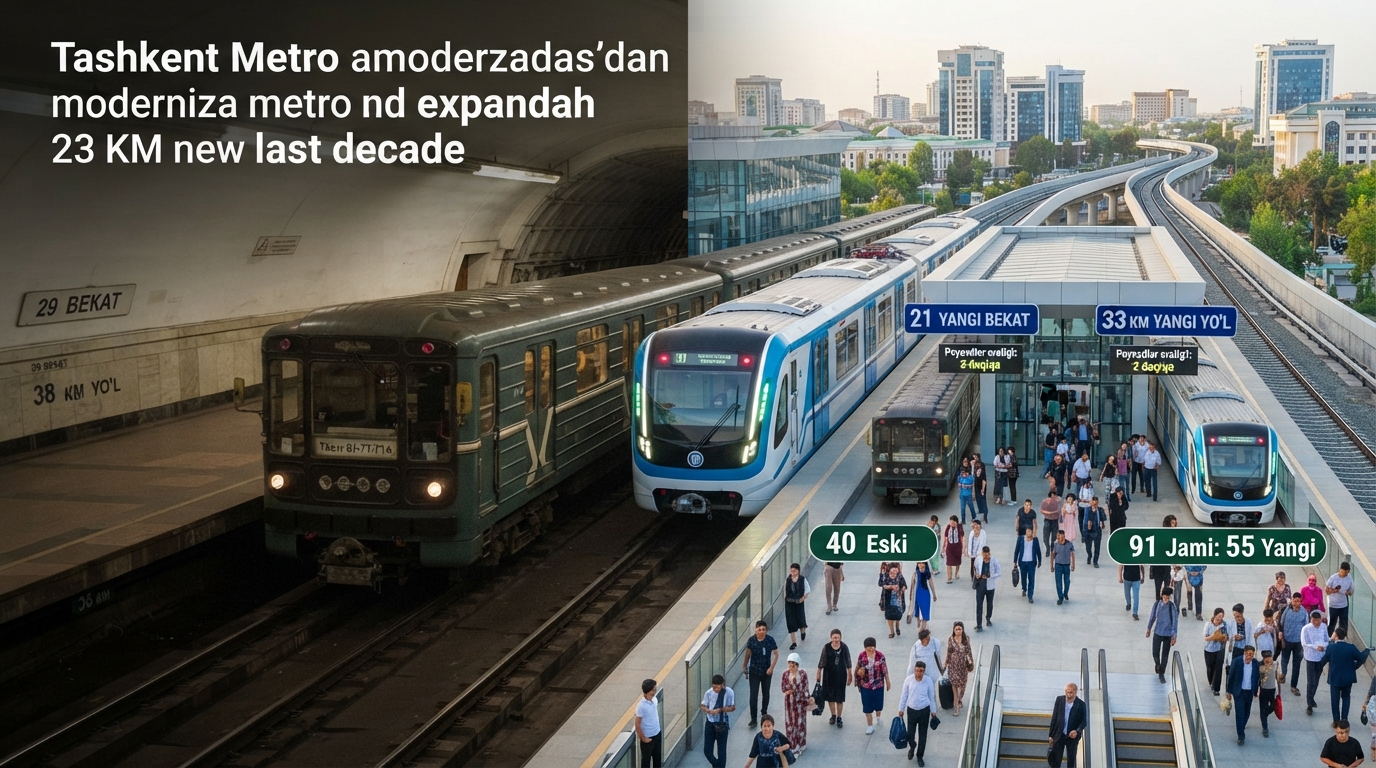
21 new stations, 33 kilometers of track and a 2-minute interval: How has the Tashkent Metro changed over the last 10 years?
The Tashkent Metro was launched in 1977. In its early stages, its main task was to connect the central parts of the city with major residential areas.
However, over the next nearly 40 years, the metro network expanded very slowly. By 2016, the Tashkent Metro had 29 stations and 38 kilometers of track. Over the last decade, these figures have changed significantly: 33 kilometers of new metro track were built and 21 new stations were opened.
Today, the total length of the metro network is 71 kilometers. That is, the new lines built over the last ten years alone are equal to almost 87 percent of the previous 38-kilometer network. The network expanded into areas that were not previously covered by the metro, where ground transport such as railways or buses was mainly used. From this perspective, one of the main changes in recent years is the expanded share of the metro in Tashkent's transport system.
In 2023, 172 million passengers used the Tashkent Metro. In 2024, this figure reached 270.3 million. A difference of nearly 100 million occurred within one year. The growth amounted to 98.3 million passengers or 57.2 percent. If we convert these numbers into a simple calculation, in 2024 the metro carried an average of more than 740 thousand passengers per day.
Such rapid growth in passenger traffic places different demands on the infrastructure. Now simply increasing the number of stations is no longer enough. Trains, headways, station capacity, escalators, entrances and exits, the payment system, and even mobile communications must work together. For this reason, another direction of changes in the metro in recent years has been increasing the internal capacity of the existing system.
New metro tracks and stations do not automatically increase passenger carrying capacity. For this, rolling stock must also be sufficient. Around 2016, the Tashkent Metro had 40 old-type train sets. In subsequent years, 55 new ones were purchased. In addition, 14 modern train sets were brought in 2026 alone. Currently, there are a total of 91 train sets in the subway, 55 of which are new modern trains.